Between Croatia and Slovenia, “death must no longer be a taboo”
A European project between Croatia and Slovenia has brought together four partners to promote the development of palliative care on both sides of the border. This is a growing need in Europe, but investment is lacking. According to the experts involved, a change in mentality is also needed
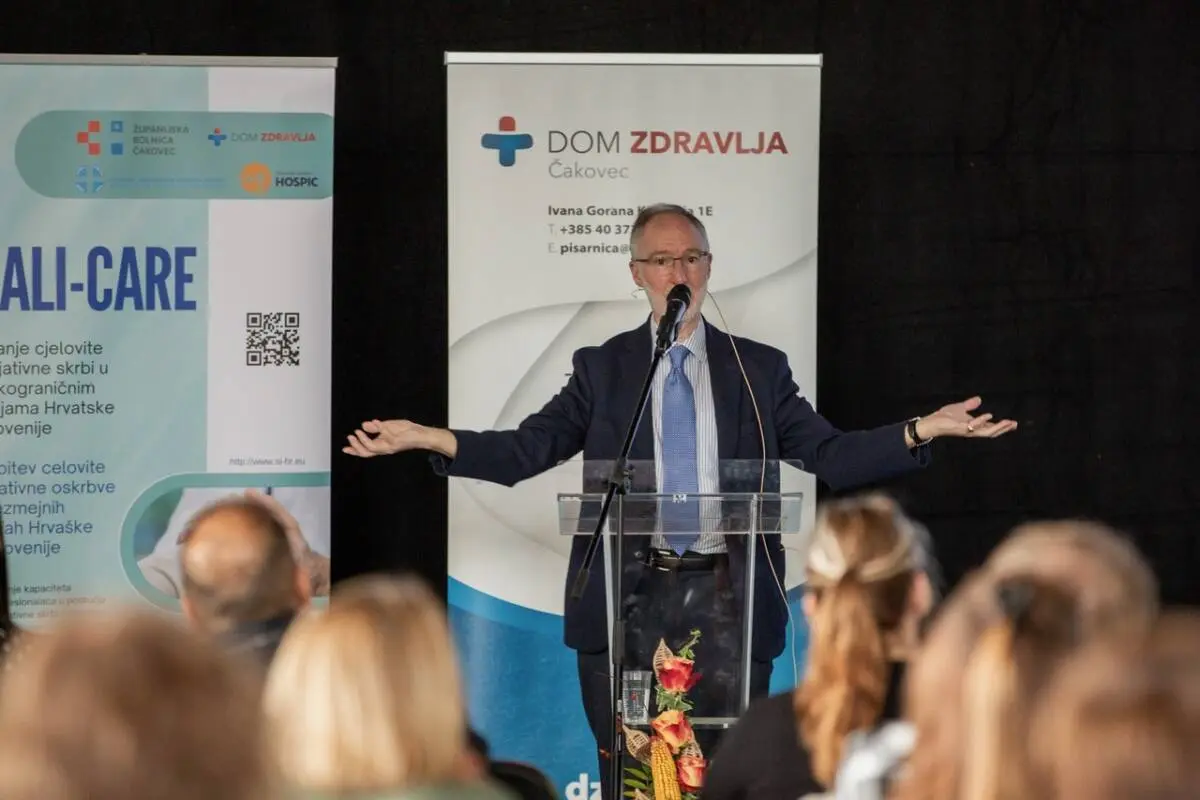
Dr. David Oliver © PALI-CARE
Dr. David Oliver © PALI-CARE
As in many European regions, in Međimurje County in Croatia, north of Zagreb, there has been a growing need for palliative care for years. The population is aging, and medical advances are increasingly pushing the horizon of death forward. Following a person through the final stages of life is no longer a process that lasts weeks or months, but increasingly years.
To address this need, the County Hospital in Čakovec, the largest city in Međimurje, decided to establish a palliative care department, and it did so with the support of the European project Pali-Care. Between 2024 and 2026, the project made approximately 688,000 euros of European funds available to the Croatian-Slovenian consortium through the Interreg Croatia-Slovenia program. The funds were primarily intended for the training of healthcare staff and the development of educational materials.
We spoke with Renata Bermanec, a nurse and palliative care coordinator at the Čakovec Health Center (which has been developing palliative care since 2013), and Tadeja Gotar, a project manager at the Slovenian Hospice Association (Slovensko društvo Hospic), the leading Slovenian NGO working in this area, which was also involved in the project with the Murska Sobota General Hospital in Slovenia.
What is the main challenge that the project tried to address?
Renata Bermanec, Dom zdravlja Čakovec
Renata Bermanec: In Međimurje, which has a population of around 120,000, approximately 1,300 people die every year, and at least half of them need some form of palliative care. Today, we care for 500 people thanks to a mobile team of doctors and nurses who visit homes and nursing homes. This is a good result, but there is still a shortage of staff. We do not have enough psychologists, social workers and interdisciplinary teams. Thanks to the project, we now have a dedicated palliative care department at Čakovec Hospital, albeit with only a few beds. Furthermore, the project helped raise public awareness about these issues.
Tadeja Gotar: The same applies to Slovenia. Our association, made up of twelve regional units across the country, complements the public system where the needs of dying patients and their families exceed the available services. In Slovenia, palliative care is still not sufficiently represented in formal educational programs, although there are various training opportunities for different professional profiles, from elective courses and master’s programs to specialised professional training. Clinical aspects are generally covered in more detail, while communication, emotional support and relational aspects are not yet sufficiently integrated. For this reason, the project placed a strong emphasis on training.
What were the requirements of the experts when you determined their training needs?

Tadeja Gotar, Slovensko društvo Hospic
Renata: Everyone, without exception, mentioned communication. How to deliver bad news, how to talk to families, how to deal with emotionally charged situations. There is also self-support. Those who work in palliative care live with the suffering of others every day and need tools to cope with this burden. With this in mind, we developed training modules, starting from real needs. The project also allowed us to travel to Graz to see how the city’s palliative care department and its mobile team work.
Tadeja: Palliative care is a holistic discipline. In addition to the medical approach, psychosocial support is necessary, as well as spiritual support. This discipline is gaining in importance as the population ages, not only in our region, but throughout Europe. Furthermore, our approach to death has also changed. In the past, people more often died at home, surrounded by family and community. Today, however, many older people spend their final years of life in nursing homes or other care facilities. People are overloaded with work, there is less support for dying at home, and death has become a taboo.
In your opinion, why has death become a taboo in contemporary European society?
Renata: Society has changed profoundly. In the past, death was a part of everyday life: people died at home, the funeral was prepared within the family and children attended. Today, we tend to reject anything that evokes negative feelings. Some parents prevent their children from attending funerals in order to “protect” them. However, excluding children from death means excluding them from life. If we consider it normal, death can also bring feelings of love, care, and closeness. We need to make death normal again.
Tadeja: We see this every day in our work. Families only contact us when they can no longer cope with the situation, for example, when chemotherapy is over and they do not know what to do. They delay calling because they are afraid that asking for help will “mark” the death of their loved one. This is an understandable defense mechanism, but because of this delay, the patient and their loved ones often lose valuable time during which they could receive support, discuss their wishes, resolve outstanding issues, etc. Talking more about death – among other things, to understand each person’s wishes – is as important as developing services.
Palliative care is often associated with the last days of life. Does this perception still correspond to reality?
Tadeja: This is a widespread perception, but too narrow. Palliative care is not limited to care provided in the last days of life and can begin much earlier in the course of an incurable, advanced or life-limiting illness. As the illness progresses, the focus of care gradually shifts from treatments aimed at curing or controlling the disease to quality of life, well-being and support. Hospice care is usually associated with the terminal phase of illness and with support for both the dying person and their family. This support can continue for the family during the period of bereavement.
Renata: In the United States, the terms “hospice” and “hospice care” refer to home care services during the last six months of life (and problems arise when this period extends beyond six months). In Croatia, we talk almost exclusively about palliative care, and hospice is an institution, one of the places where such care is provided. I think this is right, because medicine is advancing: people who once had six months to live now live five years. The process is getting longer and the needs change over time.
What remains at the end of the project?
Renata: Two years ago, in the Čakovec Health Center and the “Help for the Incurable” association, we had only one palliative care coordinator and one mobile team (consisting of one doctor and one nurse). Today, in the Čakovec Hospital, we have two coordinators, two mobile teams (consisting of two doctors and two nurses) and a palliative care department with two doctors and more than six nurses and health workers. This is a tangible achievement. The training materials will remain available in Croatian and Slovenian, and we hope that other professionals will be able to use them as well.
Tadeja:For us, the greatest value is cross-border cooperation. The challenges are the same on both sides, and collaborating with those working in another system helps us see things in a new way. This is something we would like to continue after the project.
Found an error in this article? Please contact our editorial team at redazione@balcanicaucaso.org.
This article was produced as part of the EuSEE project, co-funded by the European Union. However, the views and opinions expressed are solely those of the author(s) and do not necessarily reflect those of the granting authority, and the European Union cannot be held responsible for them.
Tag: Coesione UE | EuSEE | Sanità | Sanità e servizi sociali
Featured articles
 Investigation
 students' protest
 Montenegro Pride 2026