The Flamingo Revolution for a different Albania
Following several incidents of violence against protesters, the mobilisation to defend the protected area of Pishë Poro-Nartë in Albania intensified and quickly escalated into a demand for a different Albania. Meanwhile, Prime Minister Edi Rama is pointing the finger at alleged external enemies, calling it a hybrid war
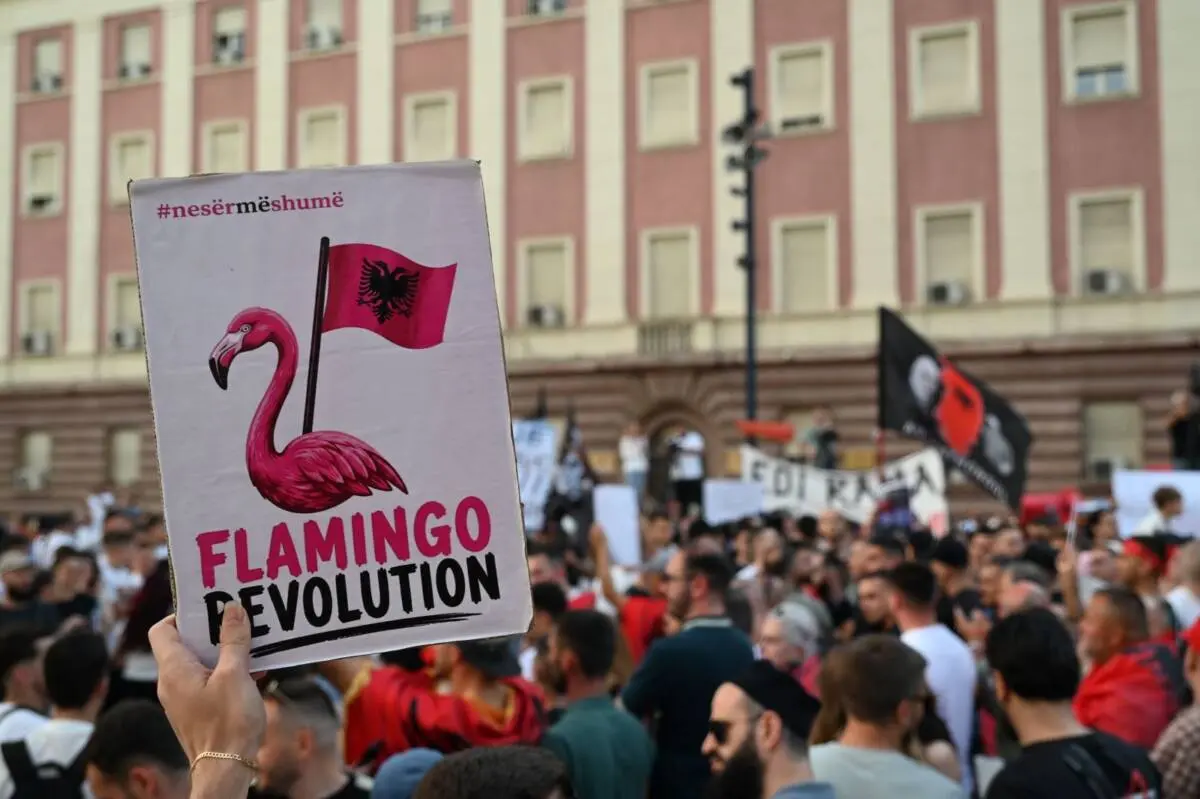
During protests in Tirana, Albania – Foto E. Kryeziu
During protests in Tirana, Albania - Foto E. Kryeziu
For more than a week, thousands of citizens have gathered in Skanderbeg Square in Tirana and marched towards the Prime Minister’s Office protesting against the project to build tourist resorts in the Pishë Poro-Nartë protected area in Zvërnec, Vlora.
At the core of the opposition is the “Zvërnec Peninsula” project, which, according to information published so far, foresees residential developments, hotels and tourist infrastructure in one of the most ecologically sensitive areas of the Albanian coastline.
How did the protest begin?
Since May, environmental activists and environmental organisations have raised the alarm over the presence of heavy machinery in the Pishë Poro-Nartë protected area. After small protests kicked-off in Tirana, the protected area was surrounded by barbed-wire fencing.
On 30 May, the protest organised in Zvërnec brought violent scenes to the public despite a massive police deployment and numerous private security personnel stationed inside the barbed-wire fences. One protester was dragged by the private security, in front of the eyes of State Police, who did nothing to stop the incident.
Images went viral on social media, leading to public outrage over the lack of State Police reaction. This led to the dismissal of the Vlora police director, while one private security employee was arrested and two others were criminally prosecuted.
The next day, citizens took to the streets in Tirana, demanding the suspension of the project in the protected area.
Flaming Revolution going on
Since 31 May, 6:00 PM has become the meeting time for thousands of citizens, who for more than a week have filled the squares with chants “Albania is not for sale” and “Albania belongs to Albanians, not to oligarchs”.
The protest, whose symbol became the flamingo, was dubbed the “Flamingo Revolution” because of the biodiversity that characterises the area, hosting over two hundred species, including flamingos, sea turtles and the Dalmatian pelican.
Narta Lagoon is part of the Important Bird Areas (IBA), a key biodiversity area and an Emerald candidate site.
For environmental activists, this is not the model of tourism Albanians want.
“I was in Zvërnec yesterday. There I found sadness. I found the area where I had admired the wonderful dunes for thirty years destroyed. I found uprooted trees, destroyed dunes, opened corridors, pipes, concrete, I found everything there except elite tourism”, said Taulant Bino, head of the environmental organisation AOS, before a crowd chanting “Cancel the project!”.
“The one in Zvërnec is an uprising for the protection of protected areas. Because after Zvërnec something else will come, Velipoja, Butrint, Divjakë–Karavasta”, added Bino.
On 7 June, activists and citizens returned to protest in Zvërnec. This time the fence in the protected area was removed, but the gravel roads remained.
“The entire gravel road was laid last month. It was not there before. Imagine the intensity with which the trucks worked to pave 7–8 kilometers of road in such a short time”, said Aleksandër Trajçe, head of PPNEA environmental organisation, as we climbed one of the hills of Dalani Beach in Zvërnec, from where the Narta Lagoon could be observed.
Prime Minister Rama stated that the project will be built on private land. However, the fence installed at the end of May blocked access to public land.
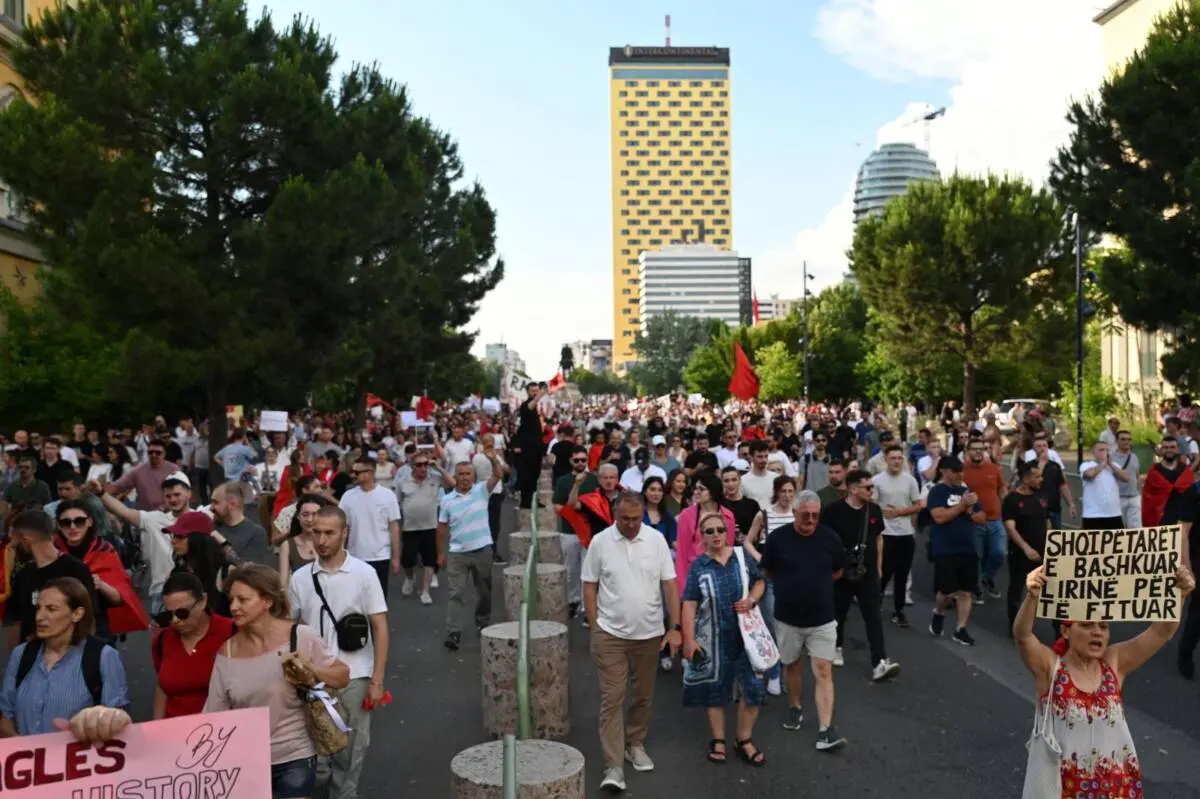
During protests in Tirana, Albania – Foto E. Kryeziu
“This intermediate wetland is the Limopuo wetland, and this is a freshwater lagoon between the sea and the main lagoon (Narta), and it is a natural monument”, explained Trajçe. “A natural monument in Albania, by law, cannot be private property, and what has been said these days on television programs is that all of this is private land. But that is not true because this is an area of nearly 15 hectares that is public property”.
Addressing the protesters, Joni Vorpsi, environmental activist and member of PPNEA, said that the protest made possible the fence removal in Zvërnec.
“There is no longer a fence there. Today it is free for citizens, but not only that. This protest also removed the fence around the idea that Albanians do not protest, do not take to the streets to protect their homeland, nature and their rights”, declared Vorpsi. “They are ready to put the fences back not only in Narta but also in other areas. No one is against development, but development must be sustainable and serve Albanians”.
Protest in defense of the environment, and more
What began as an environmental protest has turned into a protest against the Rama government, as an accumulation of all citizens’ grievances.
First, citizens demanded the cancellation of the Zvërnec project.
“The protest, born out of indignation at the state’s impotence in the face of criminals dragging citizens to the ground, has become a nationwide protest of all people who seek a different Albania”, said activist Sidorela Vatnikaj through a megaphone.
Protesters demanded the revocation of the amendments to the law on protected areas. The amendments, introduced in 2024, reduced the surface area of protected zones and left space for tourist developments. They also called for the repeal of the law on strategic investors, adopted in 2015 with the aim of attracting major investments to stimulate the country’s economic development.
However, what has been observed during the implementation of the law is that the status of “strategic investor” created a system of privileges for private companies and individuals with special access to public land, coastlines, tourist areas and assets of public interest.
Through this law, many other areas in Albania have also become conflict zones, among them Rrjoll in Velipoja. This is an ecological belt that connected the Buna Delta with the dune system of Shëngjin, where tourist projects are now permitted following the changes to the protected areas law, including the “Blue Borgo” resort. Even in this area the issue of ownership is causing protests among the population. The parcel where the resort is being built includes land belonging to five local clans involved an ongoing criminal proceeding.
“A few days ago they asked me what harm the strategic investors law had caused. And I answered very simply. That law took my son’s property. Therefore, like many other Albanians, I am fighting to protect my son’s property”, said Luciana Kokaj, one of the residents of Rrjoll who has become a symbol of resistance against development projects in the area.
“That was my first battle, but today with all of you here, we are much more than my son, you are much more than my property”, added Luciana.
Protesters are young men and women raising their voice over the situation in education, pensioners protesting low pensions, communities affected by hydropower plant construction such as those in Zall Gjoçaj, Kurdari, Thirrë, and Skavica, young professionals and citizens demanding healthcare services and better living conditions.
“The question of who is behind the protest should have an answer, and the answer is: behind the protest stands this entire square. We are here, we came for Zvërnec, but we will not leave without changing the regime”, said activist Edison Lika.
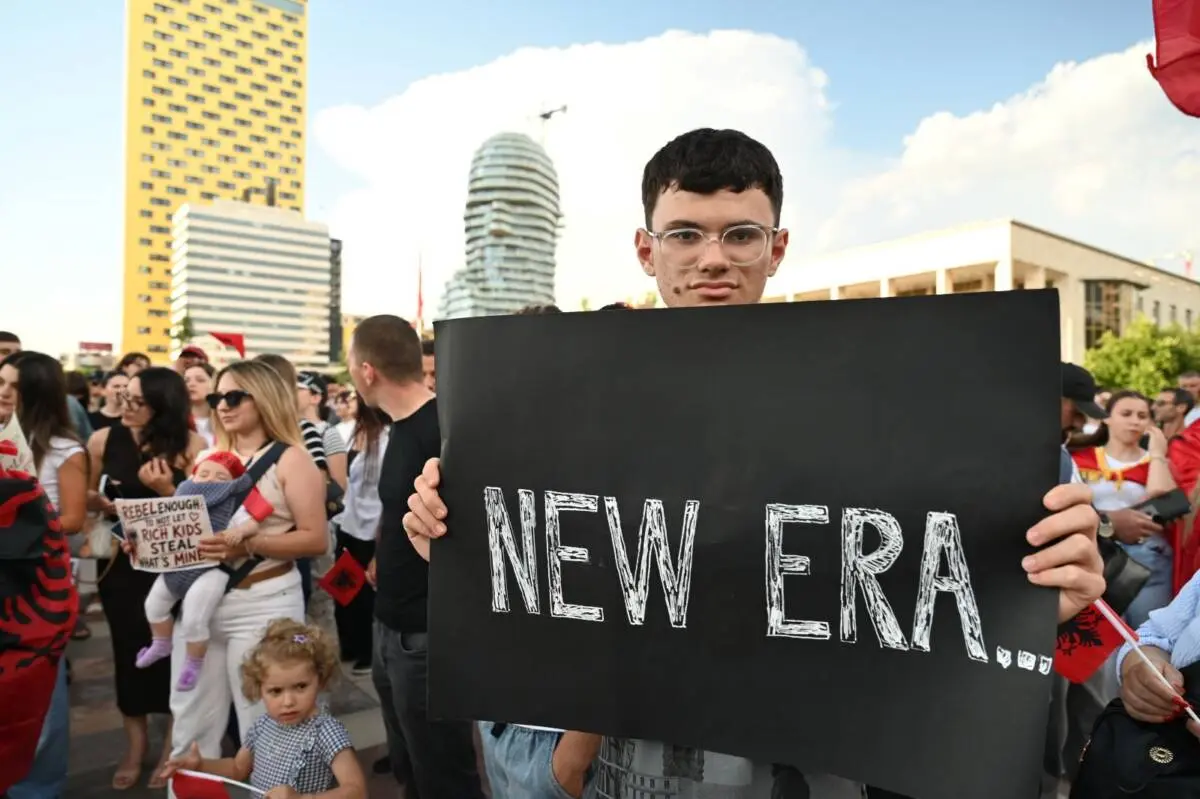
During protests in Tirana, Albania – Foto E. Kryeziu
According to Lika, the current regime in Albania is based on an economic oligarchy, organised crime and vote theft.
For Nebi Bardhoshi, anthropologist and academic, through this protest Albanians have found themselves again, and the call for a “New Albania” is the condition for understanding each other.
“We discovered our possibility to be together and to say no to the system of plunder. No to the plunder of public property. No to the plunder of nature. ‘New Albania’ this is our call to arms, our common message”, said Bardhoshi.
Zvërnec project and lack of transparency
The protest is connected to the “Zvërnec Peninsula” project, which is planned to extend over approximately 437 hectares with residential developments, hotels up to eight stories high and a marina within the Pishë Poro-Nartë Protected Landscape.
The name of the company that is carrying out the project, “Zvërnec South Adriatic Development”, was made public by the National Inspectorate for Territorial Protection (IKMT) following media pressure.
According to IKMT, the company is carrying out preparatory works for fencing and road construction based on a permit approved by the National Territorial Council on 29 April. However, the full decision has not been published, and IKMT clarified that the development permit has not yet been issued and that the current works are considered “preparatory”.
Ownership passes through a chain of companies registered in the Netherlands, including “Universal Properties Projects B.V”, “Blue Industries Investment Holding B.V” and “Dutch Trust Management B.V”, which in the official extract is listed as the entity that “exercises ultimate control over the trust”. This makes the company’s true ownership unclear.
The properties where the development is planned are owned by the company “Albania Land Development” whose main shareholders are “Sazan Holding” and the billionaire Al-Khayyat Sirian brothers naturalised in Qatar, co-owners of the company “Power Holding”. The latter were defined by Prime Minister Edi Rama as investors.
So far, there is no construction permit. According to Rama, there is not yet an approved project, and therefore he considers the protest unfounded.
“Do you know why there is no project? Because the project is being developed by five of the most prestigious studios in the world! Click on Kengo Kuma (Japan), Bjarke Ingels (Denmark), Jean Nouvel (France), Emre Arolat (Turkey), K-Studio (Greece) and get to know the authors of the architectural project”, wrote Rama in a post on the X platform.
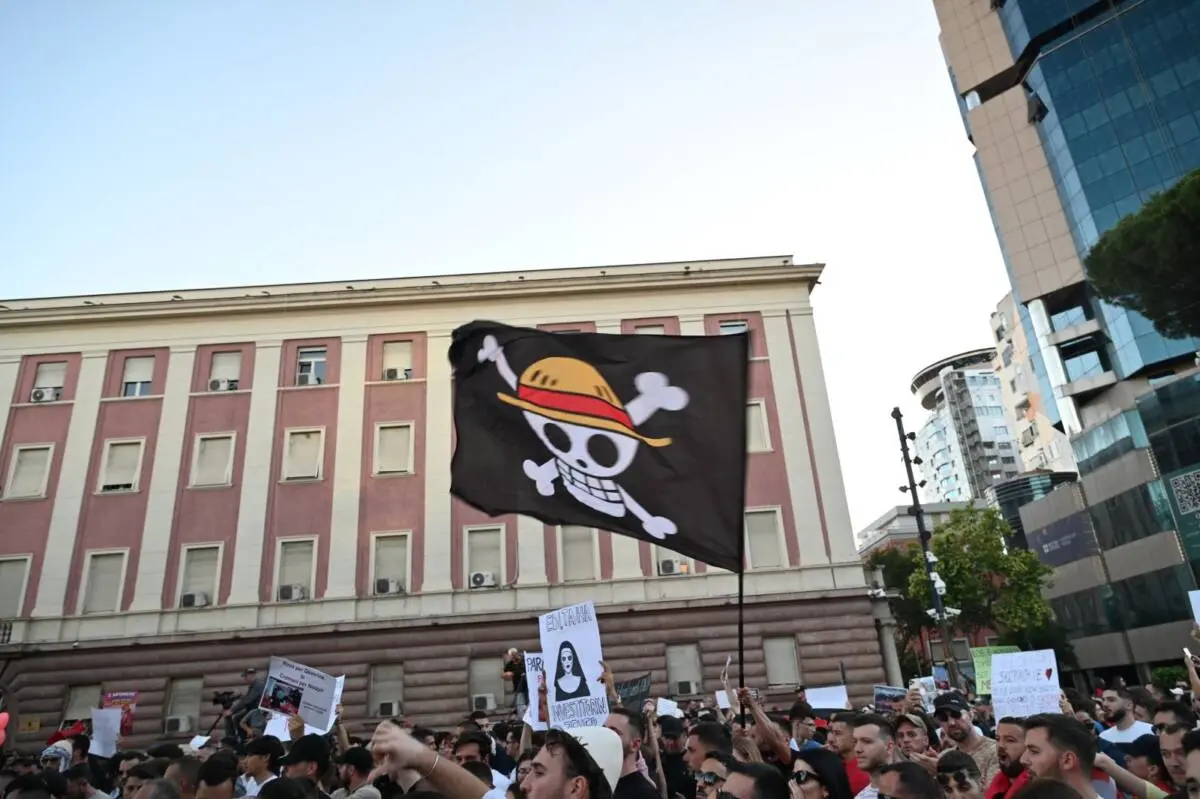
During protests in Tirana, Albania – Foto E. Kryeziu
Where do Ivanka Trump and Jared Kushner stand in all this?
In 2024, changes to the legislation on protected areas created new opportunities for tourist investments in this area. At that time, Jared Kushner, son-in-law of US President Donald Trump, publicly expressed interest in development projects on Sazan Island – which, during the communist era, was a military zone – and in Zvërnec, located opposite the island.
In January 2025, Kushner obtained “strategic investor” status. He said the idea came after a tourist visit to Albania in 2021. Sazan Island is expected to become a private luxury resort.
In June 2025, the Albanian government established a company expected to make agreements with Jared Kushner to develop a resort on Sazan. The company is called “Albanian State Development and Real Estate”.
In public appearances, Ivanka Trump spoke about a “discovered” island in Albania.
“In addition to the island, we also have about five miles of coastline opposite it, a wonderful peninsula with a lagoon on one side and the sea on the other, with beautiful white-sand beaches. To me this feels more like a challenge than a business”, said Trump in a recently released podcast.
However, what is known so far is that there is no official evidence proving that Trump and Kushner are direct investors in the Zvërnec area or in Sazan. They have served as promoters of the area, while on the side of the Albanian government there has been a lack of transparency, which has further irritated citizens who have now been protesting for days.
The narrative of “foreign agents”
Edi Rama has attempted to direct the narrative towards the identification of protests’ organizers, linking them to neighboring countries.
“Greek newspapers today are all filled with your cause. There is something here that does not add up, or the traitor was found, the seller of the homeland was found, the corrupt person was found, and that person is your Prime Minister”, said Rama.
To support this narrative, a photo generated with artificial intelligence circulated on social media showing buses arriving from Greece to protest in Albania. The photo even became the basis of discussion on television talk shows close to the government that supported the narrative that the protest was backed by Greeks.
During the EU-Western Balkans Summit held in Tivat, Montenegro, on 5 June, Prime Minister Rama told foreign media that what is happening in Tirana is not only about environmentalists but about a hybrid war by Iranians.
“Enemies of the country, we know them, everyone who knows our history knows them, the Iranians, who have been engaged in cyberattacks against us for a long time and who have done us so much damage that obliged us to kick them out, are part of this [effort] to fuel the narrative that the project is not what is told”, said Rama. “[There has been] an increase [in the number] of users of Albanuan digital ecosystem in the first day of the attack, it is a hybrid war”.
Found an error in this article? Please contact our editorial team at redazione@balcanicaucaso.org.
Featured articles
 Montenegro Pride 2026
 Political deadlock