Journalism that resists in Azerbaijan: the story of Aytac Tapdıq
Despite the Baku regime’s years-long campaign of repression, there are still those who believe in free and independent journalism. The story of Aytac Tapdıq one of the many Azerbaijani journalists who refuse to be silenced. She’s in pre-trial detention for over nineteen months
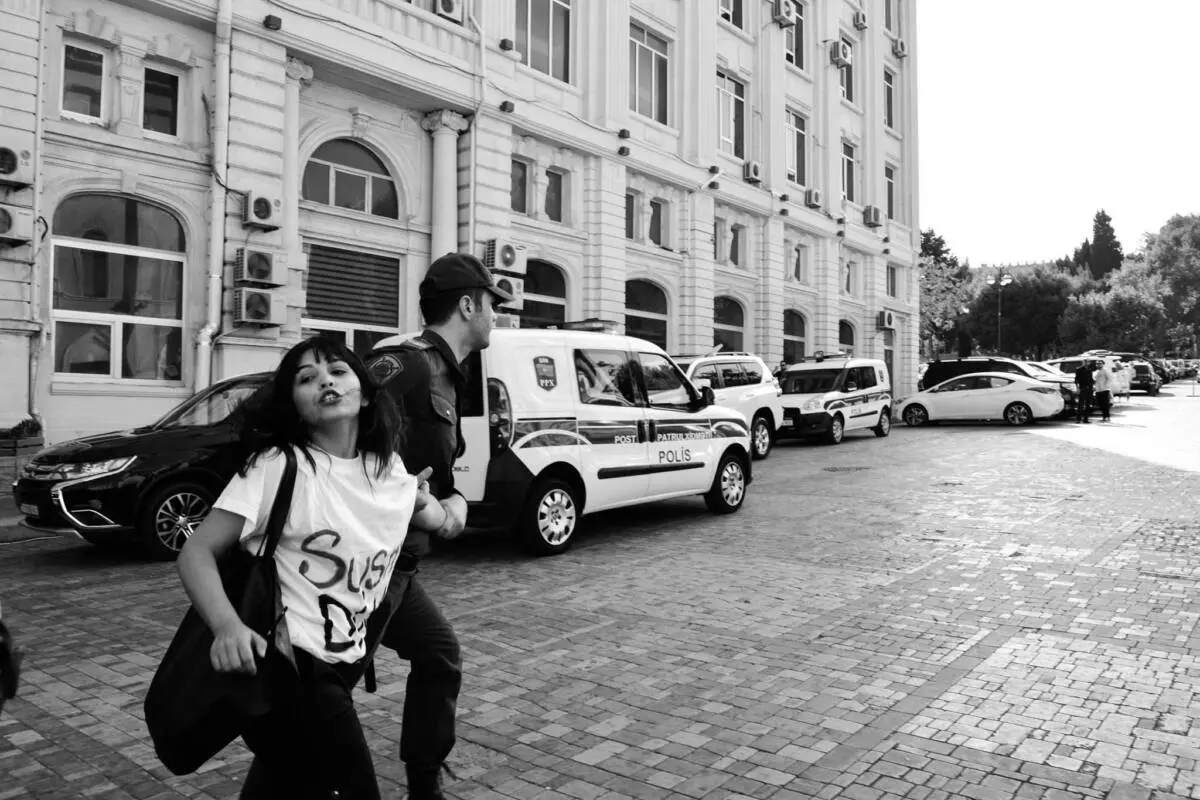
Aytac Tapdıq during the protest in Baku © Bashir Kitachayev
Aytac Tapdıq during the protest in Baku © Bashir Kitachayev
In a courtroom cage in Baku, journalist Aytac Tapdıq once said that, for her, reporting was never simply a job – it was the fabric of how she lived. She has since described what has happened to her profession as a “massacre of the media in Azerbaijan”. On 27 July 2026 a Baku court sentenced nine of her colleagues from Toplum TV, an independent outlet, to prison terms ranging from 12 to 15 years. The trial against Aytac is still ongoing. But that verdict makes clear what the government intends for journalists like her.
A pattern, not an incident
The arrests of Azerbaijani journalists since late 2023 are not isolated cases. They follow a deliberate template: independent journalists are charged with currency smuggling under Article 206 of the Criminal Code, a charge elastic enough to apply to almost anyone who receives a foreign payment, initially carrying up to eight years, extended further through the accumulation of additional charges added during investigation. It has been used against journalists from AbzasMedia (sentenced to 7.5–9 years in 2025, upheld on appeal in April 2026), Toplum TV (12–15 years), and the twelve journalists of Meydan TV, including Aytac, whose trial continues.
The strategy is not new. Independent voices have faced censorship and harassment for decades in Azerbaijan. Throughout the 1990s, reporters worked under the constant threat of arrest and physical violence. In the mid-2000s, the authorities removed foreign broadcasters from local airwaves. A decade later, bloggers sharing critical content online found themselves handcuffed.
A sweeping 2014 crackdown swallowed much of what remained of civil society, filling prisons with activists, lawyers and editors. The websites of independent outlets, like Meydan TV and Radio Liberty, were blocked, offices raided, reporters jailed. What is happening today is the culmination of this arc, but at a scale and intensity that has no precedent.
Before her own arrest, Meydan TV editor-in-chief Aynur Elgunesh described what Azerbaijan’s media landscape had become: a place where a small number of journalists were keeping something alive that had, by any honest measure, already ceased to exist as a functioning institution. She spoke of pluralism as a memory, and of free reporting as something the country’s authorities had long since decided it could not afford.
Following that interview, Elgunesh was arrested and is on trial, just like Aytac, facing the same spurious smuggling charges.
Who is Aytac Tapdiq?
Aytac Tapdiq – this is her byline name, her full name is Aytac Əhmədova – was born on 18 July 1993 in Baku. She has been a reporter for Meydan TV since 2015, covering social issues, women’s rights and political repression. Meydan TV was founded in Berlin in 2013, its website has been blocked in Azerbaijan since 2017.
Her relationship with the Azerbaijani security apparatus long predates her 2024 arrest. In September 2015 she was abducted off the street by plainclothes officers and interrogated about Meydan TV’s activity. In 2018 she was detained while filming in a Baku suburb. In February 2020 she was arrested at her home alongside Elgunesh while covering an election protest outside the Central Election Commission. Elgunesh sustained injuries from the use of force. Each time, Aytac returned to work.
The arrest and what followed
On 6 December 2024, days after COP29 ended in Baku, Aytac was among six Meydan TV journalists arrested at their homes simultaneously. Computers and phones were confiscated. Currency alleged to have been found during a home search was described by Aytac as planted by the investigator. The charges were later expanded to seven articles of the Criminal Code.
At a court hearing in January 2025, she addressed the proceedings directly: “We knew that journalists were being arrested with false accusations. We saw the danger coming. Nevertheless, we continued our work. If we were smugglers, we wouldn’t be in prison today”. She added: “The real smugglers are those who exploit and steal the country’s resources”.
In a later statement during the same proceedings, she addressed those within the system who were making her prosecution possible – judges, prosecutors, officials – and told them that their complicity would not protect them, that the regime they served consumed its own instruments, and that they would eventually discover this at their own cost. She promised that the trial would become the place where she and her colleagues would do what they had always done: hold those in power to account, this time face to face.
Since then, the conditions of her detention have deteriorated. In February 2026, all open family visits were banned at the Baku Pre-Trial Detention Facility where she is held. Her mother was blocked from leaving the country at Heydar Aliyev International Airport twice – in April and in May 2026 – while attempting to fly to Berlin to visit Aytac’s sister. The journalist’s mother was informed each time that a travel ban had been imposed by the Ministry of Internal Affairs. In late June 2026, Aytac’s phone calls with her friends were cut.
In July 2026, Aytac sent a letter from detention documenting the denial of medical care. She wrote that she had used 80 boxes of nasal drops in 20 months, developing a dependency due to the facility’s construction on reclaimed swampland.
The Penitentiary Service employs no salaried ENT specialist — meaning thousands of prisoners have no access to ear, nose and throat care. The six women journalists in the Meydan TV case have received one gynaecological examination between them during their entire imprisonment. Aytac said that the UN’s Nelson Mandela Rules and the standards of the European Committee for the Prevention of Torture – both of which Azerbaijan has committed to uphold – were being “deliberately” violated.
On 1 May 2026 – International Labour Day, two days before World Press Freedom Day – Aytac and four other women journalists in the Meydan TV case stood on their chairs in the Baku Serious Crimes Court and shouted slogans loud enough to be heard outside the courtroom. “Being a journalist is not a crim”, they declared. Security filed a disciplinary report against them. It was the only form of public protest available to them.
A view from Baku
The most recent convictions against Toplum TV – 15 years for the most senior defendants – are also the harshest handed down so far in Azerbaijan’s crackdown on independent media. They are not anomalies. They are the announced tariff.
The government, meanwhile, continues to speak of reforms and the “economic independence of the media”. President Aliyev has publicly stated that the country is considering full withdrawal from the Council of Europe, dismissing a recent PACE human rights resolution as “a piece of paper”.
When European Commission President von der Leyen visited Baku in July to announce 200 million euros in connectivity investment – without raising political prisoners publicly – a prisoner who had written to her before the visit was placed in a punishment cell the day after her departure, explicitly for having written that letter.
Aytac Tapdıq is 32 years old. She has been in pre-trial detention for more than nineteen months. Her trial has no verdict date. She is one of more than thirty journalists arrested in Azerbaijan since 2023. Azerbaijan ranks in the bottom ten countries globally on the World Press Freedom Index and is among the world’s top jailers of journalists according to the Committee to Protect Journalists.
Found an error in this article? Please contact our editorial team at redazione@balcanicaucaso.org.
Tag: Libertà di stampa
Featured articles
 the students' voices
 Investigation
 students' protest