‘Not in my name’: Kosovo torn between memory and justice
The protests against the ruling from The Hague – which, at first instance, saw Hashim Thaçi and the UÇK leaders convicted of war crimes – have reignited an issue that has dogged Kosovo ever since the street protests of 1997, extending right to the institutions of its independent state: who has the authority to speak on behalf of its people?
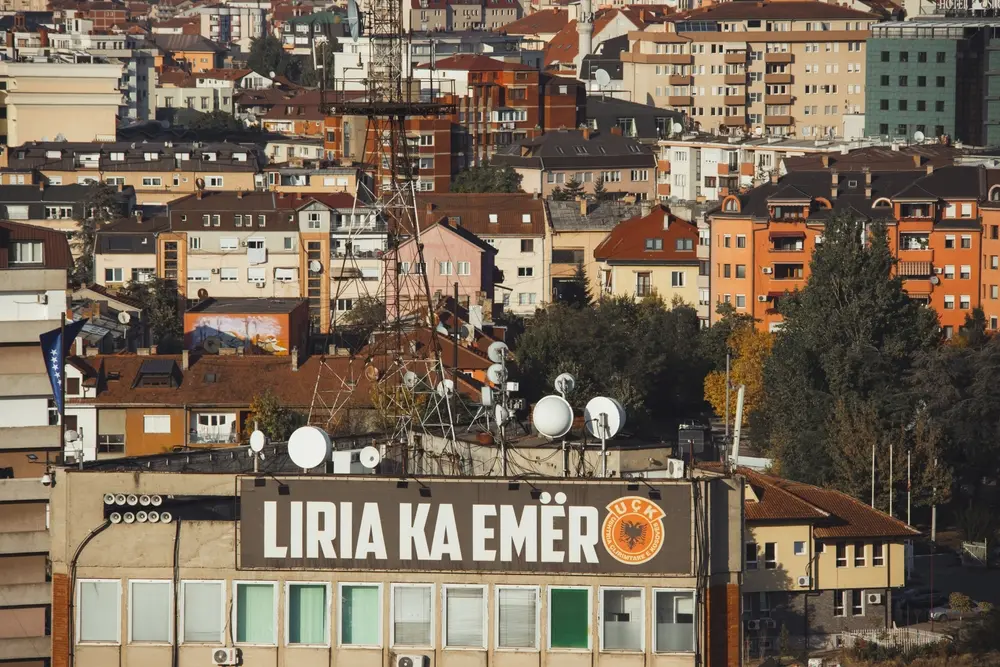
Poster for the ‘Liria ka Emër’ platform, Pristina © Matthew Figg/Shutterstock
Poster for the ‘Liria ka Emër’ platform, Pristina © Matthew Figg/Shutterstock
In 2023, I was working in a senior role at an international security organisation in Pristina. Most evenings, after work, I would board bus number 4 at the Newborn monument, carrying a bag filled with groceries or books bought at Buzuku bookstore, and travel back to my flat in Bregu i Diellit. The journey had become routine.
Yet, at the point where the bus turned towards the University of Pristina’s student dormitories, something would repeatedly catch my eye: a large banner bearing the faces of Hashim Thaçi, the former political leader of the Kosovo Liberation Army (KLA) who later became prime minister and president of Kosovo, and Kadri Veseli, a senior KLA figure who headed its intelligence services and later led the Democratic Party of Kosovo.
Beneath the emblem of the Kosovo Liberation Army (KLA), the words were unmistakable: “HEROES OF WAR” (Heronj të luftës) stood out in large, bold letters, followed almost as an afterthought by the phrase “…and of peace” (dhe të paqes) in much smaller italics.
The banner was more than a political image encountered on the way home. It was a statement about how the war should be remembered, and about who was entitled to embody its legacy. Long before the Hague judgment, the claim that the KLA’s leaders were heroes was already inscribed on the city’s streets, encountered not only at rallies or commemorations but in the ordinary rhythms of urban life. The past did not wait for an anniversary to become visible; it accompanied the everyday.
Kosovo’s two Octobers
On 1 October 2026, Kosovo’s streets became a stage for an argument about history, justice and political representation. Under the slogan Jo në emrin tim — “Not in My Name” — demonstrators challenged the first-instance judgment delivered on 16 September by the Kosovo Specialist Chambers in The Hague against four former leaders of the Kosovo Liberation Army (KLA).
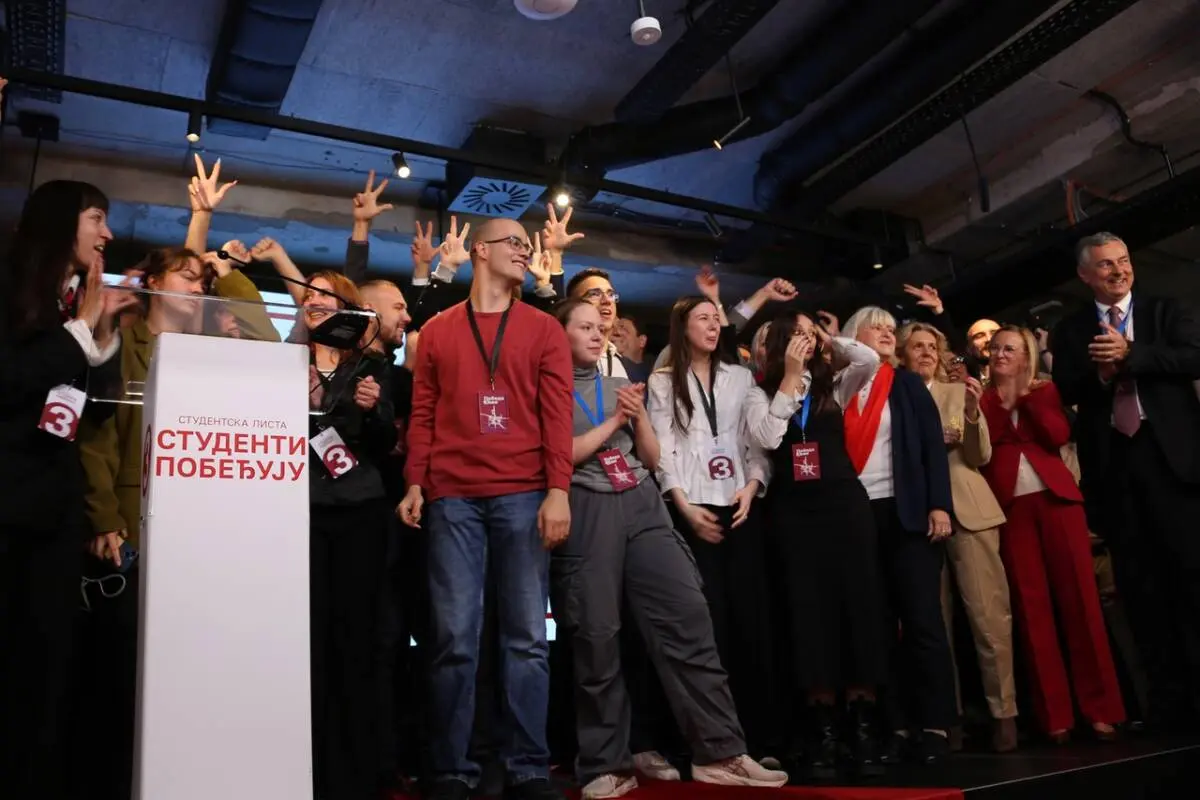
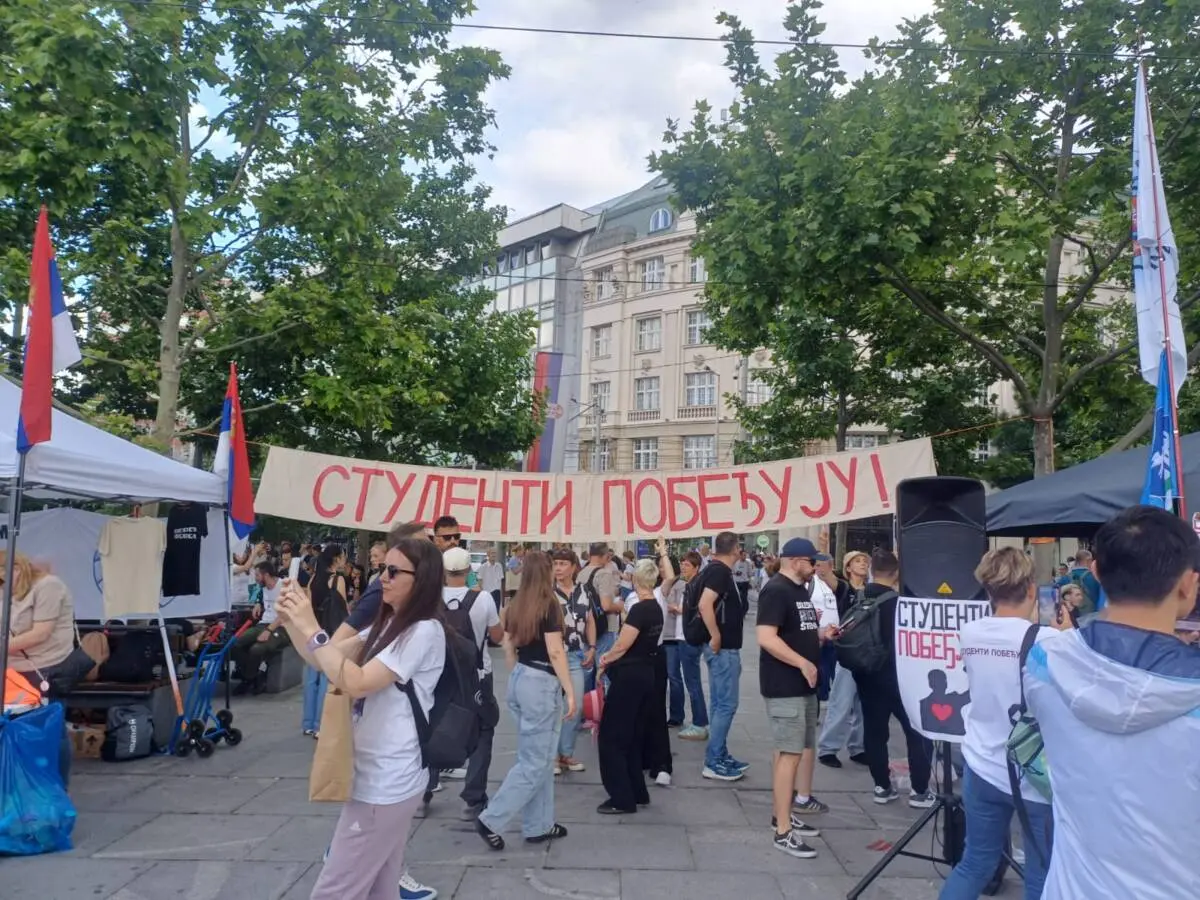
The date was deliberate. The organisers, Liria ka Emër (“Freedom Has a Name”), a civic platform created in 2020 to document and promote the legacy of Kosovo’s liberation struggle, explicitly invoked the student protest of October 1st, 1997, when around 15,000–20,000 Albanian students gathered in Pristina to demand access to university buildings from which they had been excluded under Serbian rule.
The date was not an incidental anniversary. By recalling the 1997 protest, the 2026 march was placed within a longer history of public mobilisation and attached the current dispute to the memory of resistance.
The 2026 slogan, however, carries a particular charge. The judgment has been delivered in the name of the people of Kosovo; the demonstrators have contested the assumption that this formulation could speak for their understanding of justice and history. For many Kosovo Albanians, the proceedings have touched a wound that independence had not closed: the fear that the struggle against Serbian rule, and the sacrifices associated with liberation, might be recast through the prosecution of the movement’s wartime leadership.
The memory that returned to the street
In response to a question about the intended focus of this article, Feim Maliqaj, a Pristina-based lawyer who was seventeen when the students marched in 1997, offered a reflection on the connections between the two October protests. He sees both as demands for dignity: in 1997, the freedom to exercise rights denied under Serbian rule; in 2026, the right to defend what he regards as the integrity of Kosovo’s liberation history.
The immediate demand in 1997 was concrete. Albanian students had been excluded from the University of Pristina’s premises, while an agreement intended to restore access to educational buildings remained unimplemented. The Independent Students’ Union organised the protest, with the support of the university’s rector, Ejup Statovci. Serbian police responded with violence.
The 1997 mobilisation also drew on an earlier history of student protest, particularly the demonstrations of 1968 and 1981, when demands for educational rights and better university conditions had opened onto broader struggles over Kosovo Albanians’ political status. Maliqaj places the students’ mobilisation within the exhaustion of what might be called a politics of waiting: the expectation that patience, non-violent resistance and international engagement would eventually bring political change.
His own connection to this history also runs through Hashim Thaçi, who served as student vice-rector under Statovci before becoming a political leader of the liberation movement. For Maliqaj, this trajectory matters to how the present proceedings are understood: his criticism concerns the Kosovo Specialist Chambers in The Hague and what he sees as their collective criminalising effect on the KLA and Kosovo’s liberation struggle, rather than the legitimacy of international justice in general.
Scholar Howard Clark’s work on civil resistance in Kosovo (2000) offers a useful context for understanding that movement’s significance. Nevertheless, the 1997 protest should not be reduced to a prelude to the war or absorbed into a single retrospective narrative over the history that followed. The students were responding to the conditions they faced at the time; their mobilisation deserves to be understood on its own terms, rather than only in light of what Kosovo would subsequently become.
Whose history, whose voice?
Ideal Zhaveli, executive director of the Activism Roots NGO based in Gjakova/Đakovica, was in Kosovo on 16 September, when the judgment was announced. He described the immediate response around him as one of “deep disappointment and anger”. In his view, this widespread reaction reflected the weight of wartime losses and continuing frustration over what many Kosovo Albanians perceive as an imbalance between international scrutiny of former KLA leaders and accountability for Serbian crimes.
The controversy surrounding the verdict has revealed how deeply the KLA’s legacy remains embedded in Kosovo’s public life. Anthropologist Stephanie Schwandner-Sievers helps explain why memories of resistance continue to shape political legitimacy.
In her 2018 study of the legacy of pre-war Albanian activism, she argues that the public commemoration of earlier militant self-organisation has “produced a hegemonic morality against which the actions of those in power are judged internally”. The point is not that everyone shares one account of the past, but that memories of resistance provide a powerful moral vocabulary through which political authority is assessed today. The Hague judgment has entered that contested landscape, where legal findings are interpreted not only in relation to the defendants but also in relation to the meaning of liberation.
The persistence of this memory is something I witnessed first-hand during my time living in Kosovo. At celebrations, birthday parties and gatherings among Albanians, both in Kosovo and in diaspora communities elsewhere in Europe, an evening could culminate in collective chants recalling resistance and sacrifice.
I was repeatedly struck by this transition: an occasion that began with food, music and conviviality could reach its emotional peak in a collective affirmation of a shared past. What I initially found strange gradually became a way of recognising how closely memory, belonging and the experience of resistance could be intertwined in Kosovars’ everyday social life.
A further difficulty concerns the legitimacy of the court itself. In his 2019 analysis of the Kosovo Specialist Chambers, political scientist Aidan Hehir argues that the institution had been established without sufficient local ownership, warning that “the court was not created in response to domestic pressure from within Kosovo”. His research predates the 2026 judgment, but the question it raises remains pertinent: formal legal authority does not automatically translate into public trust. Nor does a lack of public trust, on its own, determine the merits of a judgment.
Yet, the dispute cannot be understood only through the opposition between the court and Kosovo Albanian national memory. Mila Mihajlović, a Kosovo Serb writer and human-rights activist from Rabovac, observes that the verdict did not visibly transform everyday life overnight, even as KLA flags and symbols became more prominent on cars and outside homes. In an interview with OBCT, she also pointed to the marginal presence of Roma, Egyptian, Bosniak and other non-majority communities in the public debate, whose experiences, she said, had been “barely recognised”.
Her observation complicates any claim that Kosovo speaks with a single voice. This does not diminish the grievances expressed by protesters. But it does raise a further question: when people invoke the name of Kosovo, whose memories and losses are included in that claim, and whose remain peripheral?
Independence amid an unfinished argument
The meaning of the two Octobers lies in both the connection and the distance between them. They are not equivalent struggles. What links these two moments is how each drew on an earlier history of resistance to make a claim about political agency in the present.
Kosovo’s past cannot be contained in a verdict, a liberation narrative or a protest slogan. Nor can accountability gain public legitimacy simply by invoking the people in whose name it is pursued. The harder task is to distinguish individual responsibility from collective history, while recognising that no single account can encompass every experience of the war and its aftermath.
In this sense, the question carried between these Octobers is not whether Kosovo has one voice. It is whether its public life can make room for disagreement over the meaning of liberation and justice — without turning accountability into an accusation against an entire people, or memory into a shield against scrutiny.
Dr. Mary Drosopoulos is a COFUND “Migration Diaspora Citizenship” Postdoctoral Fellow at the Institute of Ethnology of the University of Münster, Germany. She has lived in Kosovo for more than a decade, where she has worked both for international organisations and with local CSOs, doing ethnographic work and research, contributing to policy change, interethnic dialogue and youth advocacy.
Found an error in this article? Please contact our editorial team at redazione@balcanicaucaso.org.
Tag:
Featured articles
 the students' voices
 Investigation