Bosnia and Herzegovina: the levers of political control over the media
Since 2023, Bosnia and Herzegovina has fallen 21 places in the Reporters Without Borders press freedom index, dropping to 90th place — its lowest ranking in twenty-five years. Underlying this figure is the direct or indirect control that political actors exert over media ownership, funding, and regulation
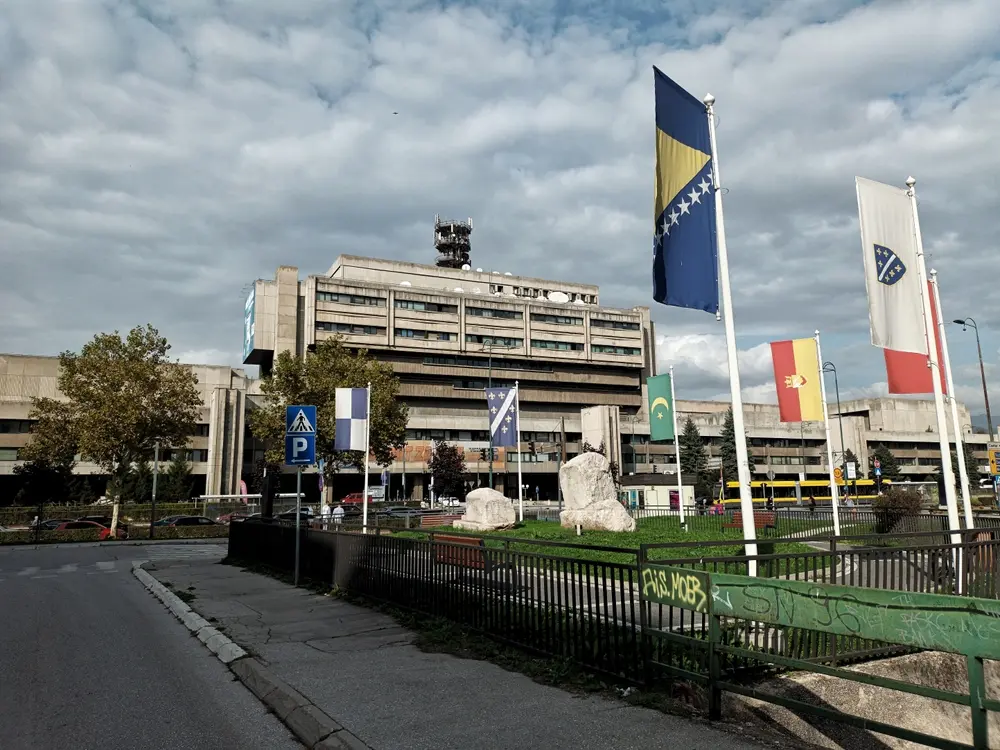
Radio and TV building of Bosnia and Herzegovina in Sarajevo © DIA TV/Shutterstock
Radio and TV building of Bosnia and Herzegovina in Sarajevo © DIA TV/Shutterstock
On October 4, 2026, the citizens of Bosnia and Herzegovina (BiH) headed to the polls to elect their political representatives at the state, entity, and cantonal levels. For voters to make informed choices, a free media environment is essential. Yet, in 2026, Bosnia and Herzegovina fell to 90th place in the Reporters Without Borders (RSF) World Press Freedom Index — its lowest ranking in twenty-five years.
The shadow report “Challenges to the Rule of Law and Media Freedom in Bosnia and Herzegovina”, produced by OBCT and Mediacentar Sarajevo (MC), notes that the country dropped 21 places between 2023 and 2026. Underlying this decline is a fundamental issue regarding power structures: the direct or indirect control that political actors exert over media ownership, funding, and regulation.
An opaque system
The primary challenge is the lack of transparency within the system, compounded by both economic and regulatory pressures. The Communications Regulatory Agency (RAK) license registry does not disclose ownership data; for online media, transparency is required only during election campaigns, following amendments to the electoral law in 2024. Without knowing who owns a media outlet, the public cannot assess which interests might be shaping its editorial line. The failure to adopt a law on transparency is largely due to the authorities’ reluctance to reveal the ties between media owners and centers of political or economic power. Furthermore, a working group established by the Ministry of Communications ceased its activities at the end of 2025, stating that it could not complete a draft law due to the fragmentation of jurisdictional authority. This situation is confirmed by the Center for Media Pluralism and Media Freedom Monitor, which classifies Bosnia and Herzegovina as being at high risk (77%) and identifies political interference linked to media ownership as a common phenomenon.
A second form of control is economic in nature. As highlighted in the shadow report by OBCT and MC, systematic data on the amount of public funding allocated to media outlets has not been published for a decade, and there are no specific regulations governing the transparency of such funding. The case of the Herzegovina-Neretva Canton — where a large portion of funds reportedly went to websites that either lack an impressum or publish one only sporadically — demonstrates how vague criteria leave room for discretionary decision-making. The European Commission’s 2026 report on Bosnia and Herzegovina also points to deep stagnation regarding media freedom, exacerbated by a lack of transparency in media ownership and the discretionary management of state advertising. These issues, combined with opaque public financing and political pressure on public service broadcasters, facilitate the instrumental use of funds and distort market competition. The clearest example is Alternativna Televizija (ATV) in Banja Luka. When imposing sanctions in 2022, the U.S. Department of the Treasury described it as a private broadcaster linked to a company close to the family of Milorad Dodik, former president of Republika Srpska, alleging that Dodik himself had increased funding for the outlet to disseminate content that served his own political objectives.
The crisis of public service broadcasting
Public service broadcasting serves as the litmus test for independence. The state broadcaster BHRT is on the brink of financial collapse: its debt to the European Broadcasting Union (EBU), exceeding 11 million euros, fell due in February 2026 with no new arrangement in place, while the Radio and Television of Republika Srpska (RTRS) ceased transferring its share of the license fee in 2017. RSF notes that, in Republika Srpska, the authorities have taken political control of RTRS and pushed BHRT to the verge of ruin. In 2025, during the news program Pečat (“The Stamp”) — broadcast by the Republika Srpska public broadcaster (RTRS) — a report was aired claiming that, over the last decade, Bosniak citizens residing in Sarajevo (within the Federation of Bosnia and Herzegovina) had purchased hundreds of properties in neighboring East Sarajevo (located in the Republika Srpska entity). The report cited approximately 800 new housing units, as well as various apartments and plots of land in the Pale and Jahorina areas. While acknowledging that the transactions were entirely legal, the report and its guests characterized this phenomenon as a dangerous trend — an alleged strategic plan aimed at altering the ethnic composition of the area and seizing control of part of Republika Srpska’s territory. The “Pečat” case highlights the limitations of the regulatory body: the Communications Regulatory Agency (RAK) launched an ex officio investigation that remains ongoing, marked by the agency’s evident hesitation in dealing with RTRS.
The responsibility of politics
In Republika Srpska (RS), the pressure is also exerted through legislation. In 2023, defamation was reintroduced as a criminal offense, reversing a change made between 2001 and 2002, when Bosnia and Herzegovina was one of the first countries in Europe to decriminalize defamation. While the judicial impact has been limited (273 complaints, only one indictment), it has created a widespread chilling effect: journalists now conduct more thorough fact-checking and get legal counsel before publishing.
The law on “foreign agents,” introduced in February 2025, was struck down by the Constitutional Court of Bosnia and Herzegovina on May 29, 2025. Meanwhile, a draft media law — which had been stalled due to a change in government — has been revived by Prime Minister Savo Minić.
Furthermore, power is also exercised through “dog-whistling”: politicians label journalists as “foreign agents” or enemies of the state, which often triggers threats and attacks.
According to the Mapping Media Freedom platform, the number of incidents rose from 17 in 2024 to 25 in 2025. A survey by the Friedrich-Ebert-Stiftung reveals that, for the majority of citizens in both entities, politicians are perceived as the primary obstacle to the work of the media. This view is held by 66.9% of respondents — a figure that reaches 72% within the Federation and stands at 56.6% in the Republika Srpska (RS). Editorial independence is not secure, and journalists fear that, through further developments, media outlets could end up in the hands of individuals close to the establishment.
What could serve as a starting point for diluting the concentration of political power and its influence over the media in Bosnia and Herzegovina? One initial answer seems clear: the necessity for — and the right to — transparency. There is a need for legislation on ownership transparency that aligns with Article 6 of the European Media Freedom Act (EMFA), the requirement for institutions to disclose the amounts and purposes of funding provided to media outlets, the decriminalization of defamation in Republika Srpska, and the reform of the appointment process for the leadership of the RAK (Communications Regulatory Agency) — the risk is that, given the deep-seated political opacity that currently characterizes the environment in which media in Bosnia and Herzegovina must operate, even the most progressive regulations may remain nothing more than words on paper.
Found an error in this article? Please contact our editorial team at redazione@balcanicaucaso.org.
This publication is the result of activities carried out within the framework of the Media Freedom Rapid Response, co-funded by the EU, and the ATLIB - Transnational advocacy for freedom of information in the Western Balkans project, co-funded by the Italian Ministry of Foreign Affairs and International Cooperation. All opinions expressed are those of the author and do not necessarily reflect the views of the co-funding institutions.