Return hubs in Rwanda: Five EU countries are outsourcing repatriations
Greece, Germany, the Netherlands, Denmark and Austria are preparing to open a center in Rwanda, expected to be operational by 2027, for rejected asylum seekers. However, Rwanda cannot be considered a safe country, and the protection of rights risks being lost amid fragmented responsibilities
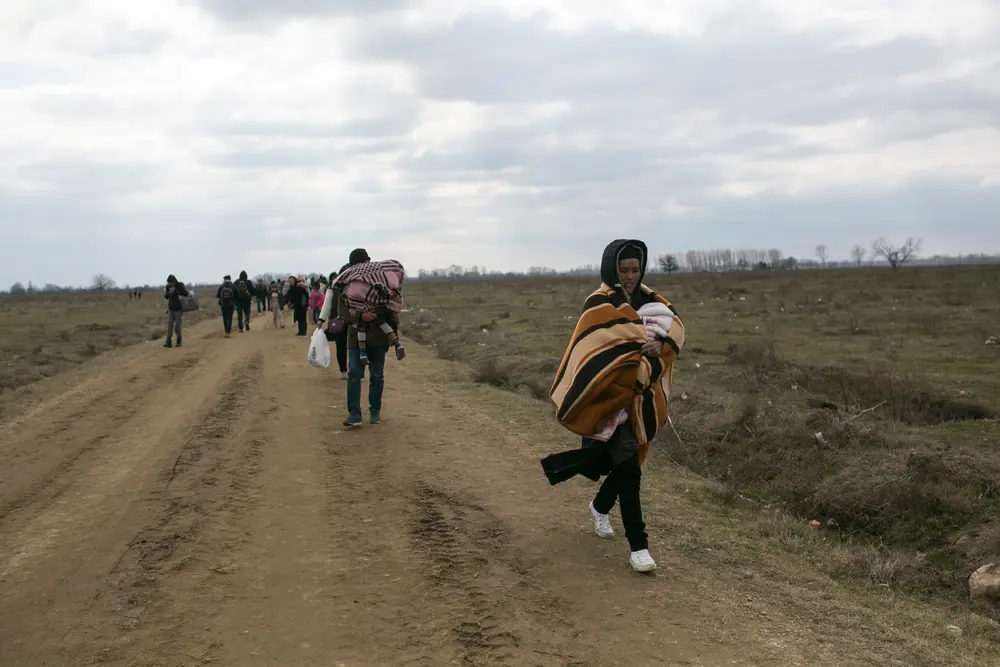
Refugees trying to enter Greece by crossing the border with Turkey © Tolga Sezgin/Shutterstock
Refugees trying to enter Greece by crossing the border with Turkey © Tolga Sezgin/Shutterstock
On 16 November 2026, Greece, Germany, the Netherlands, Denmark and Austria announced that they had reached the final stage of negotiations for a first pilot return hub project in Rwanda.
The facility is scheduled to open between spring and summer 2027, with an initial capacity of one hundred places: each signatory country will be able to transfer to Rwanda up to twenty people whose applications for international protection have been rejected at all levels of jurisdiction and who have therefore received an expulsion order.
The center will not be a detention facility and European countries will be formally responsible for it.
A new aspect, as Rwandan Interior Minister Vincent Biruta explained, concerns the possibility for people sent to the center to choose whether to stay and integrate in Rwanda with a specific program, return to their country of origin, or settle in a neighboring country.
The role of Denmark
Emilie Ewald, a journalist for the independent Danish newspaper Føljeton, has reconstructed the long history of relations between Copenhagen and Kigali regarding the externalisation of migration.
The cooperation, which began in 2021, continued with a joint declaration in 2022 and a program that provided for the transfer of asylum seekers arriving in Denmark to Rwanda: their applications would be examined in the African country and, in the meantime, anyone who wished could settle there.
However, in 2023, Denmark suspended the bilateral agreement, initiating a dialogue with other European states interested in externalising migration. In 2026, the Danish proposal found concrete support.
The initiative was launched by Social Democratic Prime Minister Mette Frederiksen, who has always held very restrictive positions on migration. Only recently has the idea gained broad support across Europe, in a coalition that spans the Social Democrats and more conservative parties.
Accountability and deterrence
On the pages of Der Standard, Kim Son Hoang and Michael Völker explain the project’s structure, highlighting its most controversial aspect: the transfer of people with no connection to Rwanda, where monitoring, effective protection and decent living conditions are not guaranteed. Furthermore, after the transfer, European states could limit their responsibility, effectively delegating the protection of fundamental rights to Kigali.
Another important aspect of the program is deterrence: the risk of being returned to a non-European country after being denied protection should discourage others from attempting to reach Europe. According to the promoters, it would also serve to combat human trafficking.
The Greek laboratory
In June 2026, with the entry into force of the European Pact on migration and asylum, Athens passed a law incorporating all the elements of the new EU legislation: from new screening procedures to accelerated border procedures, from coordination with the EUAA and Frontex to strengthening reception and identification capacities on the island of Crete, to specific legislation to expedite the expulsion of people whose protection claims are rejected. This last point effectively paves the way for transfers to future return hubs.
A month after the Pact entered into force, the NGO Refugee Support Aegean denounced the criminalisation of asylum seekers, documenting serious irregularities in the registration of applications and the practice of arresting people attempting to access the procedure, who were subsequently detained with expulsion orders. A case in point is that of a mother and her two children.
From Crete to Kigali
The months of July and August this year were particularly tense on the route from Libya to Crete and Gavdos. Maritime surveillance has been strengthened, thanks in part to collaboration between Frontex and the Libyan Coast Guard, with the aim of containing and repelling departures before the boats reach Greek waters.
Then, in September, Greece joined the ranks of countries most insistently calling on Brussels to introduce a transfer mechanism to third countries. This is why Athens sat down to discuss the pilot project in Rwanda.
Drawing on the European Emergency Response Framework announced by Commission President Ursula von der Leyen, in October Greek Migration Minister Thanos Plevris proposed a Special Derogation Regime: an exceptional regime that would allow member states, in the event of an unexpected increase in migrant arrivals, to temporarily suspend the possibility of requesting international protection and further expedite returns. The risk is that a derogation intended as an exception could become the norm.
Although it did not result in a concrete decision, the proposal received political support from several countries, particularly concerned about the possibility of third countries taking advantage of migratory flows, as happened in Ceuta.
Legal and political implications
In El Confidencial, Lola García Ajofrín interviewed Judith Sunderland of Human Rights Watch about the role of humanitarian partners involved, such as IOM and UNHCR, who should monitor the rights of transferred asylum seekers. The IOM’s example in the Lipa camp, in Bosnia and Herzegovina, shows, however, that the presence of these organisations alone is not enough to rule out violations.
Sunderland emphasises that the opening of return hubs puts at risk several pillars of the right to asylum: not only the individual examination of each request and the assessment of the risk of persecution in the event of repatriation, but above all the concrete possibility of appealing against a denial, a tool that in recent years has allowed many people to obtain second-instance protection.
According to Human Rights Watch, Rwanda is not an adequate partner, given the documented violations: restrictions on press freedom, repression of dissent and abuses committed by Rwandan forces and Kigali-backed militias in eastern Democratic Republic of the Congo.
These examples also raise serious questions about the ability of European actors to monitor and verify the program in Rwanda once it is underway.
Even if formally legal, any transfer to Rwanda would lack concrete guarantees for the rights of those transferred. This would create areas of fragmented responsibility, where the migrant would pay the price: expelled, transferred and abandoned in a foreign country, without any protection. And this at a time when the primary concern should be avoiding the images of thousands of nameless faces and bodies, vanished while attempting to reach Europe that wants to keep them away.
Found an error in this article? Please contact our editorial team at redazione@balcanicaucaso.org.
 This article was produced as part of PULSE, a European initiative coordinated by OBCT that supports transnational journalistic collaborations. Kim Son Hoang, Michael Völker (Der Standard) and Lola García Ajofrín (El Confidencial) contributed to the text.
Tag: PULSE