Albania, the fence as a structure of power
As the demonstrations in favor of the Pishë Poro-Narta protected area go on, local communities in other parts of Albania are also in turmoil. The symbol of this new wave of protests is the barbed-wire fencing surrounding the areas where new projects are planned. The fence represents power and exclusion; tearing it down is a political act.
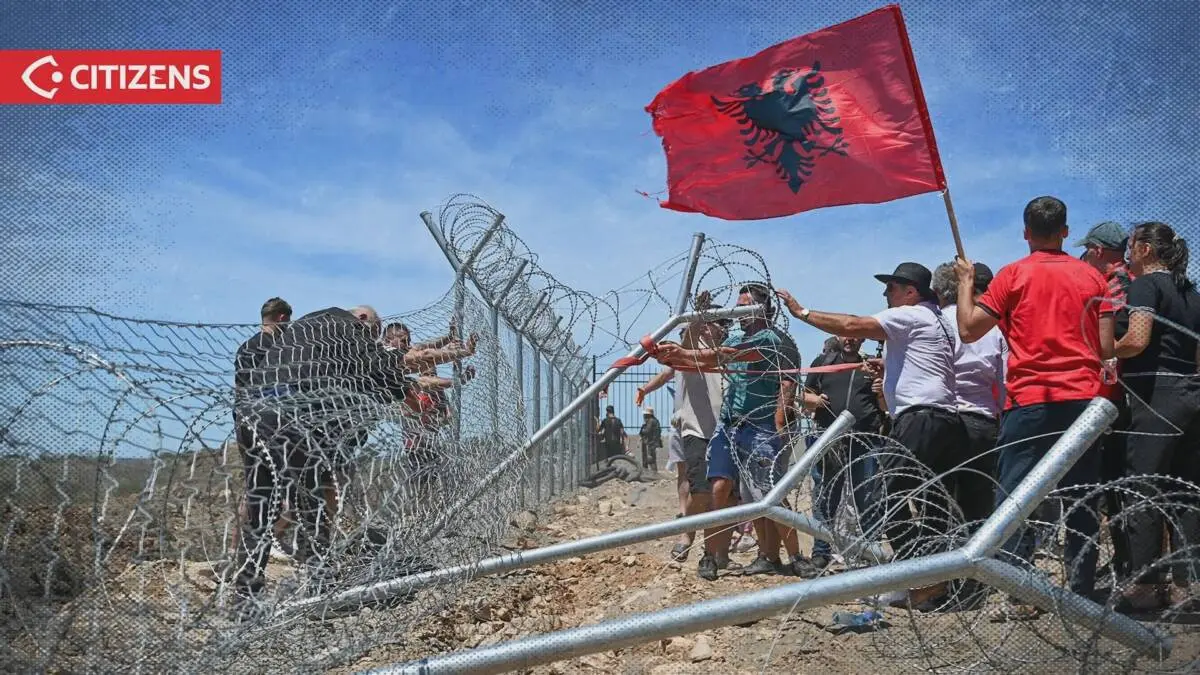
Protesters attempt to remove barbed wire in Rrjoll
Protesters attempt to remove barbed wire in Rrjoll - Photo © Citizens.al
Mass protests that have been ongoing for more than two weeks in Albania began following clashes between residents and authorities over the removal of a fence surrounding the area of Pishë Poro-Narta, where a luxury resort is planned to be built. What initially appeared to be a local dispute quickly turned into the spark of a broader civic uprising.
From Tirana, where the protests have gathered thousands of citizens and have become some of the largest demonstrations in recent years, the movement has also spread to other cities across the country. Alongside rallies in public squares and marches in several regions, a different form of resistance has emerged in local communities: the tearing down of fences that residents see as symbols of exclusion from land, water, and shared public spaces.
Today, the fence has become a central symbol of this wave of protests. For many residents, it represents restricted access to natural resources and decision-making processes carried out without local participation. In this sense, tearing it down is seen not merely as a physical act, but as a political and social statement against the way development projects are being implemented across the territory.
As urbanist and activist Doriana Musai explains for OBCT, the symbolism of the fence lies in its visibility as a structure of power: “The fence is a powerful symbol because it very visibly materializes a power relationship, separating those who are allowed to enter from those who are excluded. In Zvërnec, it was not perceived simply as a construction structure, but as the physical boundary between private interest and public interest.”
She adds that its removal carried meaning beyond physical destruction: “When citizens tore down the fence, the act was not only about removing a physical barrier, but also a form of expression of rejection of a governance model that places barriers between people and their own territory.”
After Narta, fences also fell in Rrjoll and in Dardhë, creating a domino effect that has connected different local causes to the broader uprising spreading across the country.
Rrjoll and the clash over the “Blue Borgo” resort
On Saturday, June 13, two weeks after the protests began in the Albanian capital, residents of Rrjoll, a village in Velipojë in the district of Shkodra, tore down the fence surrounding the construction site of the “Blue Borgo” tourist resort. The project has been designed by Italian architect Stefano Boeri, known for his urban projects in several European cities and for his involvement in major developments in Tirana.
Protesters entered the construction site and, using improvised tools, removed barbed wire and demolished parts of the fencing structure near the coastline. According to them, the fence represented not only a physical barrier but also the exclusion of the community from a territory they consider part of their traditional livelihood and property.
The project is being developed by the company Gener 2, which has fenced off the entire perimeter of the land. Residents who claim ownership stakes in parts of the area have repeatedly attempted to access the coastline.
The head of the Shkodra Police Directorate was present on site and attempted to communicate with the protesters. “The police are with us,” and “Come gather here,” were among the chants heard from the crowd.
Their main demand is the suspension of construction until the case is resolved in court.
Residents have been protesting the project for months. They claim it has been developed without sufficient consultation with the local community and that it infringes on their property rights and land use. The case has also been submitted to the Special Prosecution Office Against Corruption and Organized Crime (SPAK), which later delegated the investigation to judicial authorities in Shkodër.
“We are asking for our rights. They have oppressed us. It is not the first time we protest. We do not want confrontation. If possible, we will remove the fence. We are calling on the state: do not oppress us,” said one of the protesters during the action.
The “Blue Borgo” resort received its construction permit in December 2024 and is planned to be developed by brothers Bashkim, Astrit, and Ahmet Ulaj. Their name often comes up because “Gener 2” has been a frequent contractor in state-linked infrastructure projects and is also active in large private developments, including tourism resorts like “Blue Borgo.”
The project includes around 35 residential and tourist structures of varying heights and covers an area of approximately 147 hectares, located between the Vilun lagoon and the protected natural monument Rana e Hedhun.
Under its strategic investment status, the project is expected to benefit from access to coastal land, state infrastructure support, and fiscal incentives. It is part of the government’s tourism development policy, through which hundreds of hectares of land have been allocated to private investors over the past decade for tourism and residential projects.
Doriana Musai argues that the current wave of protests reflects a deeper shift in how citizens understand development: “What stands out most is that opposition is not being built on rejecting development itself, but on demanding a different model of development. Citizens are not saying ‘don’t develop’; they are asking ‘development for whom, at what cost, and in whose interest?’”
She adds that the concept of territory is increasingly central: “Territory is being understood as a collective good, not just property or environment separately, but a shared asset over which citizens have the right to demand accountability.”
Dardhë and the water conflict
A similar incident took place in Dardhë, in the district of Librazhd, where residents tore down a fence installed by the company “Lucente Koncesionare,” which operates a hydropower plant in the area.
The action followed months of complaints about water shortages in the village. Residents say that for around six months the water supply has been significantly reduced and that the hydropower plant’s activity has directly affected local water sources.
In this case, the fence became a symbol of a deeper conflict between basic community needs and the interests of a private energy project. Its removal was seen as a necessary act to draw attention to the lack of institutional solutions.
Following the residents’ intervention, the mayor of the municipality stated that the fence had been installed illegally, partially confirming the community’s claims.
A domino effect of protests
From Tirana to the coast of Shkodra and the mountainous areas of Librazhd, the protests are revealing a shared pattern: escalation from demonstrations in public squares to direct actions on the ground. The tearing down of fences has become a symbolic form of civil disobedience, linking different local disputes into a broader narrative about rights over land, water, and public space.
Although each case has its own specific context—from tourism developments on the coast to hydropower plants in rural areas—they are united by a common perception among communities that decisions about their territory are being made without their participation.
As Doriana Musai concludes, the shift is also political in nature: “Citizens are not simply asking to be heard after decisions are made, but to be part of decision-making before they are taken. And this represents a fundamental shift in the country’s democratic culture.”
In this sense, the “fence” has become a metaphor for a deeper divide between development promoted by institutions and how it is experienced by local residents. And while more fences may fall in the coming days, the remaining question is whether this domino effect will remain a series of symbolic acts of resistance, or whether it will lead to a deeper shift in how development is understood in Albania.
Found an error in this article? Please contact our editorial team at redazione@balcanicaucaso.org.
Featured articles
 Investigation
 students' protest
 Montenegro Pride 2026