The doctor at the gate: Maria Karystianou and the politics of grief
From a mother devastated by the Tempi rail tragedy to a political leader: on May 22 Maria Karystianou launched her “Hope for Democracy” movement. A move which already shook the Greek establishment with her calls for accountability and renewal, though not without contradictions
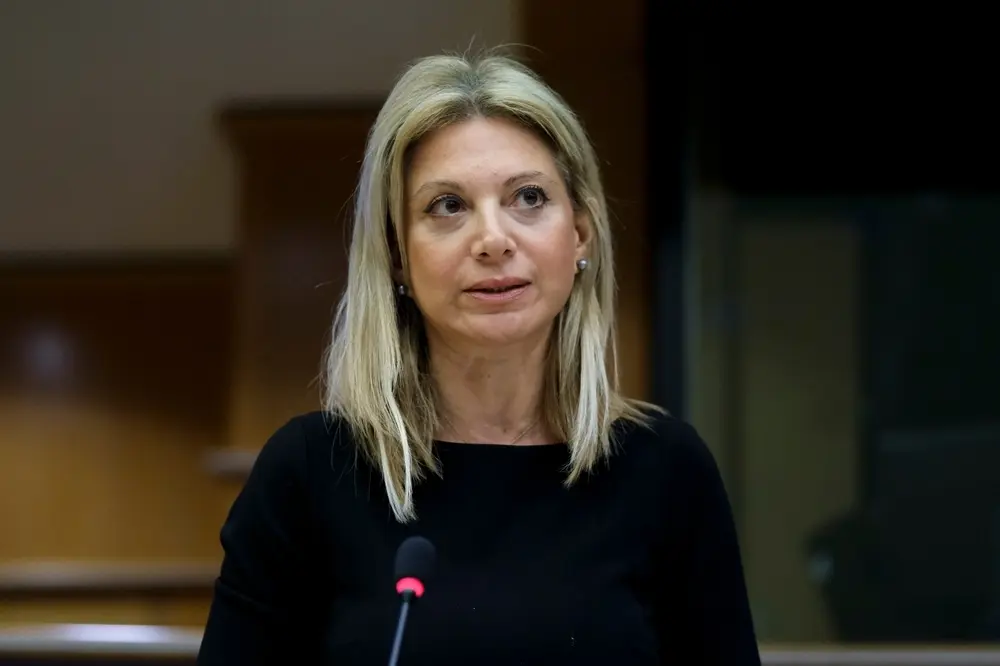
Maria Karistianou at the EU Parliament © Alexandros Michailidis/Shutterstock
Maria Karistianou at the EU Parliament © Alexandros Michailidis/Shutterstock
The moment was theatrical, but its stakes were real. Maria Karystianou — the mother who became the face of Greece’s demand for accountability after the 2023 Tempi train disaster — was no longer just a campaigner. She was a candidate for power.
The Tempi crash killed 57 people, most of them young students, when a passenger train collided head-on with a freight train in central Greece on 28 February 2023. Among them was Karystianou’s 19-year-old daughter, Marthi.
What followed was one of the most sustained civic mobilisations Greece had seen since the financial crisis: mass demonstrations, legal battles and a campaign for accountability that has consistently outrun the political establishment’s ability to contain it.
Last year, Karystianou helped bring hundreds of thousands onto the streets in the largest rallies Greece had seen in years. This May, she converted that energy into Elpida gia ti Dimokratia — Hope for Democracy.
Maria Karystianou, from pediatrician to anti-establishment leader
Before Tempi, Karystianou was invisible to the broader Greek public. A practising paediatrician in Kalamaria, Thessaloniki, she was, by the accounts of patients who knew her, a doctor who kept pace with the better instincts of modern medicine: cautious with antibiotics, attentive to what the body could do on its own. One of her clients, Nefeli A., mother of two, remembered her as someone who would not reach for a prescription unless it was warranted.
That same disposition shaped how she carried her grief into public life. She did not merely mourn. She investigated, organised, and litigated; domestically and before the European Public Prosecutor’s Office, after concluding that Greek justice had failed:
“My daughter was burned alive,” she said in October 2025, “and in the official case there is no reference to fire. There is no charge for that. This suits the government.”
By January 2026, polling cited by Eurotopics placed her approval at 33% — ahead of Prime Minister Kyriakos Mitsotakis at 26%, and ahead of every other political figure in the country. By April 1, she had formally announced the movement on social media.
The structural conditions for such a figure are visible in plain sight. New Democracy, which secured 41% in the 2023 elections (Hellenic Ministry of Interior, 2023), has seen its support fall sharply — weighed down by corruption scandals and the still-unresolved political legacy of Tempi. SYRIZA, the party that once embodied anti-establishment energy, now hovers at the margins of parliamentary relevance— a cautionary tale about what happens when protest movements absorb the habits of the institutions they set out to challenge.
In this vacuum, Karystianou has positioned Hope for Democracy as something harder to classify, a movement built not around ideology but around the demand that the state answer for what it does.
“To be able to change things, you need the ability to do so,” she told supporters in Thessaloniki. “We are talking about power. That is our goal.” She has ruled out alliances with existing parties and excluded established politicians from her ranks, arguing they “carry the same responsibility” for Greece’s current condition.
For some analysts, the party’s ideological indeterminacy — its founding charter covers families, education, healthcare and transparency in public contracts without a clear left-right orientation — is not a weakness but its most significant strategic asset.
In a landscape where voters are moving simultaneously away from the established left and the established right, a cross-cutting accountability movement can draw from both. Polls suggest it already is, with potential support running from disappointed leftists to anti-establishment conservatives.
No honest account of Karystianou’s political venture can avoid its fault lines, and the most significant emerged before the party had even been formally named.
The abortion controversy: Karystianou’s medical background and political fault lines
In January 2026, speaking on OPEN TV, Karystianou described abortion as “a complex ethical issue involving both women’s rights” and what she called “the rights of the embryo,” calling for public consultation on a matter that has been settled in Greek law since 1986.
The reaction was immediate and cross-partisan: government and opposition alike insisted the issue was “closed.” Her remarks were careful — Karystianou did not call for a ban, and explicitly acknowledged a woman’s right to decide — but in framing fetal life as a legitimate subject of democratic debate, she drew on her medical background in a way that was visibly uncomfortable — hesitant, unscripted, clearly unprepared for the political weight the question would carry.
The consistency is genuine: this is a pediatrician whose professional identity has long been organised around the defence of children’s lives, and it shows in her politics. But consistency is not the same as political wisdom, and the abortion controversy exposed how quickly her moral authority can become a liability when it moves beyond the domain — institutional accountability, public safety, democratic transparency — where it is most universally shared.
Tempi train crash victims’ association distances itself from the new party
The founding event itself carried a telling symbolism. The city of Thessaloniki, known for its conservative electorate, lent the occasion a certain political weight. Yet the evening’s most significant absence was also its least discussed: no representative of the Tempi 2023 Victims’ Relatives Association attended in an official capacity, though some individual families signed the founding declaration.
The association’s board had formally distanced itself from Karystianou’s political ambitions as early as December 2025, stating that her actions “do not represent the Association” and that its mission remains solely the pursuit of justice for the crash. Fellow victim-parent Panos Routsis was blunt: “I fought for my child and the truth, not for political gain.” It is a rupture that matters, because much of Karystianou’s moral authority derived from her identification with a collective. The transition from symbol of grief to leader of a party is, in some eyes, uncomfortably close to what she has accused the system of doing: turning public tragedy to private advancement.
Katerina Moutsatsos and the ideological identity of ‘Hope for Democracy’
The event’s “surprise” guest, actress and activist Katerina Moutsatsos, added a further layer of complexity. Born in California to a Greek naval officer, Moutsatsos built a distinctive career across Greek television, but also Turkish drama, including a prominent role as “Stella” in Yabancı Damat (literally “foreign groom”), one of the first Turkish series exported internationally about a Greek-Turkish cross-border marriage.
This was before producing the 2012 viral video “I Am Hellene,” a passionate defence of Greek identity at the height of the debt crisis. A polyglot, a Sorbonne-trained theatre graduate, and a years-long advocate for the term “Hellene” over “Greek,” she told the Thessaloniki audience that she had “been preparing for 14 years” for this moment.
In 2024, she had run for the European Parliament with EPAM, a hard-nationalist anti-memorandum formation — a political journey whose arc has drawn questions about ideological coherence that Karystianou’s party, for now, has chosen not to answer.
Whether Hope for Democracy becomes a governing force or another entry in Greece’s long catalogue of movements consumed by the system they challenged will depend on questions that no founding event can answer.
The coalition is broad, the contradictions are real, and the absent families are a permanent reminder of what was lost. But the doctor is at the gate. And the gate, for the first time in a long while, is visibly shaking.
Found an error in this article? Please contact our editorial team at redazione@balcanicaucaso.org.
Tag:
Featured articles
 Investigation
 students' protest
 Montenegro Pride 2026