Transnational repression: the case of Chechnya
Chechnya adds a unique dimension to transnational repression: beyond being a state that pursues its opponents abroad, it is also a system of control made up of family, community, informal networks and apparatuses. Second part of our in-depth analysis
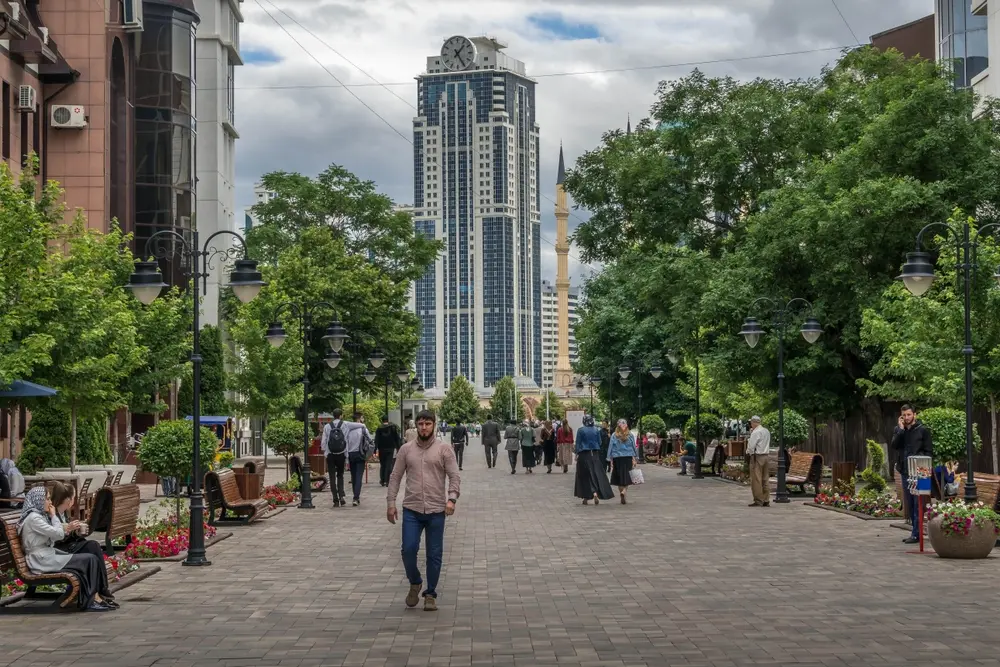
Grozny, Chechnya © artaxerxes_photo/Shutterstock
Grozny, Chechnya © artaxerxes_photo/Shutterstock
Numerous incidents have highlighted the ability of the Russian and Chechen authorities to target political opponents who have taken refuge in Europe, confirming that repression can extend beyond national borders.
The most notorious case is that of Zelimkhan Khangoshvili, a Georgian Chechen fighter and asylum seeker in Germany, murdered on 23 August 2019, in Berlin’s Kleiner Tiergarten. The perpetrator, Vadim Krasikov, was sentenced to life imprisonment in December 2021 by the Berlin Regional Court. He was subsequently extradited to Russia in 2024 as part of a large-scale prisoner exchange, where he was welcomed by Putin himself.
Imran Aliev, a Chechen blogger known by the pseudonym “Mansur Stary” who drew attention with his criticism of Kadyrov, was found dead in a hotel room in Lille, France, on 30 January 2020, with multiple stab wounds.
Investigations by French authorities led to the indictment of a Chechen citizen accused of the murder, and in 2025 the Douai Assize Court sentenced him to twenty years in prison.
While Chechen authorities were not formally held responsible for the murder, the case was widely cited as an example of the risks faced by Chechen dissidents in exile and the broader phenomenon of transnational repression.
Germany, France, and even Austria: in July 2020, Martin Bek, alias Mamikhan Umarov, a critic of the Chechen government, was shot dead near Vienna. The incident echoes the assassination of Umar Israilov, Ramzan Kadyrov’s former bodyguard, who was killed in the Austrian capital in January 2009 after fleeing Chechnya and denouncing torture and human rights violations.
The investigation into the murder of Umar Israilov led to the conviction of several perpetrators.
Chechen women
Many Chechen women are persecuted not for their opinions, but for trying to escape family control or for rejecting forced marriages or other strictly enforced social norms.
EASO/EUAA highlights how in Chechnya, family control over women is reinforced by an institutional context where the authorities tend to prioritise family reconciliation over victim protection.
Under Ramzan Kadyrov’s regime, domestic violence has effectively become institutionalised, so much so that the authorities encourage the idea that women’s lives should be strictly controlled by male relatives. The notion of family honor is used to justify crimes against women.
Chechen women seeking refuge in different regions of the Russian Federation continue to be located by their families through informal networks, missing person reports, or by involving local law enforcement. In several incidents, police authorities have detained women pending the arrival of relatives or facilitated their forced return to Chechnya.
One name among many: Seda Suleymanova, a twenty-six-year-old who fled to St. Petersburg to escape a violent environment and a forced marriage. In August 2023, she was stopped by the police and handed over to her family, who took her back to Chechnya.
Since then, there has been no accurate information about her fate, and it is speculated that she may have been the victim of an honor killing. The story has taken on further significance due to the perseverance of her friend Lena Patyaeva, who continues to organise solitary pickets and public campaigns demanding an effective investigation into her disappearance. For this reason, she has been repeatedly stopped and arrested.
On 28 July 2026, the crisis group “North Caucasus SOS”, an organisation known for supporting LGBTQ+ people and women fleeing violent situations in the North Caucasus republics, was designated by the Russian authorities as an “extremist organisation”.
The decision is part of a broader criminalisation of independent human rights networks in Russia. North Caucasus SOS stated that the designation will not halt its activities, but will make its work more complex and risky: the organisation has already reduced its presence in Russia, eliminated some internal funding sources and strengthened security measures to protect both its staff and the people they assist.
The escape to the South Caucasus
Georgia and Armenia, due to their geographic proximity to Chechnya, represent a more accessible destination for many women than Europe. Tragic cases demonstrate the risk Chechen women face of being tracked down and forcibly returned, or even killed, given the transnational repression capabilities in the region.
Aliya Ozdamirova fled to Georgia in October 2025. In November, she was reportedly lured snd transferred to Russia According to human rights activists, Ozdamirova later died in circumstances consistent with an honor killing. The Georgian Prosecutor’s Office has opened an investigation into her abduction and death, but any individual or institutional responsibilities remain to be determined.
Another emblematic case is that of Laura Avtotrkhanova, a twenty-four-year-old who fled to Georgia to escape domestic violence. After obtaining protection and shelter in a secure facility, she was found in 2025 and her family attempted to kidnap her.
The intervention of Georgian authorities prevented the young woman’s forced transfer. However, the fact that her family members were able to locate her speaks volumes about the ability of transnational family networks to operate outside Chechnya.
In October 2025, Aishat Baimuradova, who had taken refuge in Yerevan, was found dead. Armenian authorities named two citizens with Russian passports as suspects. The woman’s body remained in the morgue for over five months because, according to Armenian law, handing over the body for burial was the responsibility of the relatives. However, the family did not respond to the authorities’ requests.
Eventually, the Armenian authorities arranged for the burial at their own expense in the Nubarashen Cemetery in Yerevan. The ceremony was attended by friends and activists, who had mobilised to ensure that the woman’s dignity would not be trampled upon even in death, and that the victim would not be treated as a nameless body.
Found an error in this article? Please contact our editorial team at redazione@balcanicaucaso.org.
Tag:
Featured articles
 the students' voices
 Investigation
 students' protest