Montenegro, the ghosts of the past
On May 21, 2026, Montenegro celebrated the twentieth anniversary of its independence. With the series “Winds of Independence,” OBCT seeks to trace Podgorica’s trajectory from its recent past to the near future, attempting to decipher a present still full of contradictions. This second part focuses on transitional justice and unresolved issues from the past
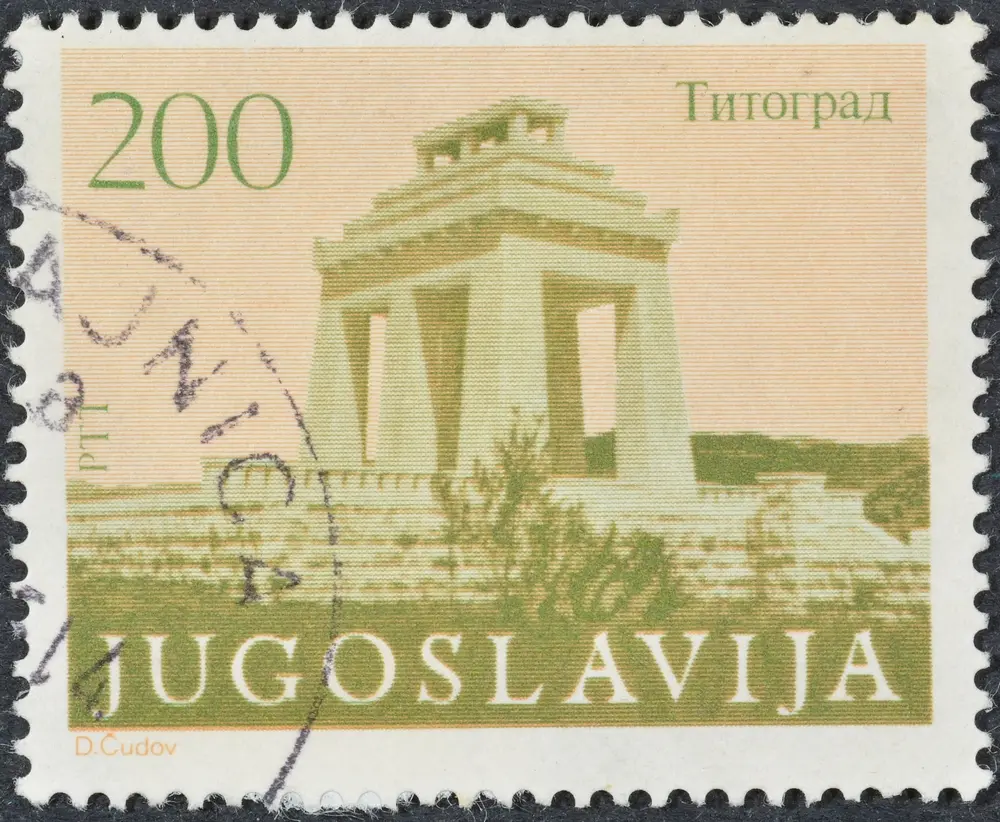
Yugoslavia 1983 stamp © ilapinto/Shutterstock
Yugoslavia 1983 stamp © ilapinto/Shutterstock
Like (almost) all former members of the Socialist Federal Republic of Yugoslavia (SFRY), Montenegro was also sucked into the violent disintegration of Tito’s unification experiment in 1991. Unlike the others, however, it remained at the side of Serbia’s Slobodan Milošević, the master puppeteer to whom the post-communist leadership in Titograd (now Podgorica) owes its rise to power (see the first part).
While Montenegrin involvement in conflicts with other secessionist republics remained limited, over 7,000 soldiers — members of the Yugoslav Federal Army (JNA) — were deployed on the Croatian front, in the Dubrovnik and Konavle sectors (in the southernmost part of Dalmatia) between September 1991 and October 1992. Relentless Serbian-Montenegrin war propaganda mobilized public opinion by exploiting the atrocities committed during World War II by the Ustaša regime, Croatian ultranationalists allied with the Nazi-Fascist occupiers. The siege of Dubrovnik, the “Pearl of the Adriatic,” lasted from October 1991 to May 1992. Until August, the Morinj prison camp (on the Bay of Kotor) operated in Montenegro, where approximately 300 Croatian prisoners of war, both military and civilian, were interned.
Podgorica’s official apology for the attack came in June 2000, while a commemorative plaque was unveiled in Morinj in October 2022. The text sparked controversy because it placed responsibility for the attack on Serbia, downplaying Montenegro’s role. Beyond the (few) symbolic gestures, however, Montenegro does not appear to have truly come to terms with its past.
The difficult path to transitional justice
Eight trials related to the wars of the 1990s have been held in Montenegro, Bojana Malović, coordinator of the transitional justice program at Human Rights Action (HRA), explained to OBCT. Of these, only one concerns the Dubrovnik campaign, and in April 2014, it led to final convictions against four former Morinj guards for the inhuman and degrading treatment of detainees (two of whom died in custody, officially by suicide). “But these are individual charges, and indeed minor ones, against low-ranking military personnel,” Malović clarified, emphasizing that “the systemic nature of torture, nor the shared responsibility of the chain of command, has never been recognized.”
According to the NGO, numerous critical issues in the war crimes proceedings conducted between 2009 and 2015 — the courts’ “passive” approach, inconsistencies in sentences, and the inadequate application of international law — betray the prosecutors’ complicity with political power. Since 1990, the government had been in the hands of the Democratic Party of Socialists (DPS), which promoted a self-exculpatory narrative that denied holding Montenegro criminally responsible.
In February 2025, the Special State Prosecutor’s Office reopened four war crimes cases, including that of Morinj, to examine new evidence from the Residual Mechanism of the International Criminal Tribunal for the former Yugoslavia (ICTY), based in The Hague. Since June 2024, another investigation has been underway into alleged torture of civilians committed in Konavle in 1991-1992 by Milivoje Katnić, then a member of the JNA and Montenegrin Chief Special Prosecutor from 2015 to 2022.
In a post-Yugoslav context, transitional justice clearly cannot stop at national borders. Yet, Malović notes, “over the last decade, Zagreb has drastically reduced judicial cooperation with all countries in the region, and it is very difficult to obtain any kind of information.” Regarding Dubrovnik, the legal advisor continues, “there has been an open case in Croatia since 2009 against Serbian and Montenegrin military personnel, but requests for transfer of the proceedings made by our Prosecutor’s Office have been repeatedly rejected.”
Incidentally, the Morinj case itself, held in Montenegro, had been transferred from Croatia. The latter is currently demanding new compensation from Podgorica for the families of detainees totaling €17 million (in addition to the more than €1.4 million already obtained), on legal grounds that Malović calls “questionable, to say the least.”
Another emblematic case concerns the crimes perpetrated by the Croatian army at the Lora prison camp, which operated between 1992 and 1997 in Split. After two final rulings, a third line of investigation focuses on the torture suffered by 14 Montenegrin reservists in 1992. The “Lora 3” case has been open since 2007, but was only revived at the end of 2024, thanks in part to the input of the HRA. The bilateral agreement on cooperation on war crimes (2006) applies exclusively to actions committed by Montenegrins against Croats on Croatian territory, Malović points out, thus excluding Lora from Podgorica’s jurisdiction.
The long shadow of historical revisionism
But post-war reconciliation does not just happen in the courtroom. A new wave of historical revisionism and manipulation sweeping across the region, blurring the distinctions between crimes, responsibilities, perpetrators, and victims, clearly demonstrates how the wounds of the 1990s — and even those of World War II — have not yet healed.
In Montenegro, this phenomenon became more visible with the end of the DPS era in 2020. Since then, the centrality assumed by political actors aligned with Serbian President Aleksandar Vučić and the Serbian Orthodox Church has given new life to a distorted rereading of national history, in a country where a third of the population identifies as ethnically Serb [2023 census data]. On the one hand, the (alleged) Serbian roots of Montenegrin identity are extolled, while on the other, the crimes committed by the Belgrade-Podgorica axis against Albanians, Kosovars, Bosniaks, and Croats are downplayed.
Anti-Croat sentiment has returned to the fore (including rhetoric blaming Zagreb for the collapse of Yugoslavia), prompting Malović to argue that “everything the DPS had swept under the carpet for years is coming to light” so as not to overly provoke its neighbor, especially after the latter’s accession to the EU. And now, instead, it is being wielded as a political weapon in an increasingly polarized social climate along these identity divides.
In Berane, a whole saga surrounds a statue erected to commemorate Pavle Đurišić, the infamous commander of the Chetniks (militias loyal to the Serbian crown operating in the first half of the twentieth century), as a “national hero.” He is even characterized as a “victim” and an “anti-fascist,” even though these groups allied themselves with the Nazis to fight the Partisans. The president of the Skupština (Montenegrin unicameral parliament), Andrija Mandić, himself claims the title of “Chetnik duke” (četničkih vojvoda).
From north to south, several pro-Serb mayors wave the Belgrade tricolor, question the Srebrenica genocide, refuse to recognize Kosovo, and name streets and swimming pools after the Dubrovnik attackers and the Morinj guards, while brazenly denying the truth of the trial.
Things are no better in Croatia. In recent years, the relativization — or even glorification — of the crimes perpetrated by Ustaša collaborators has become widely accepted, even among young people. The inclusion of the far right in the government two years ago marked the definitive normalization of nostalgic revisionism by the political mainstream.
In Split, since 2016, a sculpture commemorates the 72nd Military Police Battalion, which operated Lora. Last summer, a series of attacks against the Serbian minority forcefully brought back into the spotlight inter-ethnic tensions that had been thought to be dormant, sparking a broad civil society mobilization.
Recently, the Jasenovac concentration camp, run by the Ustaša from 1941 to 1945, has also returned to the forefront of controversy as one of the most fiercely politicized issues in the region. In a macabre tug-of-war, the number of victims has been manipulated in opposing directions since the 1980s. In June 2024, pro-Serb Montenegrin forces pushed Skupština to adopt a resolution on the Jasenovac “genocide,” to “balance” the 1995 UN resolution on the Srebrenica genocide, passed the previous month.
Montenegro’s European journey has thus also ended up caught in the crossfire of opposing nationalisms (and revisionisms). In December 2024, in reaction to the above, Zagreb prevented the closing of Chapter 31 in the Podgorica accession negotiations (Foreign and Security Policy), citing a series of “bilateral issues” that needed to be resolved. A phase of détente appears imminent, emphasis on “appears”. In this tormented corner of Europe, the present must still guard its back from the ghosts of the past.
Found an error in this article? Please contact our editorial team at redazione@balcanicaucaso.org.
Tag:
Featured articles
 Investigation
 students' protest
 Montenegro Pride 2026