Romania: “Real school reform begins in the classroom”
In recent years, the Romanian school system has changed, some say for the worse, others for the better. We spoke with Ivona Munteanu, a Romanian language and literature teacher and alumna of the Teach for Romania program, which trains teachers to work in challenging school environments
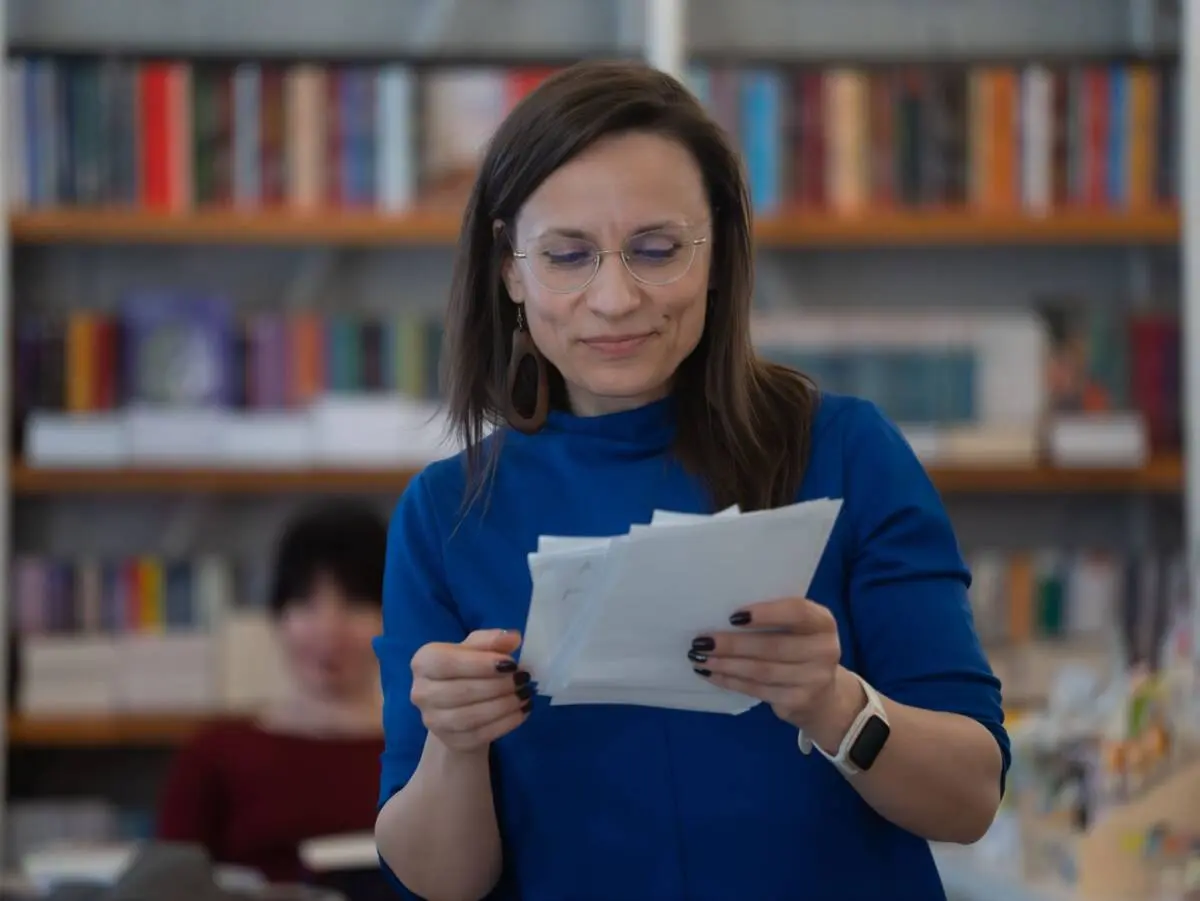
Ivona Munteanu © Maria Gorie
Ivona Munteanu © Maria Gorie
The Romanian school system follows a linear path: it begins in preschool, continues through primary and secondary school, up to high school or vocational training, after which, for those who wish, the doors of university open.
In recent years, the school calendar has changed. The old semesters have been replaced by five lesson modules, separated by vacation periods. The way students are assessed has also changed: while in elementary school, qualitative assessments are used, in secondary school grades range from 1 to 10. Two exams have a particularly significant impact on the academic career: the first, at the end of the eighth grade, is the so-called “national evaluation” (Capacitate), the results of which are crucial for admission to high school; the second is the Baccalaureate, the exam that completes high school and paves the way for university studies.
Overall, the system remains highly centralised: curricula and objectives are established at the national level. In classrooms, however, teachers and schools retain some freedom in choosing textbooks and teaching methods.
Now that schools are closed for the holidays and classrooms are empty, let us take a step back and look at Romanian schools from the outside: how effective is this model and what results does it produce?
We spoke with Ivona Munteanu, a Romanian language and literature teacher and alumna of the Teach for Romania program, which trains teachers to work in challenging school environments (areas characterised by high unemployment rates, a significant presence of minorities, poverty and low levels of education within the community). Ivona collaborates with the Association for Values in Education, where she teaches courses and designs teacher training programs, and with CSR Mindset, where she moderates reading clubs for students aged 9 to 13. She is involved in national literacy and teacher training programs and is passionate about learning and personal growth.
Let us start with one of the paradoxes of Romanian education. On the one hand, there are students who win Olympics and international competitions, and the so-called brain drain. On the other, functional illiteracy remains widespread. According to PISA data, approximately 42% of Romanian fifteen-year-olds do not reach the minimum reading proficiency level. How can such a wide gap between extraordinary results and a fragile educational foundation be explained?
I would say there are two main factors to consider: the students’ family background and classroom teaching methods. Those who grow up in a family capable of dedicating time, support, and resources start out with many more opportunities. Inequalities are evident between cities and countryside, but also between large urban centers and smaller communities.
Then there is the myth that Romanian schools “produce geniuses”. In reality, the system often tends to reward students who already have good abilities. A class only needs a few highly active students, those who constantly answer and raise their hands, to give the teacher the impression that everyone has understood. But those who lag behind need more attention. And here, the quality of teaching can really make a difference: not so much in highlighting those who would likely succeed anyway, but in engaging and encouraging those with challenging backgrounds. And this, unfortunately, does not happen often enough.
This work, however, requires considerable effort from teachers and is not always easy to sustain…
That is true. Working with struggling students requires a lot of commitment. A teacher must be curious, understand where the obstacles arise, adapt the curriculum and build learning stages appropriate for each student. The goal is not just to convey concepts, but to provide skills that students can then apply outside of school, in their everyday lives.
Speaking of practical skills, the Romanian school system has long been considered too theoretical and lacking in practical application. Is this still the case?
It is the age-old clash between theory and practice, and it is not unique to Romania. The Romanian system often continues to prioritise theory over teaching activities and practical skills, even though, at least on paper, the balance is shifting toward a more practical approach. I believe, however, that critical thinking cannot develop in a vacuum: it requires a cultural foundation.
Communication is made up of symbols, references and shared knowledge. Without theory and general knowledge, it becomes difficult to construct truly solid arguments. Therefore, a balance is needed: it is not easy to achieve, but it is not impossible either.
However, the education system has changed in recent years. Various reforms have taken place, alternative textbooks have been introduced and initiatives like “Different Week” have been launched, dedicated to educational activities outside of regular teaching. What is still not working?
On paper, many of these changes are useful and necessary. The problem is that laws change, new rules are being introduced in schools and teachers are asked to work differently, but often there is no training mechanism capable of effectively supporting them.
School is a rather rigid structure. There are teachers who have been teaching for thirty or forty years, and a new law alone is not enough to change their way of working. Take, for example, the transition from objective-based to competency-based teaching: how can someone who, until the previous year, worked under a completely different system, make this transition?
Schedules are compiled, required skills are included in documents, but that does not mean they are actually developed in the classroom. Often, teachers continue to do what they have always done.
I host online meetings for teachers and often see participants with their cameras turned off, attending primarily to obtain their final certificate. They are interested in certificates, not necessarily in new knowledge. Thus, reforms risk remaining on paper, or being implemented haphazardly and incompletely. Teachers cannot achieve results without genuine commitment and investment in their professional development, even going beyond what the state can offer.
So is this primarily a teacher issue? Are not salaries also a problem? In the early 2000s, choosing to teach without being able to rely on other financial support was almost unthinkable for a literature graduate. Is this perhaps the reason for the lack of motivation and, consequently, quality?
Compared to ten years ago, the situation has improved. Back then, teachers’ starting salaries were around 200 euros. Today, they increase with experience and the attainment of various teaching qualifications. In Bucharest, however, they remain low compared to the cost of living. In rural areas, where professional opportunities are more limited, teaching may seem a more attractive option. This does not necessarily mean that teachers motivated to introduce innovation are moving to remote areas. Often, these are people who want to stay in their area or who cannot find, or do not desire, career prospects in the cities.
Educational difficulties, however, vary significantly between urban and rural environments…
Certainly. Children grow up in very different contexts. In the countryside, they spend more time outdoors, play in nature, and develop a more direct connection with their bodies and the environment. This is something that many city children have partially lost.
On the other hand, in rural areas, children often start working very early, have fewer resources and are less exposed to a rich and diverse language. Schools must therefore also try to compensate for these cultural and cognitive differences. Even in the countryside, digitalisation is slow to arrive, and many children continue to be asked at home: “What do you need school for?”.
There are several non-governmental organisations committed to bridging the gap between large cities, small towns and the countryside. They organise educational camps, meetings with professionals and opportunities where young people can learn about different experiences and lifestyles.
To understand how important this can be, just look at the class I coordinated last year. Of all the students’ families, only one had completed high school and earned a high school diploma. We involved the students in volunteer projects and social initiative fairs, assigning them concrete tasks. At the end of the year, the baccalaureate pass rate was 92%, and many students took the entrance exam to public universities. I connected them with people who could concretely explain the university programs they desired. Many were Roma students and chose majors like Social Sciences or Political Sciences, aware of the need to contribute to change in their communities. When we asked what had really made a difference, they cited volunteering above all else. It had pushed them beyond their limits, given them a voice and helped them understand what they truly wanted.
As I was saying, a teacher’s greatest satisfaction comes not when students who have always done well achieve good results, but when those from whom no one expected success succeed.
Yet we still hear the famous saying: “It was better before”…
Yes, we hear it often. Some parents complain that teachers are no longer authoritative enough. “Teacher, I give you permission to scold him, even to touch him”, some say. Others, however, worry that their children have too much to do, forgetting that effort and facing difficulties are part of the learning process.
Even in public discourse, teachers are increasingly underrated. While they were once considered part of the cultural elite, today they are often portrayed as frustrated people who have not known how to do anything else in life. Success is associated primarily with high-profile corporate careers.
Thus, parents and teachers end up opposing each other, each locked in their own bubble. Instead, we should all sit down at the same table and, with a little goodwill, reflect on how difficult it is to engage twenty or thirty students for an entire hour. And on how different and important it is to teach not only those who learn easily, but especially those who need greater attention and support. I am not sure, however, whether this understanding is still possible. It seems to me that we are increasingly prisoners of our own beliefs.
Found an error in this article? Please contact our editorial team at redazione@balcanicaucaso.org.
Tag: Education
Featured articles
 Investigation
 students' protest
 Montenegro Pride 2026