Exiles from Vučić’s Serbia: journalists and activists are wondering whether to return
Victims of threats, defamation and persecution: in previous years, several journalists, activists and students were forced to leave Serbia. After the victory of the Student List in the elections on 25 October, they are wondering if it is worth coming back
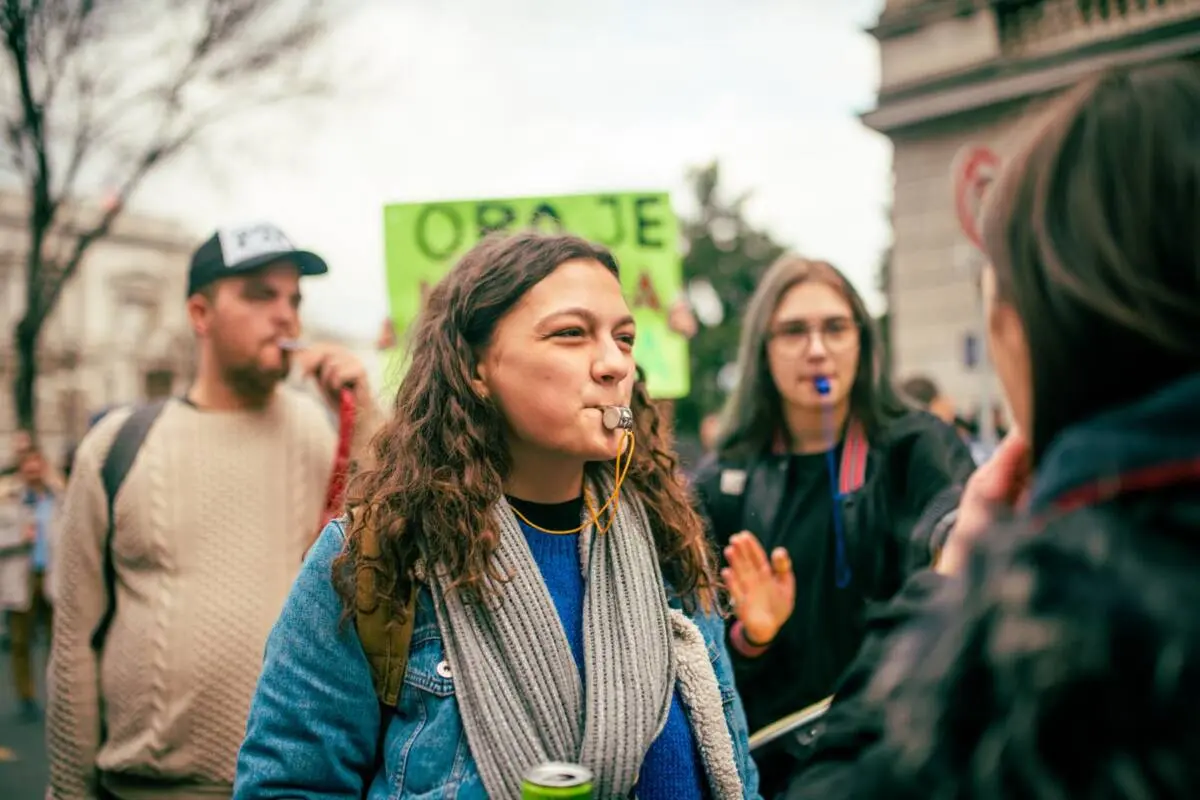
Mila Pajić. Foto: private archive
Mila Pajić. Foto: private archive
On 10 March 2024, the mother of journalist Ana Lalić from Novi Sad saw her daughter’s photo on the covers of pro-government tabloids. The photo was accompanied by accusations leveled at Ana, labeled a criminal and a foreign mercenary. The journalist was more worried about her mother than about herself, and she tried to reassure her. It was also difficult for Ana to look at her husband who, as the journalist explains, felt powerless because he could not help her or protect her.
“My life simply shrank there [in Serbia], in every sense”, says Ana.
Forced to leave Serbia
While working as a journalist for the Nova.rs portal, Ana was arrested in April 2020. She was attacked by the authorities and pro-government media after publishing an article about the lack of protective equipment and poor working conditions at the Clinical Center of Vojvodina in Novi Sad during the Covid-19 pandemic.
After receiving numerous online threats and having her phone number publicly released, Ana temporarily stayed abroad several times before deciding to leave Serbia permanently with her husband. An incident – as she explains – in which their car was chased through the streets of Novi Sad was the final straw.
“They even caused a car accident trying to catch us at the traffic light. Luckily, my husband realised that they were following us. That was when we decided that we just had enough and would leave Serbia permanently”.
Authoritarian turn of the government and the exodus of activists and journalists
The regime of Aleksandar Vučić, the former president of Serbia, exercised strict control over the media for almost fifteen years, discrediting dissenters through smear campaigns in pro-government tabloids. The situation worsened drastically after the fall of a canopy in Novi Sad on 1 November 2024, followed by mass protests. During the demonstrations, the pressure on students, activists and journalists intensified further.
In its 2025 report on Serbia, the European Commission highlighted the serious deterioration of media conditions in the country, while Human Rights Watch, in its reports, described in detail police violence, arbitrary arrests and attacks on journalists and demonstrators.
Given these circumstances, in the last year and a half several journalists, activists and students have been forced to leave Serbia or stay abroad due to threats and the risk of arrest.
From Novi Sad to Croatia
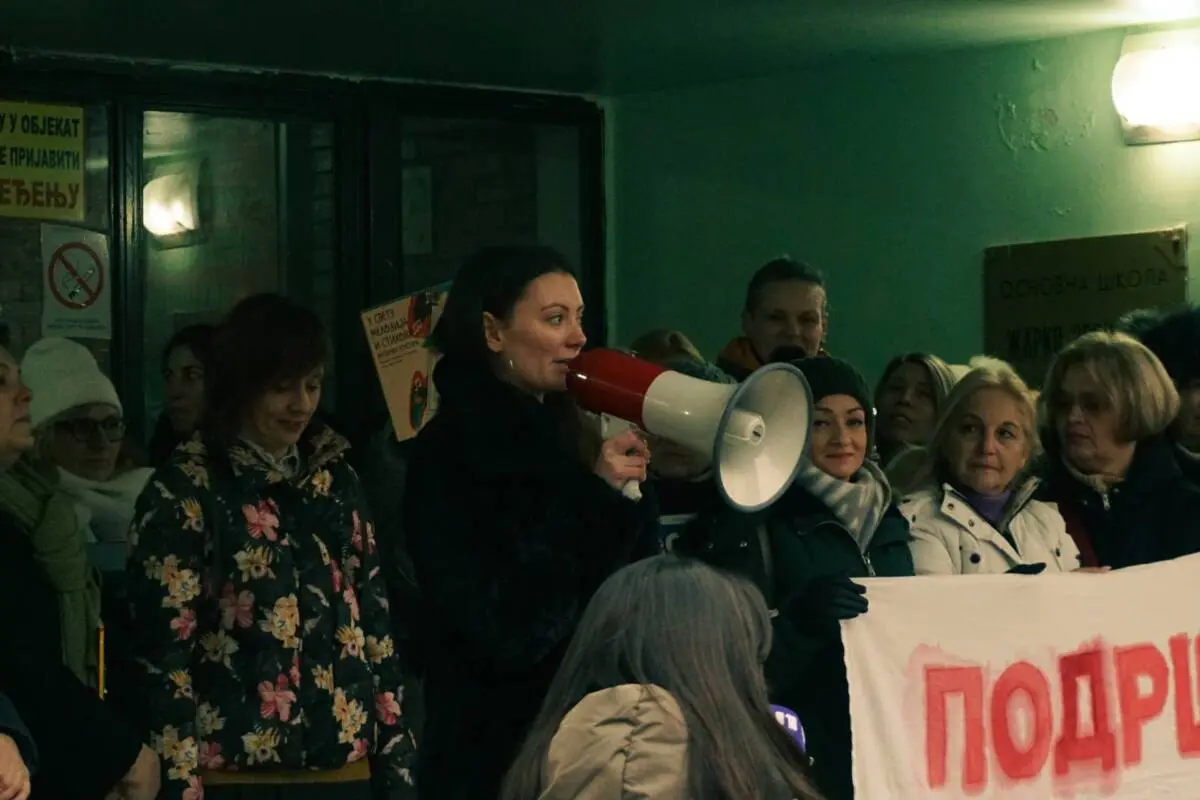
Doroteja Antić. Foto: private archive
“I did not choose Croatia. I was here and I stayed”, says Doroteja Antić, a student from Novi Sad and a member of the Students Against Authoritarian Power (STAV) group.
Doroteja and other students founded the STAV group in early 2024 with the aim of encouraging young people to vote. They protested against the influence of the ruling party on the university and defended professor and journalist Dinko Gruhonjić, who was exposed to threats and smear campaigns.
After the fall of the canopy of the Railway Station in Novi Sad, the STAV group helped organise the mobilisation. Agents of the Security and Information Agency (BIA), according to the testimony of Doroteja Antić, intercepted her while returning from work with her colleague, Mila Pajić, on 8 November 2024, and detained them for almost four hours. Doroteja says that they were “taken into custody, or rather, kidnapped”.
“Obviously, the only goal was to intimidate us and prevent us from participating in the protests”, says the student.
After their release, both joined the blockade of the Liberty Bridge in Novi Sad.
In March 2025, while Doroteja was in Dubrovnik, pro-government television stations in Serbia broadcast a secretly recorded conversation held during a meeting in which the student participated with her colleagues. The next day, six of them were arrested, and proceedings were initiated against a total of twelve people, including Doroteja. They were accused of plotting to subvert the constitutional order. Faced with the risk of arrest, following the advice of her lawyer, Doroteja stayed in Croatia.
Pardoning the activists
On 27 September Aleksandar Vučić announced that he had pardoned twelve Novi Sad activists, including Doroteja Antić.
“I say ‘unfortunately’, because we are identified with serious criminals. For me, Vučić is not someone who has the right to restore our freedom, because we did not do anything wrong in the first place”, says Doroteja.
Mila Pajić, a student and STAV activist, accused in the same proceedings, describes life in exile as a parallel existence in two worlds.
“In the morning I am a normal student in some country, and in the afternoon I am accused of subverting the constitutional order”, says Mila.
She was forced to rebuild her life and continue her studies outside of Serbia, not knowing when she would be able to return to her city.
The High Court in Novi Sad suspended proceedings against twelve activists on 2 November 2026, after receiving a pardon notice, and the following day annulled the arrest and detention warrants against six activists currently abroad.
Outside Serbia since 2023
Threats and smear campaigns also marked the life of writer and journalist Marko Vidojković, co-author of the podcast “Dobar, loš, zao” [The Good, the Bad and the Ugly]. Marko and his wife left Serbia in February 2023, with the help of the International PEN Center.
After verbal attacks by state officials and pro-government media campaigns, Marko was exposed to death threats. Organisations dedicated to protecting journalists advised him not to leave his home.
“At one point, we practically did not go outside at all, because we had no alternative”, says Vidojković.
During 2025, he stopped traveling to Serbia following new warnings about security threats.
“My wife is with me all the time. She has also received threats. Like me, she takes antidepressants”, says Vidojković.
In the last two years, Marko has visited his mother only three times. “No one will ever be able to give me back those two years”.
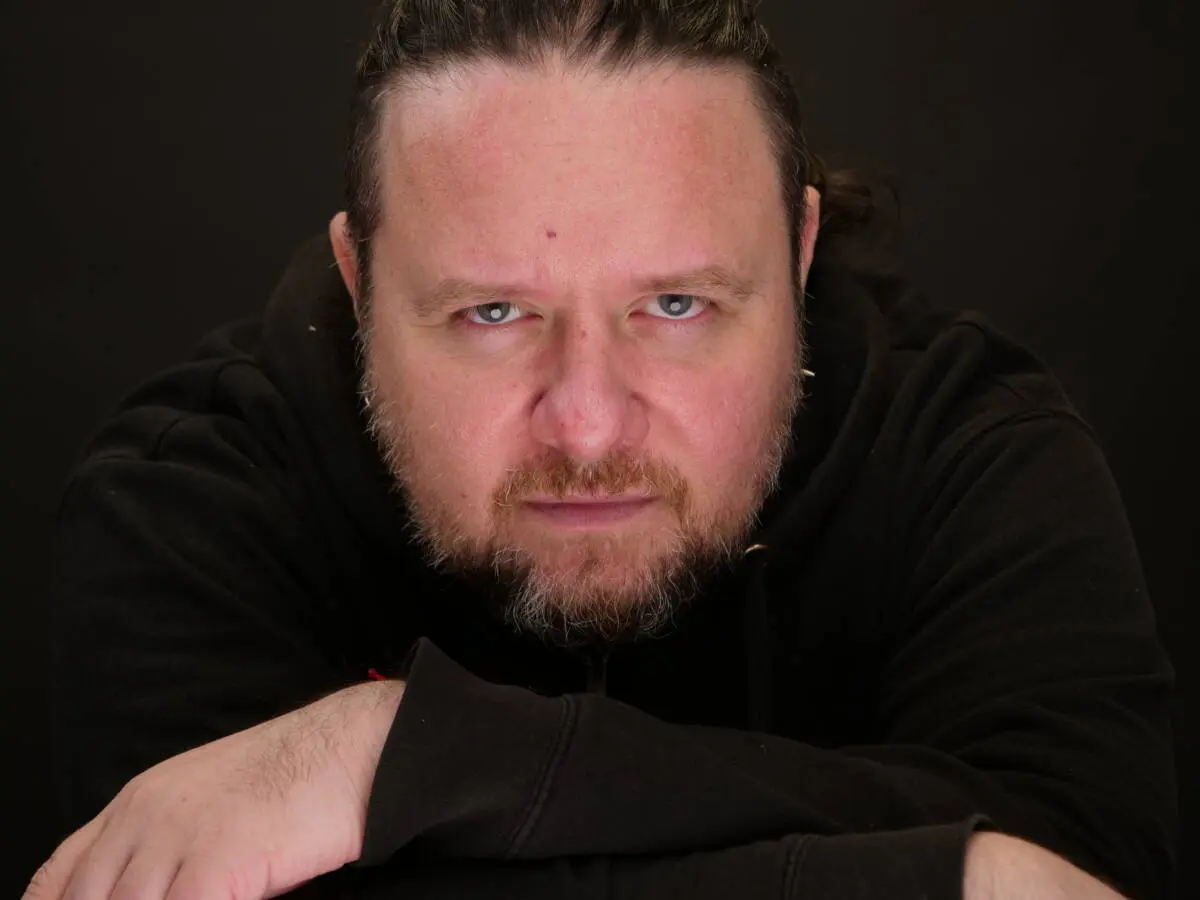
Marko Vidojković © Aleksandar Roknić
The media as a tool of the autocratic regime
Croatian journalist Maja Sever, the president of the European Federation of Journalists, has repeatedly condemned the persecution suffered by her Serbian colleagues.
“Some people’s lives have been destroyed even without physical violence”, says Sever.
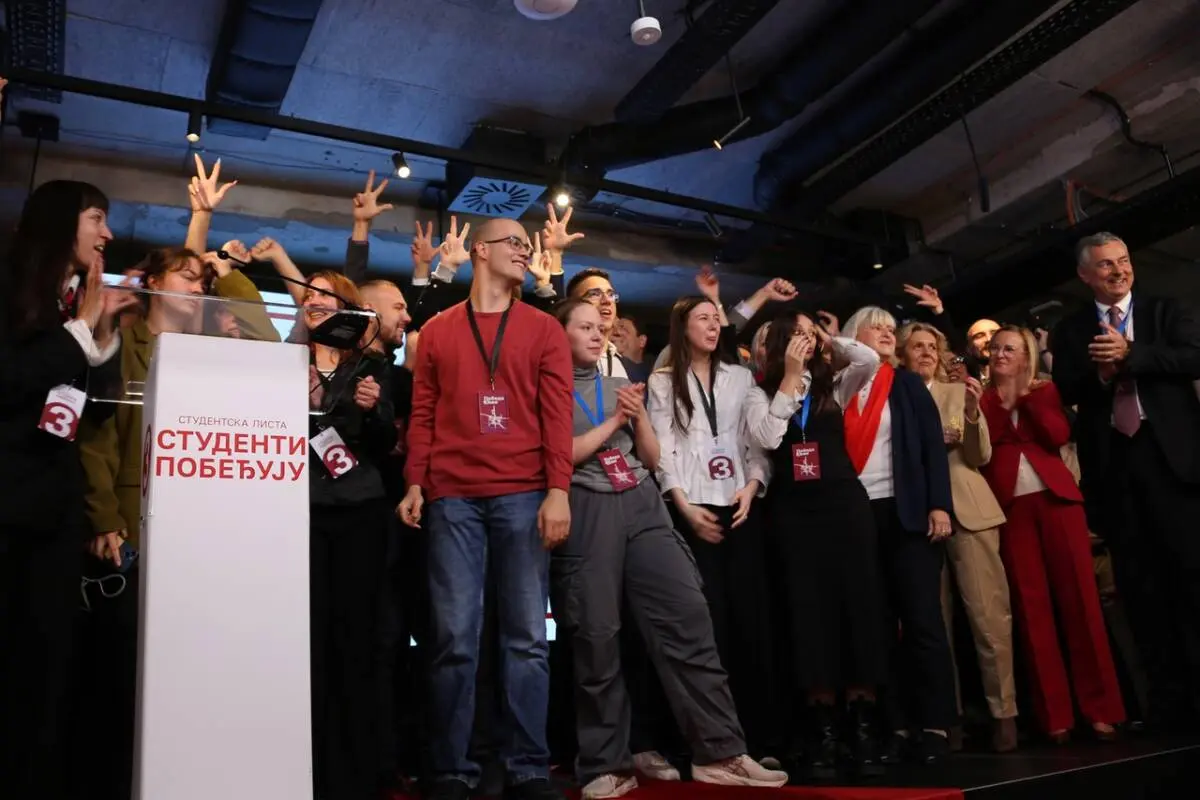
In the parliamentary elections on 25 October, the Student List defeated Vučić’s Serbian Progressive Party (SNS), winning a sufficient majority to form a new government on its own. The List brings together professors, experts and other candidates selected by students, who have led anti-corruption protests over the past two years. The government is expected to be formed shortly after the inauguration of parliament [scheduled for 17 November].
According to Maja Sever, the media system that was left behind by the previous government in Serbia is terrible, but expectations for change in the media landscape are now high and substantial reforms are expected.
As Sever points out, in addition to the tabloids, Radio Television of Serbia (RTS) also played a crucial role in spreading Vučić’s propaganda. The public service should be preserved and strengthened as the backbone of the media system, but it must be thoroughly reformed, professionalised and freed from political control.
“Replacing management is not enough to trigger change”, warns Sever. “I believe the right path is a systemic approach to solving the problem, in accordance with the law and with the support of experts”.
It is necessary to enable professional journalists to work, protect them from pressure and ensure that public money is allocated according to professional criteria. For that, real political will is necessary. Laws and strategies, as Sever explains, will remain only on paper if the government has no intention of implementing them.
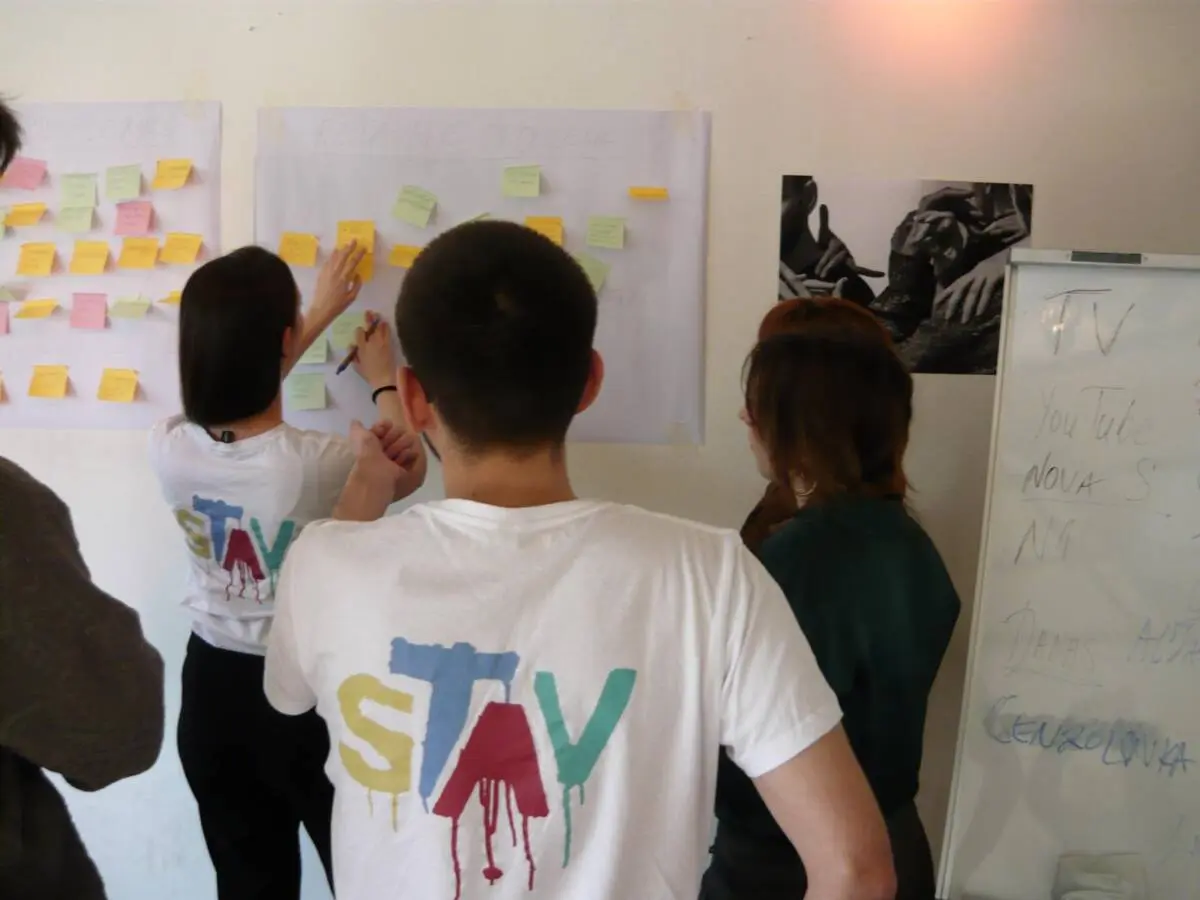
Activists of STAV. Foto: private archive
“Citizens paid for Vučić’s propaganda”
Stevan Dojčinović, editor-in-chief of the investigative journalism portal KRIK, was also the target of smear campaigns and attacks by pro-government media. KRIK’s editorial staff has been uncovering corruption scandals and documenting the connections of the top authorities with organised crime in Serbia for years.
As Dojčinović explains, Vučić always used the pro-government media to attack the opposition, and at one point his main opponents became independent journalists. While on the one hand the opposition was weakened and torn apart by internal conflicts, on the other journalists continued to investigate the government’s actions. When they became “enemy number one”, retaliation began through pro-government media campaigns.
The goal of those campaigns, according to Dojčinović, was to discredit all critical voices against the government and to dissuade undecided citizens from participating in politics and voting in elections.
Behind the propaganda – adds the journalist – were also corrupt practices. Pro-government media received public funds for projects that never materialised, and state-owned companies paid them for unnecessary advertisements.
“Essentially, citizens paid for Vučić’s propaganda”, says Dojčinović.
According to the journalist, the new government will have to investigate possible abuses and build a transparent system where media funding will not depend on political loyalty.
A particular challenge for the new government will be the ability to reject deals with Vučić’s media, which are now offering support to the winners of the last elections.
“I hope that this time the government will finally say no to those people”, says Dojčinović.
The government has changed, the scars remain
Our interlocutors’ answers to the question of a possible return to Serbia are not simple, because their decisions are influenced both by the consequences of the persecution they suffered and the lives they have built in the meantime outside of Serbia.
Vidojković came to Belgrade with his wife the day after the election victory of the Student List. For now, he plans to live between Slovenia and Serbia. They have commitments in Slovenia, and their apartment in Belgrade needs to be made home again after a long absence. The ability to decide according to their own needs is a “sweet suffering” for him compared to previous years.
Doroteja Antić wants to visit family and friends, but she does not plan to return to live in Serbia. She has already built a new life in Croatia and believes that the change of government did not lead to a change in the social climate in which she felt threatened.
“I will gladly visit my loved ones, but I have no desire to build a life there, because no matter how great the change has happened, I believe the situation in Serbia will remain dire for a long time”, says Doroteja.
Mila Pajić has not made a final decision yet. She wants to come to Novi Sad first and see how she feels there. Her return also depends on her ability to contribute to society, despite the labels attributed to her during the repression campaign. After that experience, where her life plans were shattered overnight, she does not want to make new plans too quickly.
Ana Lalić is also cautious. She does not give up on Serbia and still believes that the country needs independent journalists, but she points out that she wants to live in an open, democratic and pro-European society. She will monitor how the situation unfolds before deciding whether to return.
“Actually, I think that I cannot contribute much more. Twenty-five years have been enough, now it is up to others to fight for a better Serbia”, concludes Ana Lalić.
The political success of the Student List will not be able to compensate for the years of fear, separation and lost time for the people who bore a large part of the burden of the struggle for change.
Despite the consequences, Mila Pajić and Doroteja Antić say that they would do the same thing again.
“It was definitely worth it, I would not change a thing, because every effort has borne and will continue to bear fruits”, concludes Doroteja.
Found an error in this article? Please contact our editorial team at redazione@balcanicaucaso.org.
 This article was produced as part of the Media Freedom Rapid Response (MFRR) project, a Europe-wide mechanism that tracks, monitors, and responds to violations of press and media freedom in EU member states and candidate countries
Featured articles
 the students' voices
 Investigation