Moldova: the economy question after the start of EU negotiations
In early June, Moldova, together with Ukraine, began accession negotiations with the EU. On that occasion, a conference on European investment in the country was held in Chișinău to try to answer the question: In what areas should the Moldovan economy—one of the poorest on the continent—specialize?
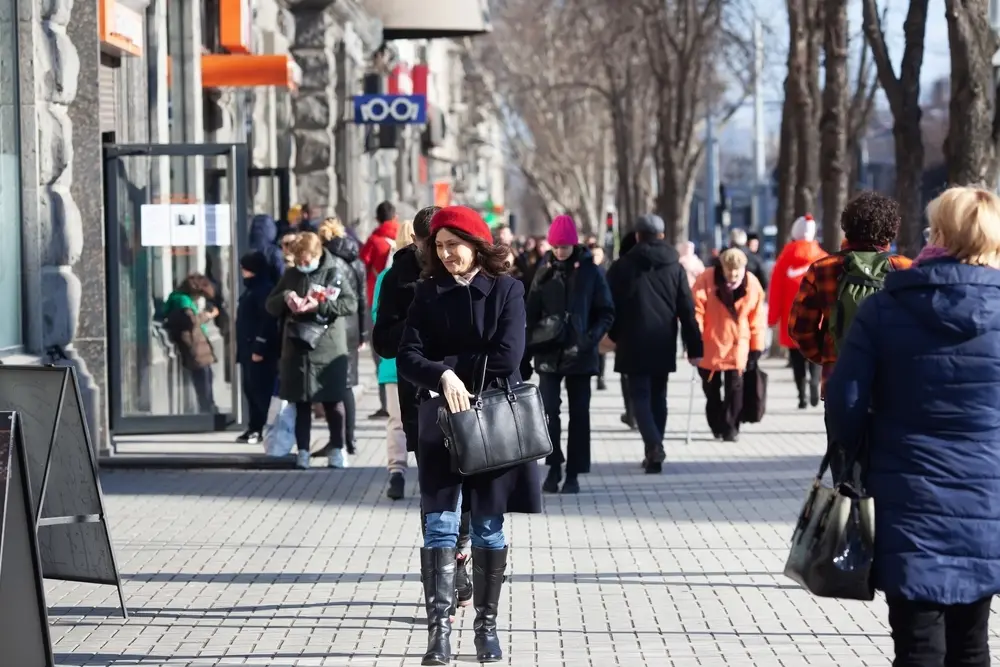
In Chișinău © snob / Shutterstock
In Chișinău © snob / Shutterstock
On the 3rd of June, Cyprus, as chair of the six-month presidency of the Council of the EU, announced the formal opening of cluster one in the accession negotiations of Ukraine and Moldova. This became possible because Hungarian and Ukrainian diplomats reached a deal on Hungarian minority rights after two years of impasse. The opening of Cluster 1, focused on the rule of law, democratic institutions, and fundamental rights, is the formal start of a process that could ultimately lead Ukraine and Moldova into the European Union.
The following day, on the 4th, the European Commissioner for Enlargement Marta Kos was in Chișinău for her three-day visit to the country. She opened the EU-Moldova Investment Conference by praising Moldova: “Now I will not say that you are the best student in the class. Moldova is a top performer [but still the best student in the class]. That’s why I am so happy about what happened last evening.” According to Kos, Moldova has in fact achieved a 93% implementation rate of the reforms tied to the European Commission’s 1.9 billion euros growth plan for Moldova. This has unlocked more than 641 million euros in investments.
Investments in what?
Out of these 641 million, 433 million euros are a combination of EU grants, guarantees and loans coming from: the Agence Française de Développement to support investments in energy efficiency in public buildings and residential housing; the European Investment Bank to support the modernisation of school infrastructure across Moldova; the European Bank for Reconstruction and Development to strengthen digital infrastructure; the European Fund for Southeast Europe and the Green for Growth Fund to support access to finance for businesses and households. In other words, a large part of the funds consists of grants to modernise the country. Since coming to power, Sandu’s Party of Action and Solidarity has, in fact, been treating EU reforms as a fast track to modernise the country and boost economic development.
Yet, the pending question is: what should the Moldovan economy specialise in? The developing Moldovan economy is heavily reliant on agriculture and remittances from workers, who now mostly live in EU countries. The population living within the country’s borders is rapidly aging, and by 2060, it is expected to further decrease by 29%. President Sandu and Commissioner Kos both mentioned “agri-food and food processing, manufacturing and light industry, renewables, ICT and digital services, as well as tourism and transport logistics” as areas where the country has “real competitive advantage”. In other words, they both focused on wine production and IT services, sectors the country has focused on for years already. Yet, it is debatable whether these alone could power the economy or convince Moldovans to move back and start enterprises in their home country.
The remaining 208 million euros of investments from the private sector seem to reinforce this line of reasoning. The ten investors celebrated at the Investment Conference will be: INVL, who will support private equity investment; TET that will develop an AI-ready data centre; Danube Logistics that will enhance transport connectivity with Ukraine and the EU; Micro Nano Tech who will focus on high-tech innovation; KB Container that will strengthen Moldova’s manufacturing potential for the EU market and Ukraine’s reconstruction needs; BOSAQ who will develop modern water infrastructure for citizens and the agricultural sector; finally, VED-MAR AGRO that will support higher-value agri-food exports. This list seems to reinforce the narrative of a peripheral economy where investments are either meant to create data centres, poor in workforce, or hubs to rebuild Ukraine.
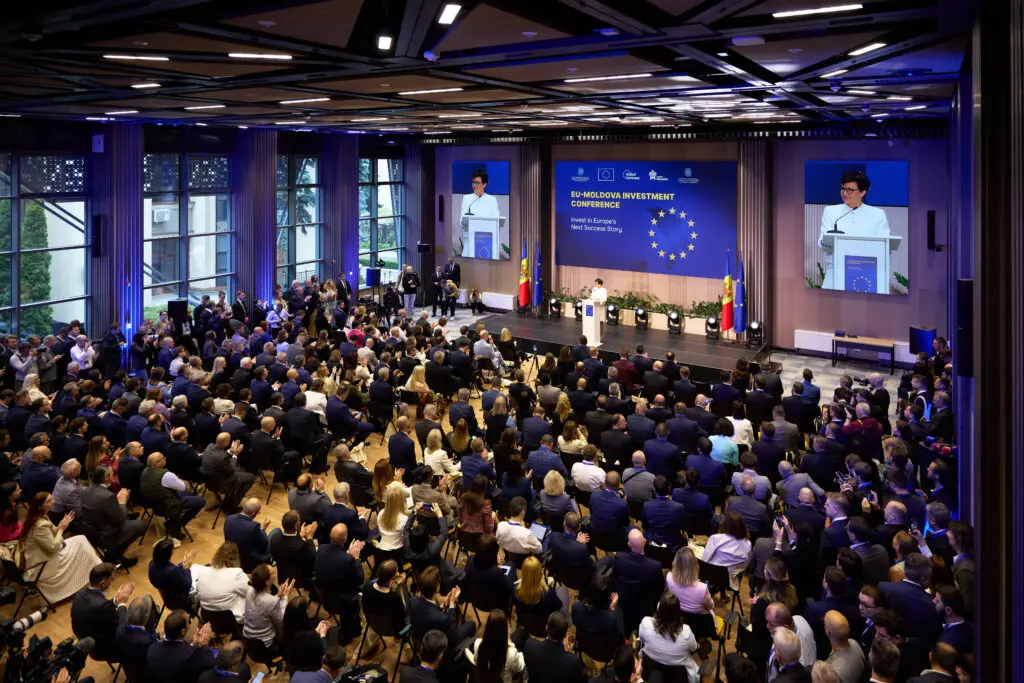
EU-Moldova Investment Conference © Ion Ples Alexandru / UE
What does Moldova need?
Except for Kosovo and Ukraine after 2022, Moldova is Europe’s poorest country. According to the World Bank, in 2023, the Moldovan adjusted GDP per capita had climbed back to the 1990 levels, the year before its independence. After decades of political instability, readaptation, and reorientation of its market toward the EU, the country’s GDP per capita only crossed the $16,000 threshold in 2024. Yet, this is not the feeling one has walking through the streets of Chișinău, which looks like a relatively wealthy Eastern European capital.
This is explained by the fact that consumption levels within the country, particularly in the capital, are comparable to those of most European cities. This is an effect of remittances of Moldovan workers in the EU. We are talking about more than 1 million people who left the country, while still being relevant during key elections. The trend does not seem to stop: in the early 2020s, around 50,000 people left the country each year. In 2024, remittances were estimated as $1.5 billion, or about one-seventh, of the national GDP. Yet, emigration, not counteracted by proportionate immigration, creates labour shortages across several economic sectors.
To this, one should add that Moldova’s informal economy in 2019 was equivalent to a quarter of its GDP. International creditors include the IMF, the World Bank, and the European Union. The IMF evaluates the country’s economic situation barely within acceptable thresholds of external financing. Just in May, commenting on the latest IMF loan, the leader of the Party of Moldovan Socialists, Igor Dodon, argued that continuous borrowing will induce “a major economic crisis”. While Dodon is neither an impartial nor a credible critic, he has a point when addressing the fragile state of the country’s economy.
However, there seems not to be an alternative to the path traced by the EU. According to the Economics Observatory, the recipe for Moldovan economic success is: focus its exports of electronics, pharmaceuticals and the creative industries; improve its tourism and food processing sectors; continue to receive international loans while conditioning the EU-imposed reform agenda; increase its access to the EU single market. In other words, while one can be critical of the brotherly imbued rhetoric of Marta Kos’ visit to the country, Moldova can only hope to keep dancing its way into EU accession one hora at a time.
This article is part of the PULSE Europe collaborative project and was produced following a press trip to Chișinău organised by the EUNEIGHBOURS EAST programme, funded by the European Union.
Found an error in this article? Please contact our editorial team at redazione@balcanicaucaso.org.

This article was produced in collaboration with the Hungarina web portal EUrologus as part of PULSE, a European initiative coordinated by OBCT that supports transnational journalistic collaborations.
Featured articles
 Montenegro Pride 2026
 Political deadlock