Bulgaria: presidential elections in the shadow of war
Bulgaria goes to the polls for the first round of its presidential election on Sunday, October 25. Interim President Iliyana Yotova, backed by Progressive Bulgaria, is the clear frontrunner. Her main challenger is former caretaker prime minister Andrey Gyurov. The Russian invasion of Ukraine and the widening conflict in the Black Sea are at the heart of the campaign
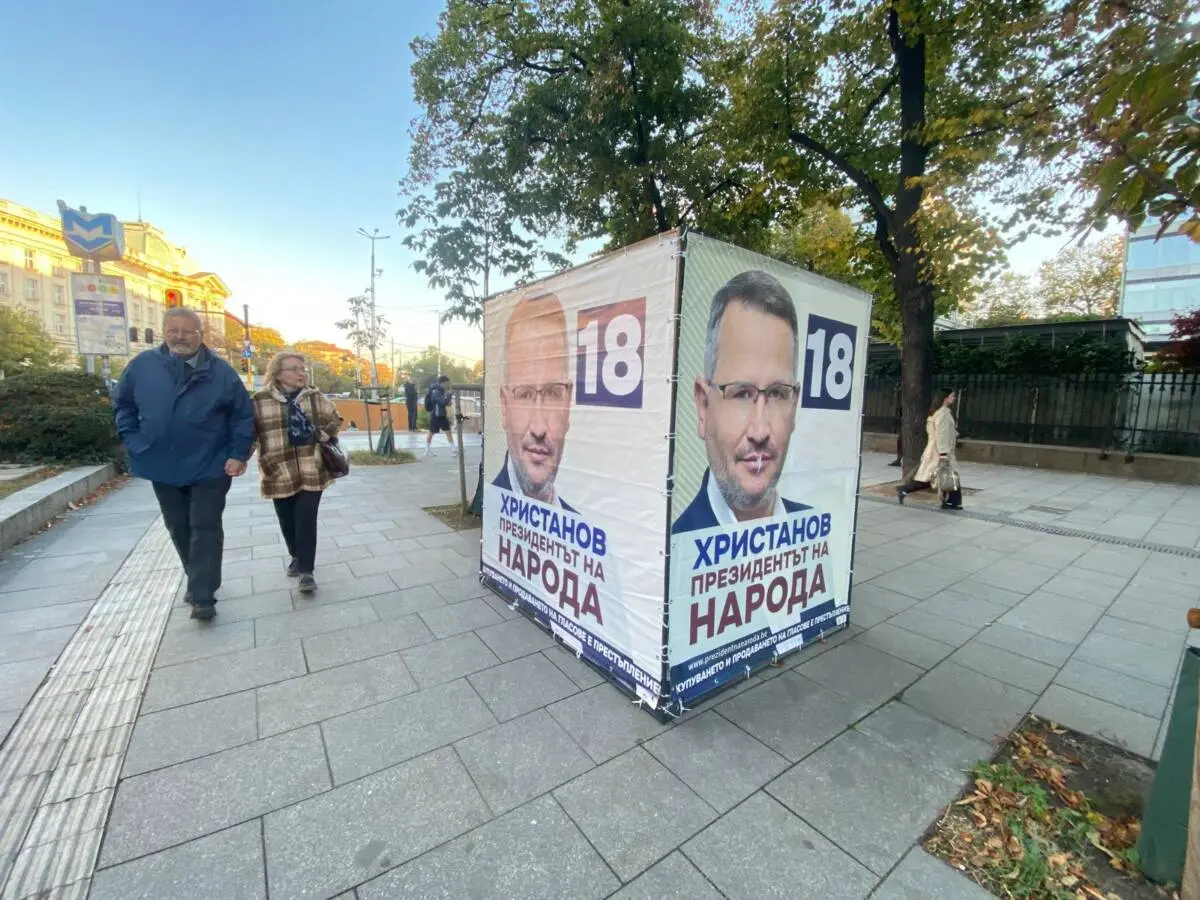
Election posters in Sofia – photo by F. Martino/OBCT
Election posters in Sofia - photo by F. Martino/OBCT
War clouds over the Black Sea, ideological divisions between Russia and the West, and the electoral prospects of Progressive Bulgaria — the party that swept last April’s parliamentary election, bringing an end to years of political instability — are set to shape Bulgaria’s presidential election on Sunday, October 25.
Two candidates stand a realistic chance of winning. One is interim President Iliyana Yotova, who previously served as vice president under Rumen Radev, the current prime minister and leader of Progressive Bulgaria, during his two terms as head of state. The other is economist Andrey Gyurov, a former caretaker prime minister who led the country in the early months of 2026.
Both candidates are running as independents. Yotova, however, has received the official backing of Progressive Bulgaria, while Gyurov is supported by the reformist movement We Continue the Change.
The campaign opened with spectacular ceremonies marking the return to Sofia of the remains of the medieval Bulgarian tsar Samuel. Since then, polls have consistently shown Yotova with a commanding lead over her rivals. Support for the interim president has stood at around 45% in recent weeks.
Gyurov is widely expected to finish second, with polling agencies putting him at close to 25%. The remaining candidates trail well behind, including Konstadin Konstadinov, the nationalist candidate from Revival, whose support is struggling to reach 10%.
Yotova’s victory in the first round appears all but assured. The key question is whether she can secure an outright majority, with the polls putting her only a few percentage points short of the 50% threshold. If Gyurov manages to force a runoff, he would still face an uphill battle, but could attempt to overturn a result that currently looks all but decided.
An election in the shadow of war
In Bulgaria, the president’s role is largely ceremonial. Yet, during the prolonged periods of political instability the country has experienced in recent years, the office has often taken on a central role in navigating its most delicate political crises.
Given the nature of the office, presidential campaigns tend to focus less on concrete policy proposals – the preserve of the executive – and more on broader ideological questions and matters of principle.
Following recent attacks on Ukrainian-owned merchant ships off the Bulgarian coast, the campaign debate has centred on Russia’s invasion of Ukraine, the widening hostilities in the Black Sea, and Bulgaria’s position in an increasingly dangerous regional environment.
On one side is the approach championed by Radev and reflected in Yotova’s candidacy: Bulgaria should avoid taking sides and instead pursue a negotiated peace, which they argue would best serve the country’s strategic and economic interests.
“On Ukraine, we do not need a ‘coalition of the willing’, but a ‘coalition for peace’. I will work to ensure that Bulgaria has a strong voice in peace negotiations,” Yotova said during the campaign. She added: “As long as I am president, no Bulgarian soldier will set foot in Ukraine.”
Opposition figures, however, see the professed pacifism of the Radev-Yotova duo — which political scientist Daniel Smilov has described as “strategic indecision” — as little more than a clumsy attempt to curry favour with the Kremlin ahead of an anticipated Russian victory. They warn that this approach risks cementing Sofia’s reputation as an unreliable partner among EU countries and NATO allies, or even as a Russian “Trojan horse”.
Referring to Radev’s decision not to speak out clearly on who was behind the drone attacks that have struck four ships in Bulgarian exclusive economic zone waters in recent weeks, sinking two of them, Gyurov criticised interim President Yotova for her reluctance to take a clear position.
“The current presidency is not acting as a check on the executive, but merely echoing it,” the former prime minister said. “Her response [to the attacks] offers neither factual evidence nor assurances of concrete steps to improve the security of Bulgarian citizens.”
The West-Russia divide
The dispute over the new political majority’s geopolitical orientation and values has reopened the fault line between the West and Russia. This divide runs deep through Bulgarian society, cutting across political and social groups, and has shifted in prominence over the years. It is inevitably set to influence voters’ choices in the presidential election.
Public sentiment, and much of Radev’s actual policy record, point to a country firmly anchored in its Euro-Atlantic orientation. That commitment has been reinforced in recent years by Bulgaria’s accession to the Schengen Area and its adoption of the euro in early 2026.
Yet, mounting economic pressures in recent years – marked by a sharp rise in energy prices, after Russia had long served as Bulgaria’s main supplier, and surging overall inflation – combined with a war drawing ever closer to the country’s borders, have strengthened the case made by those who favour a diplomatic path out of the conflict and a resumption of some form of cooperation with Moscow.
Mobilising the electorate
Beyond the strategic and ideological debate, domestic political dynamics will also shape the outcome. GERB, the conservative party led by former prime minister Boyko Borisov, which dominated Bulgarian politics for at least a decade, has decided not to field its own candidate.
Borisov has said he will not vote for Yotova, while also expressing serious reservations about Gyurov. It therefore remains unclear how GERB voters will cast their ballots. Despite losing substantial support in recent years, the party remains Bulgaria’s second-largest political force, according to opinion polls.
The presidential election will serve as a barometer of support for the new government, just six months after Progressive Bulgaria’s electoral triumph.
For the movement, which emerged and grew around Radev but lacks a strong grassroots organisation, the election is a test of its ability to rally Yotova’s supporters and mobilise a weary electorate exhausted by a prolonged succession of snap elections.
According to the latest polling data, around 38% of voters say they are certain to turn out on election day.
Found an error in this article? Please contact our editorial team at redazione@balcanicaucaso.org.
Tag:
Featured articles
 Investigation
 students' protest
 Montenegro Pride 2026