Journalists’ safety at risk during protests in Tirana
Rubber bullets, pepper spray, tear gas, journalists pushed and obstructed by police, interrupted broadcasts and damaged equipment. The recent protests in Tirana have highlighted the risks faced by journalists in the field, but also the lack of preparation and the conditions needed to carry out their profession safely.
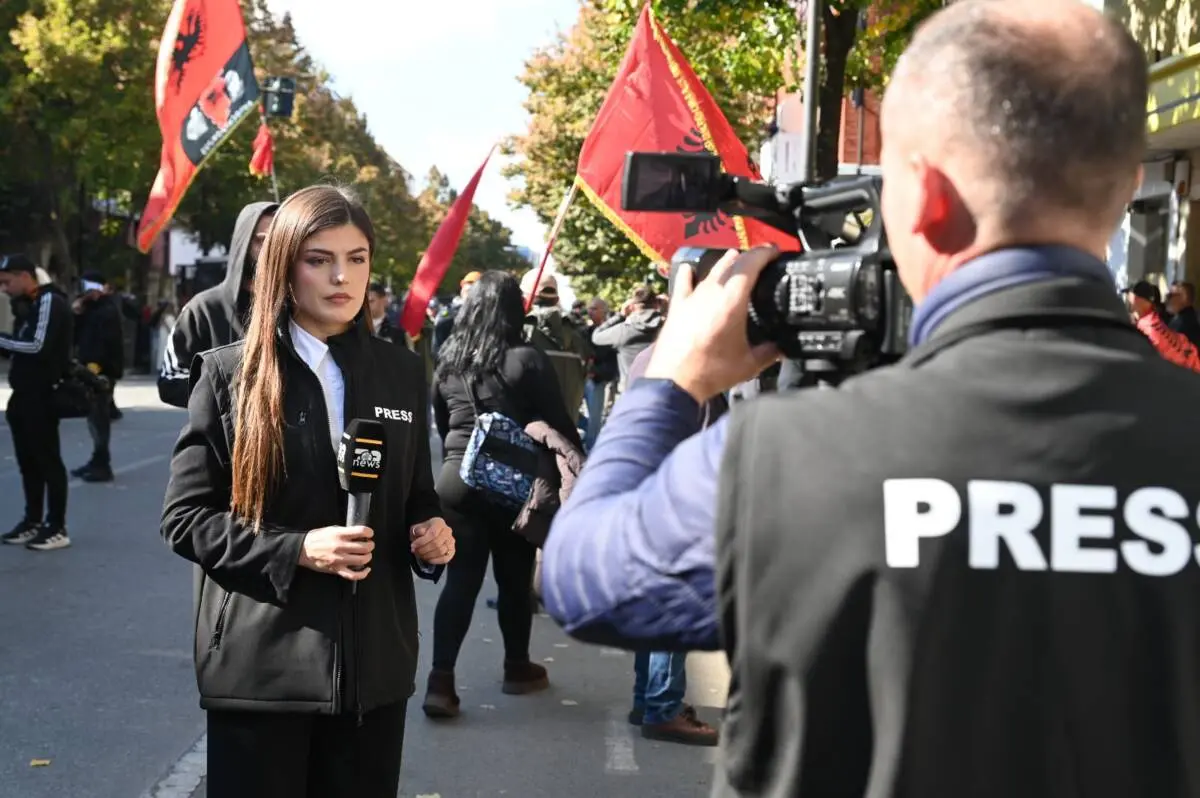
Journalist Kleida Mukaj from the Albanian TV channel Top News – (photo from private archive)
Journalist Kleida Mukaj from the Albanian TV channel Top News - (photo from private archive)
On 18 October, Citizens.al journalist Elira Kadriu was hit in the lower chest by a stone thrown towards police while covering student protests in front of the Ministry of Education. The impact caused kidney damage and internal bleeding, leaving her hospitalised for ten days.
“I had my gas mask and helmet, but the stone struck an unprotected part of my body. I was not wearing a protective vest,” Kadriu told OBCT.
Although her injury differed from cases involving direct police assaults, it highlighted the vulnerability of journalists in the field.
“It made me realise how fragile a journalist’s position is and how one incident can have long-term consequences for their health and ability to work,” she said.
55 incidents, 41 linked to police actions
According to the Association of Albanian Journalists (AGSH) and Safe Journalists, at least 55 incidents targeting media workers were documented between 13 and 31 October 2026. In 41 cases, the State Police were involved.
The incidents included physical violence, rubber bullets, pepper spray, obstruction, detentions, threats and equipment seizures. At least six journalists were hit by rubber bullets and eight exposed to irritant substances.
Renaldo Salianji, a “News 24” journalist, reports to OBCT five incidents involving assaults or obstruction. On 17 October, while questioning State Police Director General Skënder Hita about police violence and unidentified individuals operating alongside officers, he was pushed and physically removed.
“The scene happened in Hita’s presence, but he did not react,” Salianji recalls.
The following day, officers without identification numbers allegedly assaulted him while he was documenting the search of two teenagers. He also says tear gas was thrown near his broadcasting vehicle and a water cannon struck his camera twice.
“They damaged our equipment, assaulted us and prevented us from broadcasting,” he says.
Despite wearing a press badge and helmet marked PRESS, Salianji says police repeatedly obstructed his reporting.
Top News journalist Kleida Mukaj was hit with pepper spray after reporting live on clashes, despite wearing a press vest.
“It forced me to stop reporting and go to hospital. I had covered protesters exposed to pepper spray, but never imagined its consequences could be so serious,” she told OBCT.
She says she has repeatedly interrupted broadcasts to find safety amid tear gas, water and spray used by police and stones and fireworks thrown by protesters.
“Even with anti-gas masks, staying at the scene was sometimes impossible,” Mukaj says.
Reporters Without Borders (RSF) documented 28 cases of violence, intimidation or obstruction affecting at least 23 media professionals between 13 and 19 October. In at least ten cases, journalists faced physical force. RSF called on police to stop attacks and guarantee journalists’ right to document their actions.
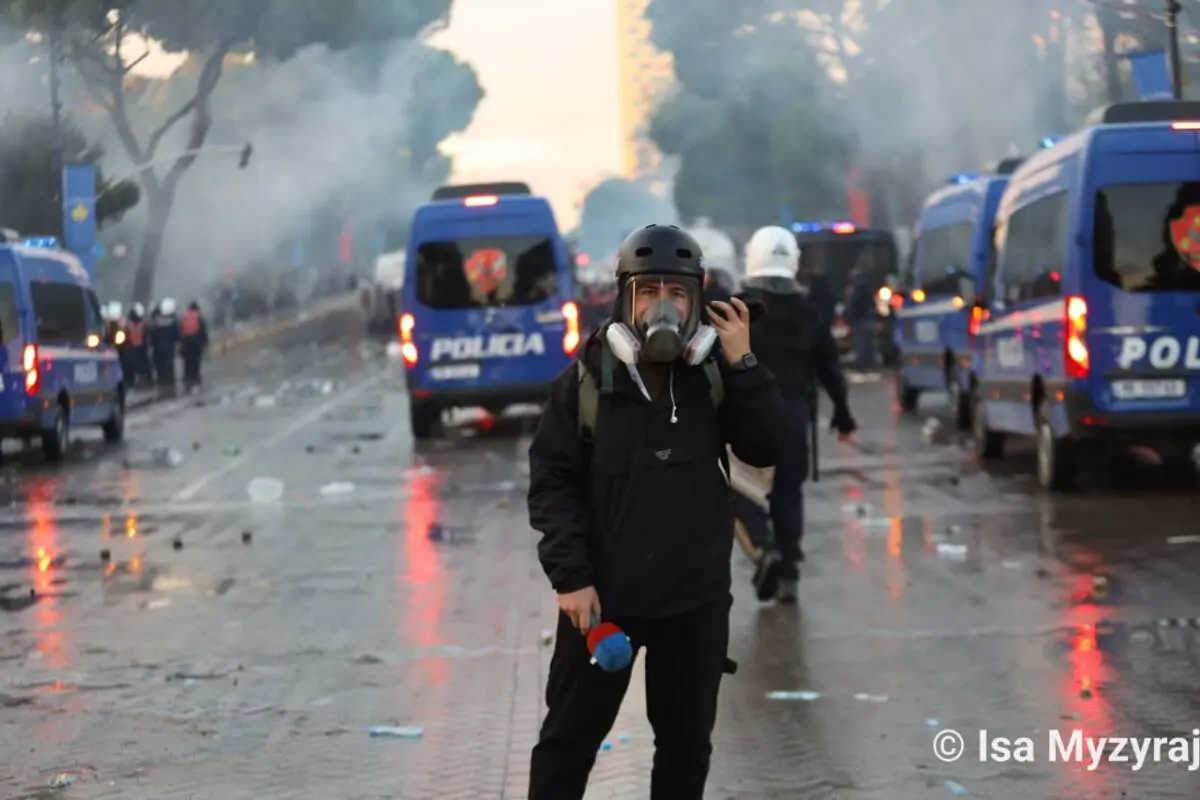
Journalist Renaldo Salianji of News 24 – photo © Isa Myzyraj
Without training or protection, facing police violence
Neither Salianji nor Mukaj has received specialised training for covering violent protests.
“I was not prepared for this kind of violence,” says Salianji.
Mukaj says she searched online for safety guidelines, but this was insufficient.
“You need more than the courage to go into the field; you also need to be prepared to return home safely,” she says.
According to AGSH head Isa Myzyraj, journalists lack systematic preparation, particularly in risk assessment, protective equipment, first aid and evacuation procedures.
However, he stresses that insufficient training cannot justify attacks. “Responsibility for the lawful and proportionate use of force remains with the relevant institutions,” he says.
For Salianji, obtaining protective equipment was a personal effort from the very first day.
“I had a gas mask from the first day. It is my own, which I bought during previous protests. On the second day, the newsroom brought us helmets.”
According to AGSH, many journalists lacked helmets, anti-gas masks and protective vests, particularly those working for smaller outlets, independently or as photojournalists.
“We cannot accept that a journalist is sent to cover a violent protest without protective equipment and that responsibility for their safety is left entirely to them,” Myzyraj argues.
Police accountability and the right to report
For Blerjana Bino, head of the Centre for Science and Innovation for Development (SCiDEV) and Safe Journalists representative in Albania, repeated incidents during the documentation of police interventions indicate a serious escalation.
“Journalists and camera operators have been hit, exposed to tear gas and rubber bullets, while some teams have been prevented from filming. In many cases, the danger has come from the very authorities responsible for protecting them,” Bino told OBCT.
She stresses that police must guarantee journalists’ safety and right to report, even when protests escalate.
“The public interest is particularly high when journalists document the use of force, detentions or possible abuses by authorities,” she says.
Although Albania adopted a police protocol on journalists’ safety in May 2025, repeated incidents raise questions about its implementation.
However, the gap between the protocol on paper and police conduct on the streets also points to shortcomings in its implementation, particularly in training and oversight. Bleriana Bino says that, although the State Police have formally introduced training on journalists’ safety through the Security Academy over the past two years, these efforts remain insufficient.
“They claim that last year they trained more than 120 new officers at the Security Academy. In addition, several others have attended events organised by SCiDEV, the Council of Europe and other organisations”, says Bino.
However, according to Blerjana Bino the topic currently accounts for only half a day in the broader police training curriculum and is not sufficiently institutionalized to ensure continuous training throughout officers’ careers. Bino argues that training should be expanded to regional police directorates across the country, with designated contact points beyond Tirana, and delivered in cooperation with media experts, journalists’ organizations and unions.
“This would allow police officers and journalists to better understand each other’s perspectives and build trust”, she says.
She also stresses the need for effective oversight and accountability mechanisms, warning against relying solely on self-regulatory approaches when violations occur.
“When police obstruct the documentation of their own actions, the possibility of verifying violations and demanding accountability is undermined,” Bino argues.
She calls for investigations by the Police Oversight Agency and Prosecution Office, as well as independent oversight by the Ombudsman and Parliament.
Journalists also need systematic training in risk assessment, safe positioning, first aid and protective equipment. However, Bino emphasises that preparation cannot replace the police’s obligation to avoid unjustified force.
She warns that violence can discourage journalists from filming police interventions, creating a chilling effect that limits public access to information.
AGSH has called for investigations, identification of those responsible and parliamentary hearings with the Interior Minister and State Police leadership.
The Director General of Police announced the suspension of seven officers for exceeding their powers during interventions against protesters. However, according to Myzyraj, it remains unclear whether these measures specifically concern attacks against journalists.
For more than five months, Tirana has witnessed continuous protests, beginning in May against the tourism project in Zvërnec and expanding to demands for political accountability, transparency and better living conditions. Recent clashes have involved tear gas and water cannons, while journalists continue reporting amid risks and obstacles to their work.
Found an error in this article? Please contact our editorial team at redazione@balcanicaucaso.org.
 This article was produced as part of the Media Freedom Rapid Response (MFRR) project, a Europe-wide mechanism that tracks, monitors, and responds to violations of press and media freedom in EU member states and candidate countries
Featured articles
 the students' voices
 Investigation