Boban Pesov: “Drawing cartoons is my way of rebellion”
Boban Pesov is an Italian cartoonist of Macedonian origin. Last year, he published his first graphic novel, “Once upon a time there was the East”, which tells three stories from Italy and North Macedonia. With this interview, we announce his new comic column on OBCT
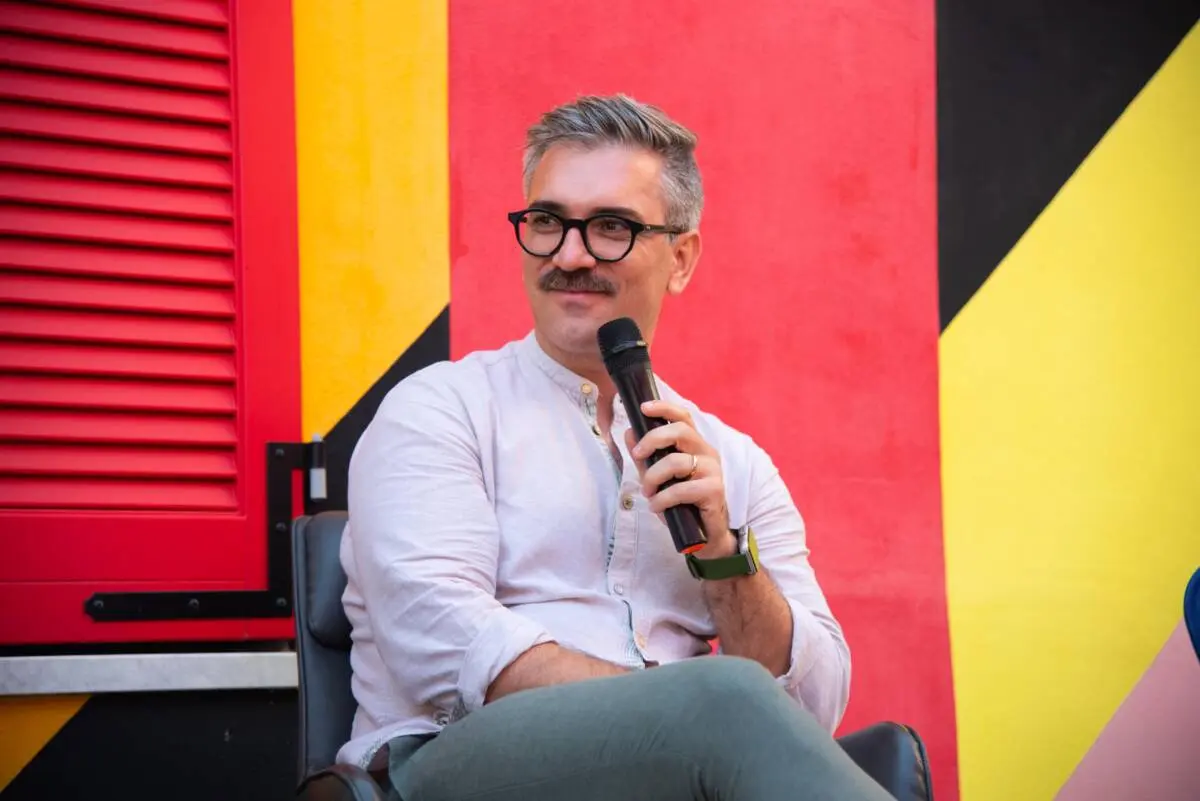
Cartoonist Boban Pesov, author of the graphic novel “Once upon a time there was the East”. Photo: private archive
Cartoonist Boban Pesov, author of the graphic novel “Once upon a time there was the East”. Photo: private archive
Let’s start from the beginning. How did you and your family come to Italy?
I was born in 1988, and I came to Italy in 1996, in Piedmont, near Alba. Since then I have lived in the Langhe area. I arrived with my mother, on a flight from Sofia to Milan. My father was already in Italy as an irregular immigrant, and when he received the documents, he applied for family reunification.
In fact, after our arrival, my mother had to return immediately, because while my brother and I were registered on my father’s residence permit, my mother was not, and she was expelled.
So we kids spent six or seven months alone with Dad. He had to work and help us with school, while Mom was in Macedonia trying to sort out bureaucratic problems so she could return.
You can imagine, at that time it was not common for a father to stay alone with his children, especially in Macedonia. But it was a nice period.
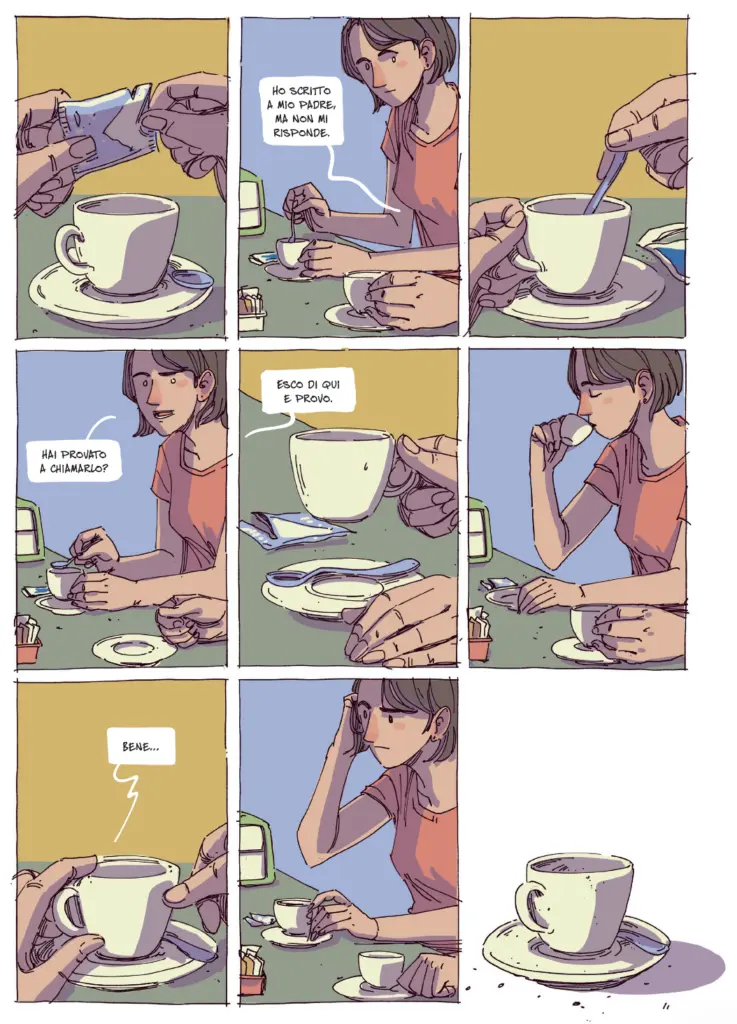
Page from the graphic novel “Once upon a time there was the East” © Boban Pesov
What kind of relationship did you maintain with North Macedonia?
Since we got the residence permit, we have returned to Macedonia every summer. We did not go only during the bombing of Belgrade.
We still return every year. My maternal grandmother is still alive, while my paternal grandparents died in the 1990s. My children speak Macedonian, along with Italian, and in the place where I was born I can let them move freely, as my brother and I did: they play with other children, get dirty, and fall.
Over time, I became interested in North Macedonia (and Eastern Europe in general) in a professional sense as well. I am interested in its history during the last hundred years, its brutalist architecture, the earthquake in Skopje and the work of the architect Kenzo Tange. But also Skopje’s kitsch, the Equestrian Monument of Alexander the Great. In short, the Balkans in general.
Let’s talk about your career. Before you became a cartoonist, you started as a YouTuber…
Yes, I used to make ironic and satirical videos and tutorials. I had over 150,000 followers. Then I stopped, it was getting a bit overwhelming. I sm not so interested in followers and numbers anymore. In a sense, I took the opposite path to many of my fellow comic book artists: I started online and then returned to print.
Today I cannot imagine anything other than comics, books and stories. During Covid, I published comics daily, and it was during that time that I discovered my passion for creating characters. I realised I was ready to tell something more.
How did your first graphic novel “Once upon a time there was the East” come about?
The idea was born from the desire to tell my father’s experience as an irregular immigrant in the 1990s, combining real anecdotes and stories.
In the book, the father flees Yugoslavia in 1992 in search of a better future, then in 2001, during the summer, the family travels home for the first time, within the post-war borders. In the period 2022-2023, the son, already grown up, returns to North Macedonia to visit his mother, who is in the hospital in Skopje.
Of course, there is a lot of my own life: an autobiography requires the ability to find a balance between the person and the author, while avoiding excessive sentimentality.
In the background of this family story, we learn a lot about the recent history of Yugoslavia…
Yes, the book is full of “Easter eggs”, little hidden surprises. They reveal my political ideas and my vision of Balkan society.
There is, for example, “Motel Tito”. The father says that when he was young, they advertised it saying that Tito ate soup there. When they returned in 2001, it was still open, but the decay was already evident: dirty dishes, neglected building. Later, when his son returned, only the skeleton of the building remained.
This is a metaphor for the gradual decay of the Yugoslav dream. No words are needed, only a drawing: that is why a graphic novel is the perfect medium.
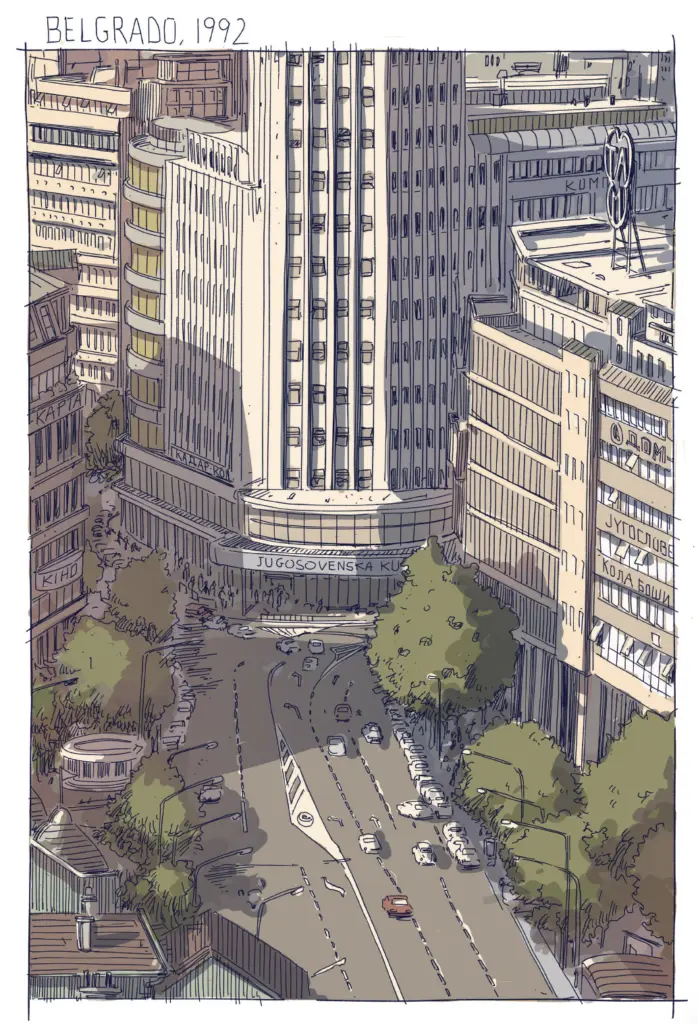
From the graphic novel “Once upon a time there was the East” © Boban Pesov
How do you see North Macedonia today?
It seems to me that the country wants to forget Yugoslavia in a sense. Macedonians are afraid that they will be considered not Macedonian enough, so they often look for an artificial identity, a kind of hyperpatriotism. This is where Alexander the Great, flags and sometimes grotesque, vulgar revisionism come into play.
I know many of my compatriots would slap me for this. But do not get me wrong, it is nice and right to rediscover one’s identity, but sometimes that process becomes toxic and leads to unpleasant situations, especially when the recent past is forgotten.
This week, Tunué published the graphic novel “Silent Devil. Stories from Gaza”, created in cooperation with Emergency, on which you also contributed. Can you tell us more?
It is a collection of eight stories, real-life experiences, collected by Emergency. When I was asked to illustrate one of the stories, I immediately accepted.
Dealing with the Balkans, I felt the need to highlight the folly of us Westerners, who forget what happened not far from Italy. Gaza is not far either: it is further than Srebrenica, Vukovar or Goražde, but not that far. There is also the fact that Gaza is happening live, while information about Srebrenica arrived with great delay.
Faced with this ongoing genocide, I feel helpless again, and the only way to rebel is to draw: it does not solve anything, but it is a kind of testimony. Some trivialise saying that one book cannot help people, even mocking those who do more, like Flotilla. It is humiliating, but it does not stop me.
When my children grow up and the genocide in Gaza is talked about a lot more, as it was with Srebrenica, I would like to be proud that I was among those who did something.
What are your hopes for the Balkans?
The utopian vision of another Yugoslavia will never come true. However, I hope for more active cooperation, also outside the former Yugoslavia: with Greece, Albania, Bulgaria. And to understand our own mistakes. We Macedonians, like Serbs, tend to play the victim. We could take a step forward, instead of feeling sorry for ourselves. Bosnia and Herzegovina is, at the same time, a miniature Yugoslavia, and the situation there is even worse. I was there this summer.
I place my hope in the younger generations, that do not care about differences. I know it is a romantic vision. European enlargement, I fear, will never reach Bosnia and Herzegovina and Kosovo, and I always fear that a future war could be fought here too. Tempers have never calmed.
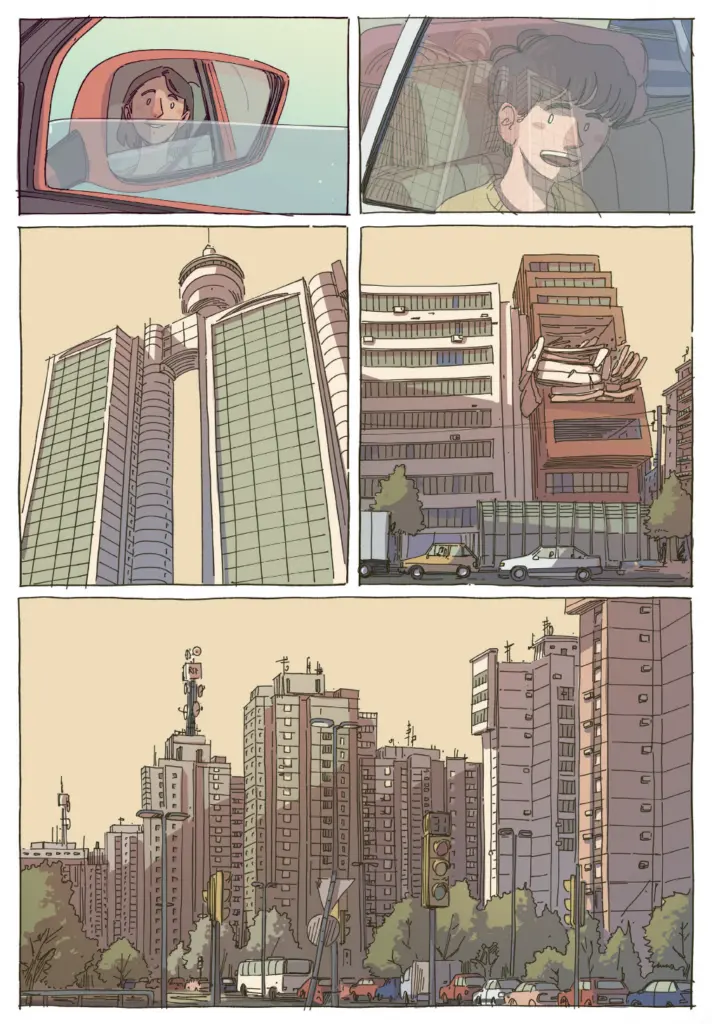
From the graphic novel “Once upon a time there was the East” © Boban Pesov
Let’s talk about your new book “Bad Neighborhood”, which will be released next year.
The story is set in an ordinary, multi-religious town in the 1980s, Dobromir Polje, where the young mayor Mujo was elected. Uncle Tom and Uncle Željko grew up together, but they hate each other to death. Not because one is a Croat and the other a Serb, but because they are neighbors.
Ethnic hatred is growing in the town, and petty quarrels turn into conflicts due to propaganda coming from Zagreb, Belgrade and Sarajevo. The mayor tries to keep the community united, but sees everything falling apart in front of him. Therefore, he asks for help from two neighbors, former partisans, who decide to join forces when they recognise fascism in nationalism.
There is also a temporal connection to the present, with Muja’s niece who works as a journalist in London and returns to investigate a mass grave in the Drina Valley.
It is a very Yugoslav story, between drama and irony.
Boban, starting today, OBCT readers will be able to enjoy your new cartoons on our website every week. We are delighted to have you with us!
And it is a great honor for me! I have been following OBCT for many years, I think since 2010. I even consulted the site to prepare my high school final paper. So I feel a bit at home.
Found an error in this article? Please contact our editorial team at redazione@balcanicaucaso.org.
Tag: In evidenza | Libri
Featured articles
 the students' voices
 Investigation
 students' protest