
Bulgaria, the longest railway tunnel on the Balkan peninsula nearly completed
The project was started 40 years ago, but an accident halted work; it is now being completed with funding from the Cohesion Funds
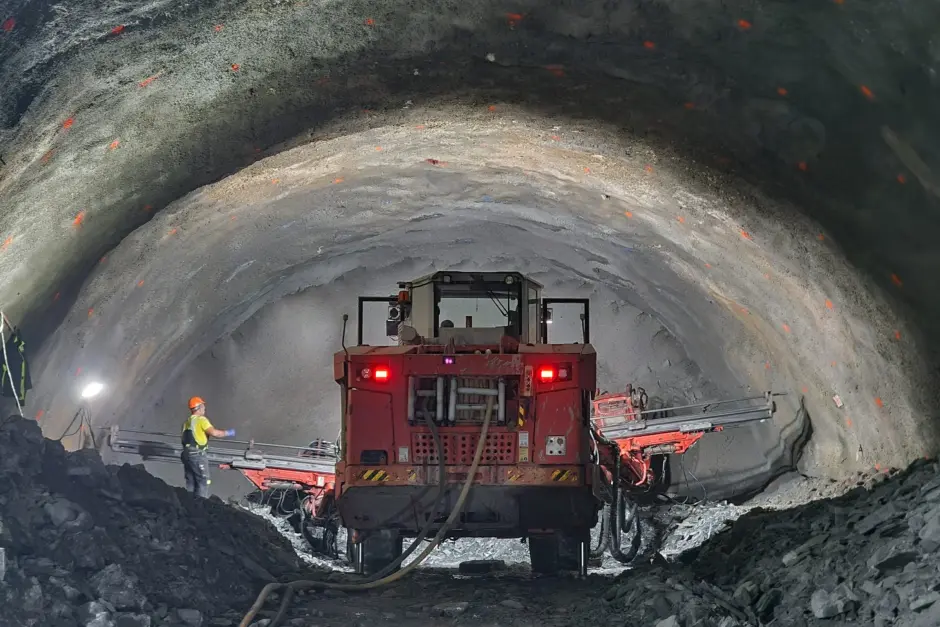
Works on the historic Lozarevo railway tunnel
Works on the historic Lozarevo railway tunnel - Photo © GBS Global Construction
(Originally published by our project partner EuSEE Mediapool)
Only 90 metres remain before the two sides of the tunnel are finally connected, announced Deputy Minister of Transport and Communications Murad Turk, as quoted by the transport ministry’s press office. On Thursday, he inspected the progress on the railway tunnel on site together with Yordan Varbanov – the new director general of the National Railway Infrastructure Company (NRIC).
The construction of the tunnel under the Balkan mountain range is one of the large-scale communist projects that were abandoned following the collapse of the regime in 1989. The project was quietly restarted in 2023.
Two years later – in early 2025 – funding for its completion was included in the ‘Transport Connectivity’ programme 2021–2027, using funds from the Cohesion Funds. Published documents show that this occurred during one of the programme’s amendments.
The project is considered strategic because it allows a fast connection between Burgas and Varna. This is one end of Corridor No. 8, which is supposed to connect the Black Sea, going through Bulgaria, North Macedonia and Albania, with the Italian port of Brindisi on the Adriatic Sea.
The history of the tunnel
A monument to time – this is how the Lozarevo railway tunnel is advertised on some tourist websites. Railway enthusiasts on Facebook still cannot believe that this marvel will soon be completed, but they are hopeful that it will finally happen.
The tunnel is named “Lozarevo” because it is located near the village of the same name in the municipality of Sungurlare. The idea for its construction dates back to the 1970s, when the strategic decision was made to double-track and electrify the Karnobat–Sindel section, engineer Petko Yankov explained to the varnamaps.eu portal. He is one of the engineers who worked the line between Karnobat and Sindel.
The planned length of the railway line is 123 km, featuring numerous trestles, bridges and three tunnels passing through the ridges of the Eastern Balkan range. The other two tunnels – ‘Daskotna’ and ‘Lyulyakovo’ – which are considerably shorter, have already been completed.
The major challenge is “Lozarevo”, touted by the Ministry of Transport as the longest double-track railway tunnel in the Balkans.
Construction began in 1987 by the Ministry of Transport’s construction corps.
However, during the project’s implementation, a series of fateful errors were made, leading to three major accidents, explains Eng. Petko Yankov. Thus, as a result of inaccurate geological surveys, a reckless change to the construction plans and poorly executed excavation work, only around 1,700 m of the planned 2,800 m length of the tunnel tube were built.
The southern entrance to the Lozarevo Tunnel is about 2 km from the village of the same name, from where the excavated length is just over 1,400 m. As a result of the contractor’s unauthorised change to the construction method, a serious accident occurred – a massive collapse of the tunnel structure. This happened because, at that point, the secondary concrete lining lagged significantly behind the primary lining that had been laid, which had been replaced with a significantly less stable one, explains Eng. Yankov.
The northern entrance to the Lozarevo Tunnel is close to the main Shumen–Karnobat road. On this side, the tunnel is in a relatively stable condition, with a finished length of around 300 m. But here too, things did not go smoothly. Due to an early accident that caused a spill of liquefied clay, the tunnel face has been sealed twice with massive concrete plugs. Despite this, destructive processes are still taking place there, causing frequent mudslides and flooding at the entrance.
The change in the political situation in 1989 and a lack of funding led to the project being halted in the 1990s.
“Responsible” safeguarding and a restart 40 years later
After yet another collapse, the tunnel was abandoned for years, but was “responsibly guarded” along with the tunnelling equipment, which had cost millions at the time. Nearly four decades later, when builders returned to the site, this equipment stood intact but rusted and practically unusable, GBS Global Construction – one of the contractors on the project – told Mediapool.
The relaunch of the large-scale project took place during the caretaker government of Galab Donev, when Hristo Alexiev was Minister of Transport. A public tender was announced for the doubling and electrification of the railway line on the Lozarevo–Prilep section, with a budget of around 100 million euros.
Significant progress
Significant progress has been made on the construction of the Lozarevo tunnel. The work is being carried out using a new Austrian tunnelling method, which is effective for the construction of underground structures, according to GBS Global Construction EAD.
The project involves the completion of a 1,000-metre-long tunnel, of which 210 metres will be constructed using the open-cut method and 790 metres using the new Austrian tunnelling method. The project also includes the construction of a new 1,890-metre-long escape gallery.
The works are being carried out with great attention to technical requirements and safety measures, the builders say, adding: “The approach is adaptive and cost-effective, utilising the natural properties of the rock and soil to ensure the stability of the tunnel excavation. This allows for real-time adaptation to varying geological conditions. The method involves continuous monitoring of rock and soil deformations, with the data enabling timely adjustments to design solutions. Real-time monitoring and the rapid implementation of support measures significantly reduce the risk of rockfalls and accidents.”
Strict control
The Lozarevo Tunnel is being constructed under strict quality and safety controls, announced Deputy Transport Minister Murad Turk following his inspection on 16 April.
Excavation is taking place on both sides of the tunnel, and 90 metres remain to be connected in an area with complex geological conditions, he added.
Construction workers told Mediapool that the most difficult and arduous task still lies ahead. According to them, work is being carried out carefully and precisely, with attention to detail, and without rushing.
The deadline for completing the historic railway tunnel is three years. Barring any geological surprises, the plan is for the facility to be fully ready by the end of 2027.
Found an error in this article? Please contact our editorial team at redazione@balcanicaucaso.org.
This article was produced as part of the EuSEE project, co-funded by the European Union. However, the views and opinions expressed are solely those of the author(s) and do not necessarily reflect those of the granting authority, and the European Union cannot be held responsible for them.
Tag: Coesione UE | EuSEE
Featured articles
 Investigation
 students' protest
 Montenegro Pride 2026