The empty frames in Ukraine’s museums
Since 2014, Russian forces have looted hundreds of museums and galleries in occupied Ukraine, stealing at least 1.7 million works of art. Experts speak of a systematic criminal campaign against Ukraine’s artistic and cultural heritage
Empty frame
Empty frame © vvoe/Shutterstock
The first thing museum workers noticed after returning to the Kherson Regional Art Museum in November 2022 was the emptiness. The labels identifying paintings were still attached to the walls, but the paintings themselves were gone. Wooden crates, some still marked with inventory numbers, stood open in the middle of storage rooms where Russian soldiers and occupation officials had spent days before retreating across the Dnipro River.
When I visited Kherson months after the liberation of the city, museum employees described the removal of the collection not as chaotic wartime theft carried out by undisciplined soldiers, but as a coordinated logistical operation involving trucks, curators, occupation officials and detailed inventories.
“They knew exactly what they were taking and where it was stored”, Alina Dotsenko, the museum’s director, told me as we walked through a storage area that once contained thousands of paintings and historical artifacts from southern Ukraine.
Between 31 October and 4 November 2022, exactly one week before Ukrainian forces re-entered Kherson, approximately 11,000 works were removed from the museum’s collection. Among them were paintings by Ivan Aivazovsky, Mykola Pymonenko, Viktor Zaretsky and other Ukrainian and European artists dating back to the period between the 17th and 20th centuries.
Within days, museum workers and locals began tracing parts of the collection to occupied Crimea.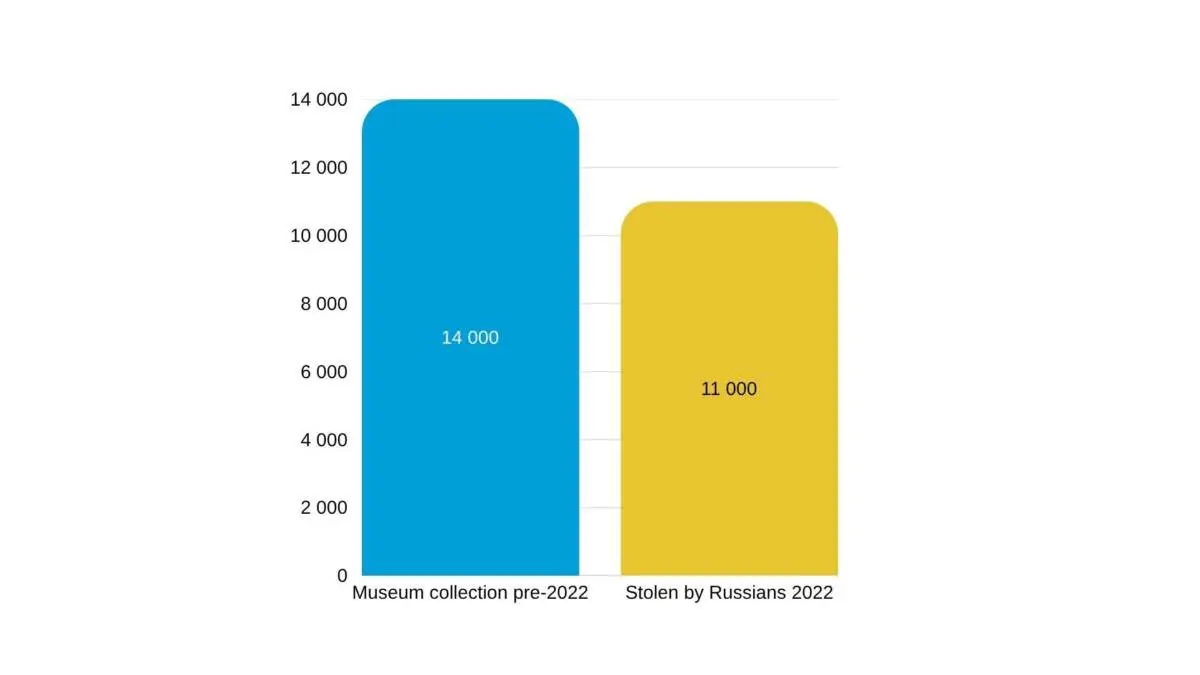
“The removal was organised, not chaotic or spontaneous”, said Dotsenko. According to her, the operation was overseen by Andriy Malgin, director of the Central Museum of Taurida in Simferopol, in occupied Crimea.
“Residents of Kherson filmed cars driving around the museum while the paintings were being taken out”, added the museum’s director. “A few days later, people in Simferopol reported seeing large trucks without license plates unloading artworks near the local history museum”.
For the museum’s staff, the looting did not end with the Russian retreat from the city. Since Kherson’s liberation, the museum building itself has repeatedly come under Russian shelling and missile attacks, making it impossible to reopen to the public. Much of the institution’s work now takes place behind closed doors, where researchers and curators spend their days rebuilding inventories and tracking stolen artworks that continue to surface in Russian museums, exhibitions and online collections.
Employees monitor Russian cultural databases, social media posts, regional museum catalogues and exhibition photographs, comparing them against prewar documentation from Kherson’s archives in an effort to establish the location of individual works removed during the occupation. In some cases, paintings stolen from Kherson have already been identified in museums in occupied Crimea.
The theft of the Kherson collection is one of the clearest examples of what Ukrainian legal experts, historians and cultural workers describe as a systematic campaign targeting Ukrainian cultural heritage across occupied territories. This campaign extends far beyond isolated incidents of wartime looting and increasingly resembles an organised effort to absorb Ukrainian cultural property into Russian institutional and historical narratives.
Since the beginning of Russia’s full-scale invasion in February 2022, Ukrainian officials and international organisations have documented damage to hundreds of museums, churches, libraries, theaters, memorials and archaeological sites. In territories occupied since 2014, particularly in Crimea, the process has unfolded over a much longer timeline, involving not only destruction but also the gradual incorporation of Ukrainian cultural assets into Russian institutional structures.
The scale of the appropriation is difficult to quantify precisely because many occupied territories remain inaccessible. Yet Ukrainian officials estimate that at least 1.7 million cultural objects have been looted and are being traded on the black market.
The looting in numbers
In Kyiv, teams of lawyers, museum researchers, archivists and cultural heritage experts for months now have been reconstructing inventories that in some cases no longer physically exist. Their work often resembles forensic accounting more than traditional museum cataloguing.
“When we speak about cultural heritage crimes, people often imagine isolated thefts or accidental destruction during shelling”, says Daryna Pidhorna, a lawyer and Analyst at The Raphael Lemkin Society. “But what we are documenting demonstrates a much broader system that includes illegal excavations, the transfer of museum collections, the integration of Ukrainian institutions into Russian administrative structures and the commercialisation of stolen cultural property”.
Pidhorna has spent years documenting violations against cultural heritage in Crimea, occupied by Russia in 2014. According to her, Russian authorities issued at least 1,355 permits for archaeological excavations at 175 sites across Crimea between 2014 and 2023, despite international law prohibiting such activities in occupied territories.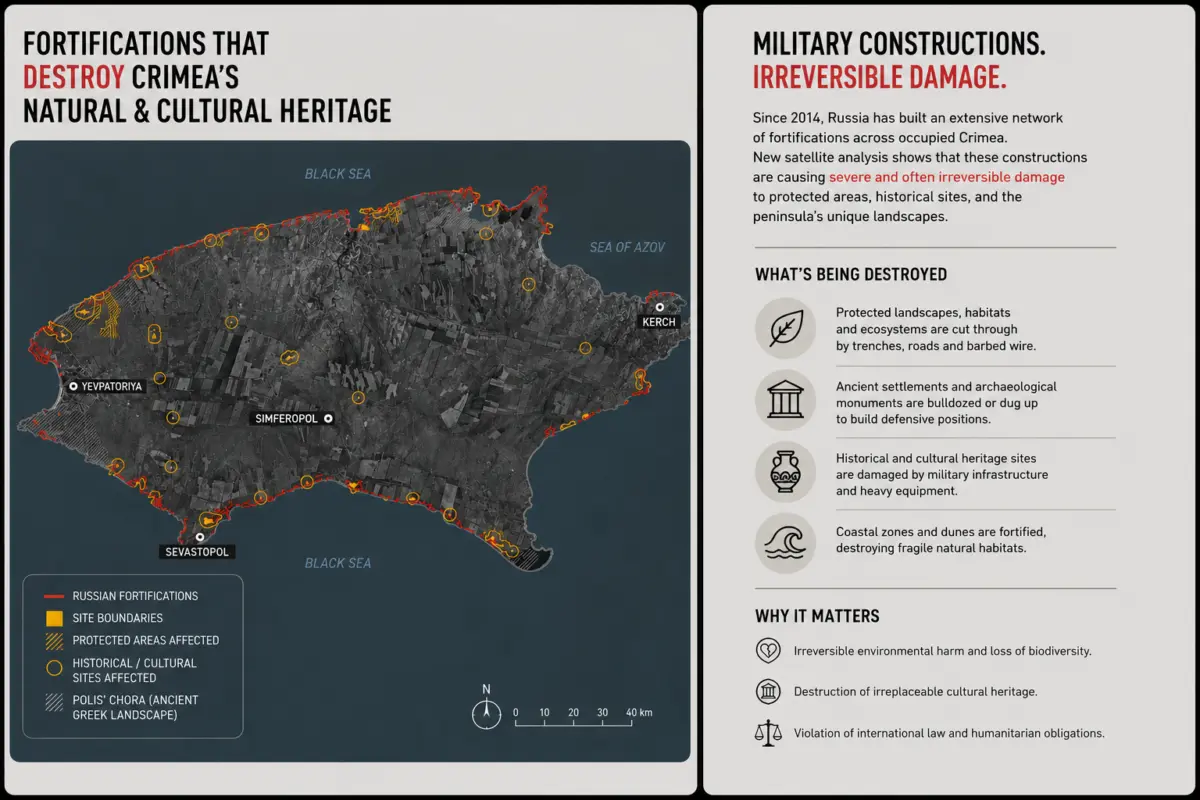
“Behind every one of these permits is a crime involving the destruction or theft of Ukrainian cultural heritage”, says Pidhorna.
The lawyer points to excavations conducted in Chersonesus, the ancient Greek city near Sevastopol, where more than two million artifacts were reportedly uncovered during the 2022 archaeological season alone. According to Ukrainian researchers, approximately 200,000 of these artifacts were later transferred to Russian territory.
Russian authorities have also incorporated thousands of Ukrainian heritage sites into official Russian cultural registers, effectively reclassifying Ukrainian state property as Russian federal or regional property.
Pidhorna explains that Russia has appropriated at least 12,612 cultural heritage monuments in occupied Crimea, along with the assets and collections of 773 libraries, 26 museums and five historical and cultural reserves containing more than 1.2 million museum objects.
“Some of these objects have already been included in the Russian federal register of cultural heritage”, says the lawyer. “This creates the appearance of legal administration while violating international law in the occupied territories”.
According to UNESCO conventions and the 1954 Hague Convention on the Protection of Cultural Property in the Event of Armed Conflict, occupying powers are prohibited from appropriating cultural property from occupied territories.
For Ukrainian investigators, however, the challenge is not only proving violations of international law but identifying the individuals responsible.
“Responsibility belongs not only to the Russian state”, points out Pidhorna. “It also belongs to the people directly involved in moving cultural property, authorising excavations, organising exhibitions, facilitating sales and identifying objects for removal. These include researchers, museum officials, auction organisers and cultural institutions participating in the process”.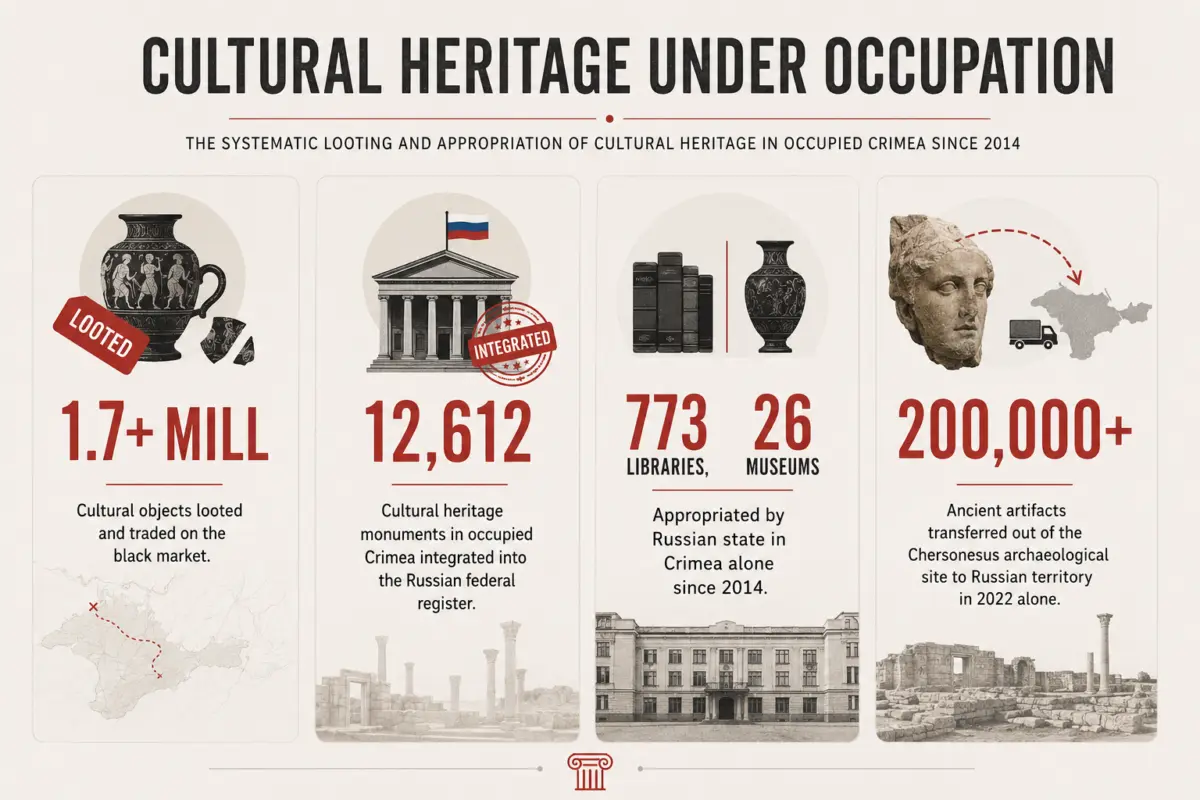
Museums under occupation
In Kherson, museum workers describe the occupation of cultural institutions as unfolding in phases. At first, Russian soldiers appeared primarily interested in administrative control over buildings. Later came inspections, requests for inventories and demands for cooperation. By autumn 2022, as Ukrainian forces advanced toward the city, museum employees say Russian-appointed officials began actively preparing collections for removal.
Some workers attempted to hide smaller objects or relocate records before the retreat began. The Kherson Regional Art Museum was not the only institution affected.
In Melitopol, museum employees reported pressure from Russian authorities seeking access to collections of Scythian gold. In Mariupol, local officials later stated that more than 2,000 museum objects had disappeared during and after the siege of the city. In Nova Kakhovka and other occupied towns in southern Ukraine, museum collections were reportedly transferred deeper into occupied territory during Russia’s retreat from the Kherson region.
In occupied Crimea, infrastructure development has itself become a source of destruction. Pidhorna cites the construction of the Tavrida highway, a large Russian infrastructure project crossing occupied Crimea, during which more than ninety historical sites were officially demolished.
“Some heritage sites disappeared because of Russian infrastructure projects, while others were damaged through so-called restoration work conducted without proper standards or oversight”, explains the lawyer.
Legal aspects
The search for Ukraine’s missing cultural works has increasingly moved from museum archives into international law enforcement networks. In February 2026, Ukraine gained direct technical access to INTERPOL’s global database of stolen works of art, enabling investigators to independently register cultural objects removed from occupied territories. Data on stolen artifacts is also being shared with customs agencies via the World Customs Organisation’s ARCHEO platform to help track illicit trafficking in cultural goods.
Legal experts say the response is now shifting from documentation to coordination at an international level. Anton Chubenko, a Ukrainian legal scholar and expert on cultural heritage law, says the scale of the problem reflects a deliberate and structured system rather than isolated incidents.
“Restoration must become an imperative, and the state and civil society need to unite their fragmented efforts”, says Chubenko, stressing the need for institutional coordination in recovery efforts.
“However, the legal framework for restitution remains incomplete”, denounces the expert. “And there is no single universal mechanism for recovering stolen cultural heritage”.
According to Chubenko, post–World War II instruments, such as the 1970 UNESCO Convention and the 1995 UNIDROIT Convention, “established key principles for restitution, compensation and time-bound claims”. He also highlights historical precedents, including bilateral commissions between Poland and Germany, where “structured legal cooperation can facilitate returns”.
Where voluntary restitution fails, legal accountability is being pursued through hundreds of criminal cases and evidence gathering intended to support future international tribunals and claims for recovery and compensation, alongside ongoing efforts by museums, activists and law enforcement to document losses and monitor illicit sales, including on auction platforms.
Found an error in this article? Please contact our editorial team at redazione@balcanicaucaso.org.
Tag: In evidenza