Albania, the independent MP challenging Edi Rama
25-year-old Marjana Koçeku is the only independent MP sitting in the Albanian parliament. On 14 June she left Edi Rama’s Socialist Party in opposition to the government’s development projects. Our interview
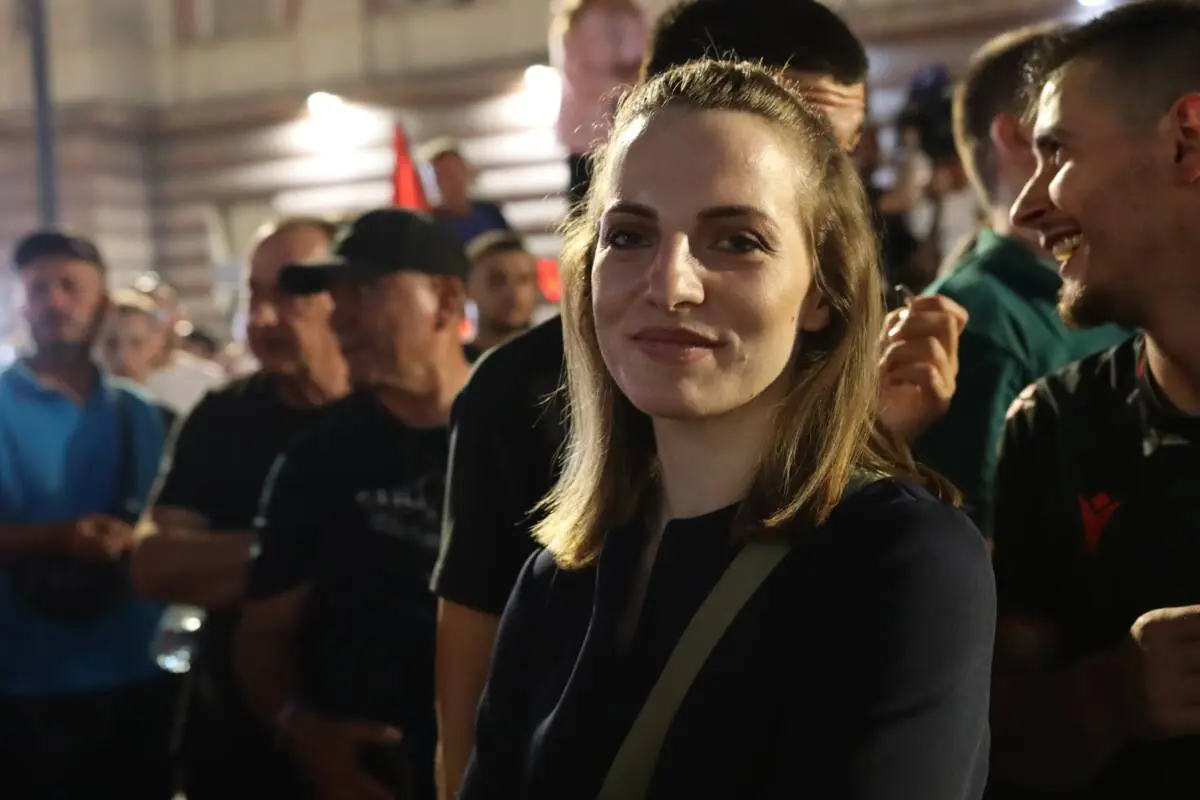
Marjana Koçeku at the anti-government protests. Photo courtesy of Isa Myzyraj.
Marjana Koçeku at the anti-government protests. Photo courtesy of Isa Myzyraj.
Marjana Koçeku was born in Shkodra in 2000 and studied Political Science and International Relations in Albania and abroad. In 2021 she returned home to work in the family business, an agritourism guesthouse in the mountain area of Lake Koman, in northern Albania, on the border with Montenegro.
Having become known online as Neomalsore (literally “the new highlander”), she was put forward by Prime Minister Edi Rama himself as a Socialist Party (PS) candidate in the 2025 parliamentary elections, which saw her elected. On 14 June 2026 she left the PS in opposition to the government’s projects in the bay of Pishë Poro-Narta and Sazan.
Let’s start in 2021. Why did you decide to come back to Albania?
Honestly, when I left Albania, in 2020, I intended not to come back. It was the peak of youth emigration, an era of moving abroad without much hope that our country could change for the better.
I was raised between the city of Shkodra and a village in the mountains, close to the lake. I am the youngest of four brothers and sisters, and like almost every Albanian family, my siblings lived abroad too. I left as a student with a scholarship, but my eldest brother went the hard way — crossing the mountains into Greece on foot, walking day and night.
I studied in Genoa and spent some time in Sweden, where my sister has lived for over fifteen years. Living abroad helped me appreciate my country and my village more, and to see opportunities to develop them rather than leave them behind. Travelling made me realise how unique this valley is, and how much potential our community could have if tourism were developed by strongly preserving who we are.
So, you came back and joined your family’s business in North Albania.
Yes, my family was the first to work in tourism in the whole region. We had hosted tourists since 2010, but it was mostly a boat concept: my father was a captain and my brothers would go out with him on the lake with visitors from Germany, Italy, France.
In 2021, I borrowed about €2,000 from my best friend for some small renovations — new beds, fixing the broken windows of our old house – and started a guesthouse. The place is very minimal and peaceful: my mother cooks on the fire, we serve what we used to eat as children. Today, we can accommodate 28 people.
At that point you became known online as Neomalsore, “the new highlander”, and you were spotted by Edi Rama. Why did you decide to get engaged in politics — and why with the Socialist Party?
Honestly, I was not looking to go into politics. I had studied political science and I had a certain idealism, but for the far future.
With my work I became quite popular and influential among the young generation. International outlets like the Financial Times made a documentary about me and I would receive hundreds of messages from young people telling me they had found the courage to go back to their villages, to see a life beyond the capital, to come back from emigration and invest at home.
So, the invitation came directly from the Prime Minister, in March 2025, and the Socialist Party was honestly the only one to make me a serious offer.
I did not really want to go, because it meant risking everything I had built. But two factors pushed me to say yes: being a young woman from an area of extremely limited opportunities, especially for girls; and coming from these mountains, left behind by every government — broken roads, no public investment, an area famous for its blood feuds, and politicians completely out of touch with what happens there.
But a few weeks ago, on June 14, you quit the Socialist Party. What disappointed you?
I really believed in the new entry of the young generation; people appreciated my genuine way of doing things and wanted me to bring it into politics.
I tried, with some initiatives on the environment, and I saw they were not welcome at all. I saw that the policy of environmental destruction was becoming more frequent and more aggressive, and I realised I was serving the opposite of what I believe, of what I have worked for, of how I built my public persona and career.
I decided I cannot belong to a group that makes laws and policies for a very small group of interests while destroying the environment. And I realised it is not just here in northern Albania: it is a well-planned thing for the whole country.
I consider the environment the essence of my political being. This is the only Albania we have — we cannot allow major mistakes whose damage cannot be undone.
So you left the party, but you did not resign as a deputy.
The Constitution allows me to keep the mandate as an independent MP.
I announced everything publicly, only through social media, with no previous contact with the party leadership. I did not want to allow any private interaction that could try to change my mind or convince me to resign the mandate.
The days that followed were full of pressure and tension. I turned off my phone because it was going crazy — it is funny, most media headlines that week were “her phone is off, where is Marjana?”. I simply needed some time for myself.
There was pressure from the party and from MPs to give up the mandate, and hundreds of anonymous troll profiles online bullying and harassing me.
But my decision was well thought through. I am strongly committed to spending the next three years as an independent MP. I am working on a public platform for my activity, with the environment at its centre, on how to make Albania a more livable country.
You work in tourism yourself, so, what kind of tourism do you wish for Albania?
I think Albania is a perfect example of how sustainable tourism can be developed without harming nature and while strongly respecting communities. It is a small country with enormous diversity — culture, ethnography, folklore, the beauty of nature and the mountains — and all these potentials could form a network to protect and promote our identity, to offer what we are.
Instead, we are destroying what we are, implementing projects that could be found anywhere, in the Maldives or in Jamaica. We do not need to be a random copy of other countries. And we need an Albania developed first of all for its own people.
You took part in the protests that started at the end of May, alongside many people your age. What do young Albanians want for the future of their country?
This protest is the most beautiful civic manifesto I have ever seen — and, I think, that Europe has seen recently. It makes me proud to belong to this young generation.
We see things completely differently from our parents’ generation. For me it is a revolution of energy — beautiful, creative, and very conscious of who we are and who we want our country and society to be. It has already obtained some small wins, and I do not think it will stop, because its ambitions are huge.
What the young generation wants is for Albania to be a country where you can live with dignity, where your energy can be put to use at home without having to flee somewhere else. Most Albanians living abroad have their heads turned back home, to parents left alone and to younger siblings. This generation is finally acting for Albania to be a place where they really live, and not just a place they live off.
Albania is negotiating its accession to the European Union, so Brussels has some leverage in this moment. Are you satisfied with the reaction of the EU institutions so far?
After resigning I spent a week in Brussels, invited by some European parliamentarians to talk about the protest, and I had quite intense meetings with MEPs from different political families.
What I emphasised most is that the European integration process must not end up being just a geopolitical move or a bureaucratic box-ticking exercise: it needs to be more inclusive. Albanian society endorses European Union values — but that does not mean we endorse our government, our political elite or our Prime Minister.
If 92% of Albanians are strongly pro-European, it is because for us EU integration is the strongest guarantee of better democracy, transparency, accountability and rule of law. It is important that the EU builds direct links with our society and our civil society, to get a real reality check on how reforms are actually being implemented — through the people, rather than through those in power, who use the EU process precisely to remain in power. Every chapter should be closely monitored in how it is implemented on the ground, not just in the reports of ministry administrations.
You mentioned you are starting a new public platform. What do your political plans between now and next year?
I am the only independent MP and I am the youngest in the parliament. Being independent limits you in some ways, but it gives you an almost infinite horizon in how vocal you can be.
I will be a critical and very strong opposition, serving the public good and the interests of citizens — free to vote or not to vote, and to raise my voice in parliament and in all our institutions.
This does not mean I am alone: in politics you can never be alone. I am many, and there will be more along the way — like-minded people who judge my actions to be right, who will come closer and join my platform and my ideas. Time will tell, and time will judge whether what I am doing is fair — and whether I am made for politics.
More than ever, I am determined to continue my political journey, because critical voices are necessary, inside or outside the parties, especially from the young generation: we have a different idea of how democracy really works and how our society can improve.
So I am very enthusiastic and optimistic about my political future — without a party, alone in terms of political belonging, but with, I believe, very fruitful ideas on how to make our country a more livable place for all generations, especially the youngest.
Found an error in this article? Please contact our editorial team at redazione@balcanicaucaso.org.
Featured articles
 Montenegro Pride 2026
 Political deadlock