The EU’s mission contributing to stability in Georgia since 2008
Following the 2008 Russo-Georgian War, the EU established a civilian monitoring mission in Georgia. Since then, the EUMM has been making an impartial contribution to stability and security, even though relations between the EU and Georgia have become increasingly strained
IMG_9524
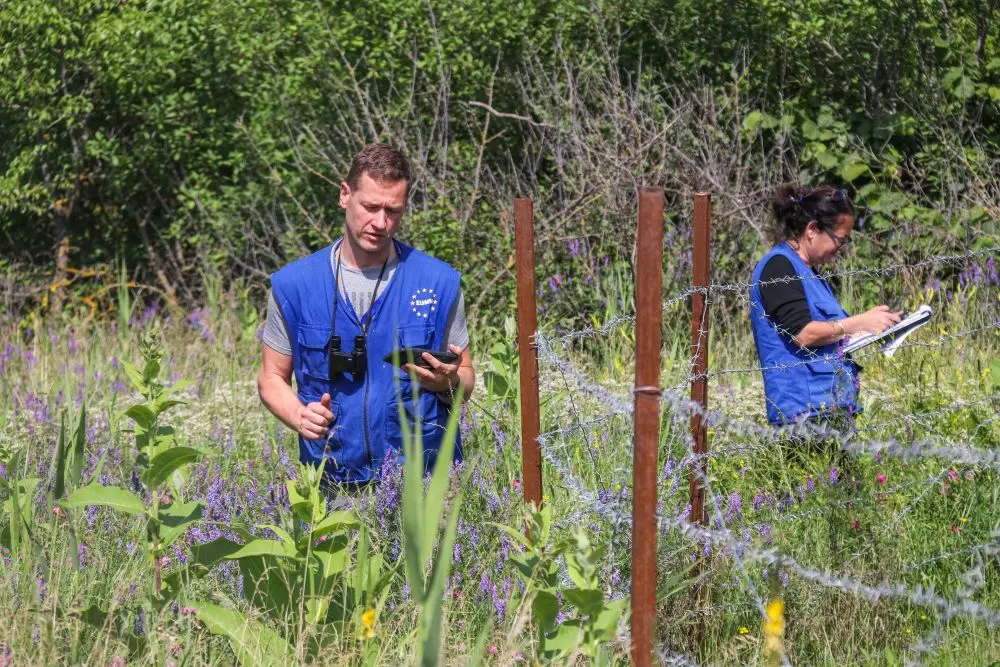
EUMM monitors patrolling along the fenced South Ossetia Administrative Boundary Line (© European Union Monitoring Mission in Georgia)
After the EU mediated a ceasefire agreement at the end of the August 2008 Russo-Georgian War, the first EU monitors arrived in the country in order to observe the implementation of the deal.
At the beginning, the European Union Monitoring Mission (EUMM) was not the only international mission operating on the ground – it was just the newest in fact. An OSCE mission had been established in 1992 and had been assisting the Georgian government on conflict settlement, democratization, human rights and rule of law issues, but in December 2008 Russia blocked its renewal. In June 2009, Russia also vetoed the extension of the United Nations Observer Mission in Georgia, ending its nearly 16 years of operation.
As a result, the EUMM became – and remains to date – the only international monitoring mission in Georgia, assuming a crucial role in reducing the risk of renewed hostilities. Two regions – Abkhazia and the South Ossetia/Tskhinvali Region – currently remain under Russian occupation.
As of today, the EUMM is composed of staff from 25 of the 27 member states, bringing together personnel from more countries than any other mission of the EU’s Common Security and Defence Policy.
“Our almost 18 years of continuous presence on the ground reflects the European Union’s long-term commitment to security and stability in Georgia,” declares Klaas Maes, spokesperson and head of the press and public information section at the EUMM.
EUMM’s activities
The EUMM focuses on three main areas of activities: patrolling along the so-called Administrative Boundary Lines (ABLs); confidence building between the conflict parties; impartial reporting to the EU and the member states.
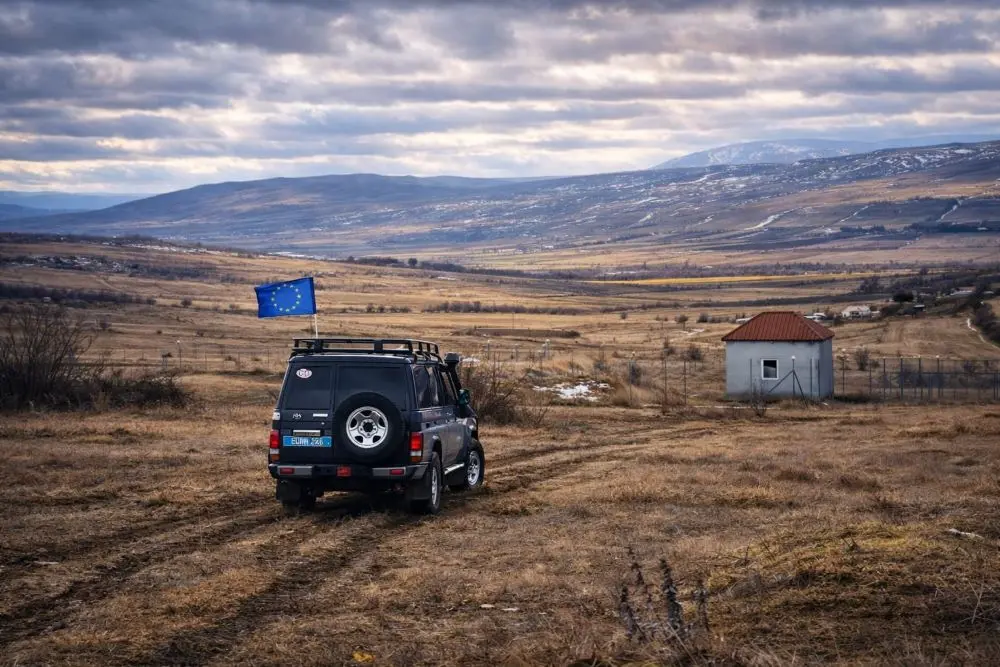
An EUMM vehicle during one of the mission’s monitoring patrols (© European Union Monitoring Mission in Georgia)
“Confidence building is basically building trust. How do we do that? That’s mainly by facilitating dialogue through our Incident Prevention and Response Mechanism (IPRM) and via a hotline. Those mechanisms enable the conflict parties to communicate with each other to discuss certain security and humanitarian issues. In a conflict, when there is no communication, there is always the risk of misunderstanding, which can lead to escalations and then a full-fledged conflict again,” Maes explains to OBCT.
IPRM meetings take place around seven times per year, attended by participants from Tbilisi-administered territory, Russian-occupied South Ossetia, and the Russian Federation.
The situation along the boundary lines
According to Klaas Maes, the situation along the Administrative Boundary Lines is now a lot more stable compared to the immediate aftermath of the war. “Shooting incidents are now very uncommon. However, at the same time, the humanitarian situation for the people living along the Administrative Boundary Lines deteriorates,” the EUMM spokesperson says.
Although the situation may appear to be a frozen conflict from the outside due to the absence of active fighting, “It still has an immense impact on the people living there”, Maes adds. “For example, along the South Ossetian ABL there is very limited freedom of movement. The crossing points are only open the last ten days of the month. That means that the rest of the time people cannot visit their family, access graveyards, go to their preferred schools, or access the land to cultivate it. Most people there depend on agriculture for their livelihoods. So, if your crops die, you lose your income,” Maes underlines.
When the EUMM monitors go on patrols along the ABLs, they try to talk to the local inhabitants to learn more about the situation and the challenges that Georgian citizens face there.
As Maes says, the ABLs are being borderized with barbed wire fences on the Northern side, becoming “like a de facto border”. Maes adds that the ABLs have such a strong psychological effect on local Georgians that many of them are afraid to get closer to it. “People often come up to us and say they feel more secure and safe when we are patrolling along the ABLs,” Maes underlined.
Although the EUMM itself does not provide humanitarian or development aid, it tends to highlight the humanitarian needs of local communities in their reports to the EU. After their reporting, some EU countries have sometimes intervened to provide assistance to those in need.
No access to Abkhazia and South Ossetia
The EUMM does not have access to the Russian-occupied Georgian breakaway regions of Abkhazia and South Ossetia. The monitors attempt to gather information on the situation on the other side of the ABLs by analysing publicly available information.
“We can talk to people who come from South Ossetia and Abkhazia into Tbilisi-administered territory. And in doing so, we are able to build a reasonably good picture of the security and the humanitarian situation there. If we had access to those regions, we could be even a more stabilizing presence,” the EUMM spokesperson tells OBCT.
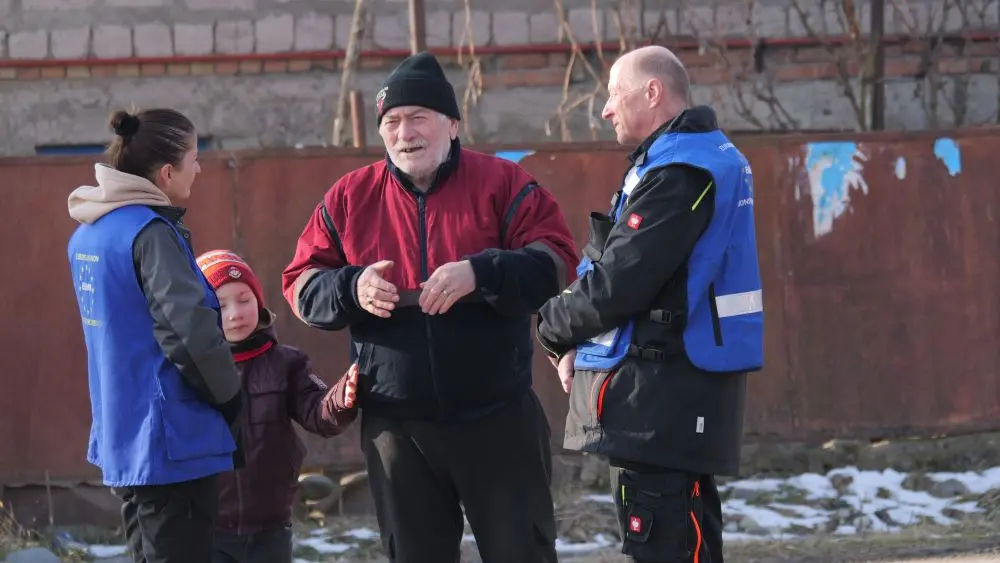
EUMM monitors speak with local residents (© European Union Monitoring Mission in Georgia)
EUMM amid strained Georgia-EU relations
Described by Maes as an impartial and apolitical mission that is part of the “broader EU family,” the EUMM has been operating in Georgia amid increasingly strained EU-Georgia relations.
In June 2024, the European Council concluded that the new Georgian law on “transparency of foreign influence” represented democratic backsliding. This has de facto led to a halt in the accession process, as the European Commission withheld funding, froze financial support and suspended high-level meetings. Additionally, parliamentary elections held in Georgia in October 2024 were marred by allegations of electoral fraud and sparked widespread protests.
The Georgian government has been attacking the EU’s foreign policy and role in the country, but according to Klaas Maes strained bilateral relations have not directly affected the EU’s monitoring mission until now.
“We are here especially to help maintain stability along the Administrative Boundary Lines, which is crucial for people living in these areas. These Georgian citizens are already the most vulnerable. Therefore, we really ensure that we maintain this impartiality and apolitical stance. So far, this has worked very well and we continue our work like before,” Maes emphasized.
Amid the ruling Georgian Dream party’s ongoing anti-Western disinformation campaign, the EUMM spokesperson says that monitors are “still very much welcomed by the local population. People in the villages have seen us and talked to our monitors since 2008. I think a lot is needed in order to break that trust,” Maes tells OBCT.
The EUMM’s current mandate runs until 14 December 2026. “Any extension of our mandate, typically for a period of two years, requires the unanimous approval of all EU member states. Until then, we remain fully committed to contributing to stability and security in Georgia and supporting conflict-affected communities,” Maes told OBCT.
Found an error in this article? Please contact our editorial team at redazione@balcanicaucaso.org.
Featured articles
 the students' voices
 Investigation
 students' protest