The challenge of economic cooperation to overcome tensions between Serbia and Kosovo
The failure to normalize relations between the two countries costs approximately 290 million euros annually in exports. “Trade does not magically soften politics, but over time it can create shared interests,” explains Demush Shasha, Executive Director of EPIK

© Shutterstock/Gannachka
© Shutterstock/Gannachka
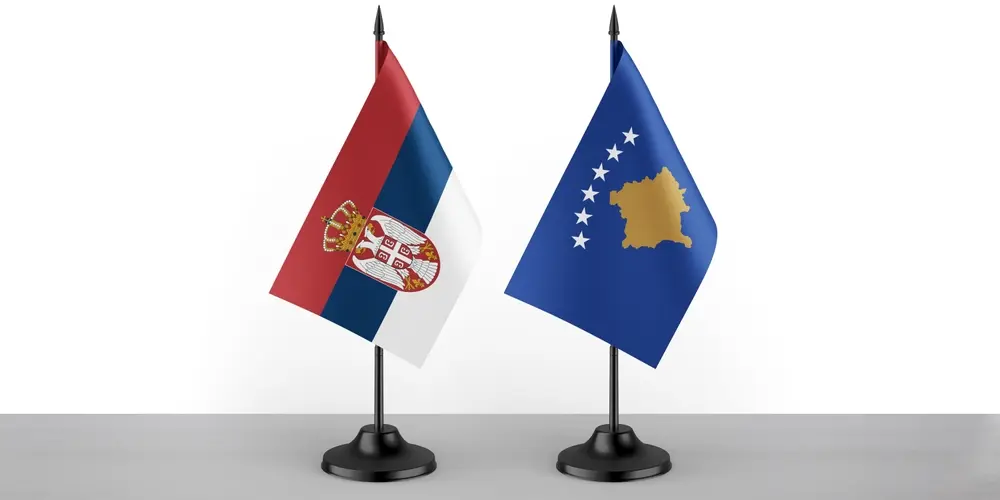
Tensions between Serbia and Kosovo – extensively studied from institutional and political perspectives since Pristina’s 2008 declaration of independence – also have a particularly significant impact on the economic and commercial level.
This aspect, too often overlooked, highlights the (real) costs of relations that remain unnormalized. At the same time, it could serve as a driver for change.
“Trade does not magically soften politics, but over time it can create shared interests and make cooperation more valuable for businesses and communities on both sides,” explains Demush Shasha, Executive Director of the European Policy Institute of Kosovo (EPIK), in an interview with OBC Transeuropa.
Drawing on a recently coordinated paper (to be published soon) regarding the strengthening of relations between Kosovo and Serbia through economic cooperation, Shasha explains that such cooperation can be developed “on a parallel track,” building trust and shared interests through “repeated and effective cooperation, without the need to resolve the political issue first.”
How significant is the economic cost of the failure to normalize relations between Kosovo and Serbia?
We estimate the potential loss at approximately 290 million euros per year in exports between the two countries – about 36 million euros from Kosovo and 254 million euros from Serbia.
We arrived at this figure by analyzing Serbia’s trade flows with a similar neighboring country, North Macedonia, where the same political dispute does not exist, and comparing them with the current situation regarding Kosovo.
For Kosovo, this is a substantial sum. For Serbia, however, the figure is relatively modest compared to the size of its economy.
Yet, we do not believe that the figure itself is what drives political developments.
The 2019 tariff dispute was not fundamentally about money – it followed a controversy over Kosovo’s bid to join Interpol – and ultimately resulted in costs for businesses and consumers on both sides.
Therefore, this figure should be viewed more as a constant economic incentive encouraging traders and businesses to seek a reduction in barriers, rather than as a factor capable of single-handedly bringing about a political breakthrough.
How realistic is it to expect that increased trade, investment, and business cooperation will influence political decision-making?
We should approach this issue with caution.
What can work in similar situations elsewhere is separating the practical, day-to-day mechanisms of trade – such as customs data, product standards, and transit rules – from the underlying political dispute, allowing businesses to operate predictably without waiting for a definitive political resolution.
This can create further incentives for policymakers to keep cooperation moving in the right direction.
Could integrating businesses into cross-border supply chains generate sustainable economic development, or would it merely increase dependence on multinationals?
There is a risk of dependency if the ties between multinationals and local firms remain weak.
Many of the multinationals operating in Serbia’s economic zones have relatively limited local supplier networks, and local firms often struggle to qualify as suppliers because they lack the environmental and governance certifications required by major buyers.
Kosovo still has much work to do in this area.
Our recommendation is clear: help local businesses obtain the necessary certifications and create better opportunities to match supply with demand, enabling them to supply the multinationals already operating in the region. This is how foreign investment can generate broader local development – not only through job creation and exports, but also by strengthening local businesses and supply chains.
What would be the greatest economic benefit resulting from a reduction in non-tariff barriers?
There is a World Bank estimate that we find particularly interesting: reducing border crossing times by three hours could lead to a 2 percent increase in real incomes.
This represents a relatively quick and tangible gain compared to productivity improvements, which take years to materialize.
We would therefore begin with practical measures: properly sharing customs data, mutually recognizing companies classified as “trusted operators,” and addressing the regulations that currently prevent certain trucks from transiting through Serbia depending on how they entered Kosovo.
None of these measures requires either party to compromise on its political position.
These are concrete economic measures capable of reducing costs for businesses and consumers and, over time, helping to build the trust needed to tackle more complex issues.
How could greater labor mobility between Kosovo and Serbia reduce skills shortages and brain drain, while ensuring that the economic benefits of mobility are distributed fairly between the two economies?
A concrete opportunity exists here, as the two labor markets have partly complementary needs.
Serbia faces a growing labor shortage in certain sectors of its economy, while Kosovo has a large pool of young people and continues to struggle to fully harness its human capital.
However, the goal should not be to create a one-way flow of workers from Kosovo to Serbia.
Instead, the aim should be to ensure that regional labor mobility benefits people and businesses on both sides.
This means seasonal and temporary opportunities where appropriate, portable social security rights, recognition of qualifications, better training, and opportunities for people to return and put the skills they have acquired to use.
The key is that mobility should expand people’s choices, rather than simply shifting the problem of brain drain from one destination to another.
If managed correctly, increased mobility can help address labor shortages while improving skills, incomes, and opportunities in both economies.
Found an error in this article? Please contact our editorial team at redazione@balcanicaucaso.org.
This publication is the result of activities carried out within the "Contribution of the economic cooperation to Kosovo-Serbia normalisation", a project co-funded by the Italian Ministry of Foreign Affairs and International Cooperation. All opinions expressed represent the views of their author and not those of the co-funding institution.
Featured articles
 Montenegro Pride 2026
 Political deadlock