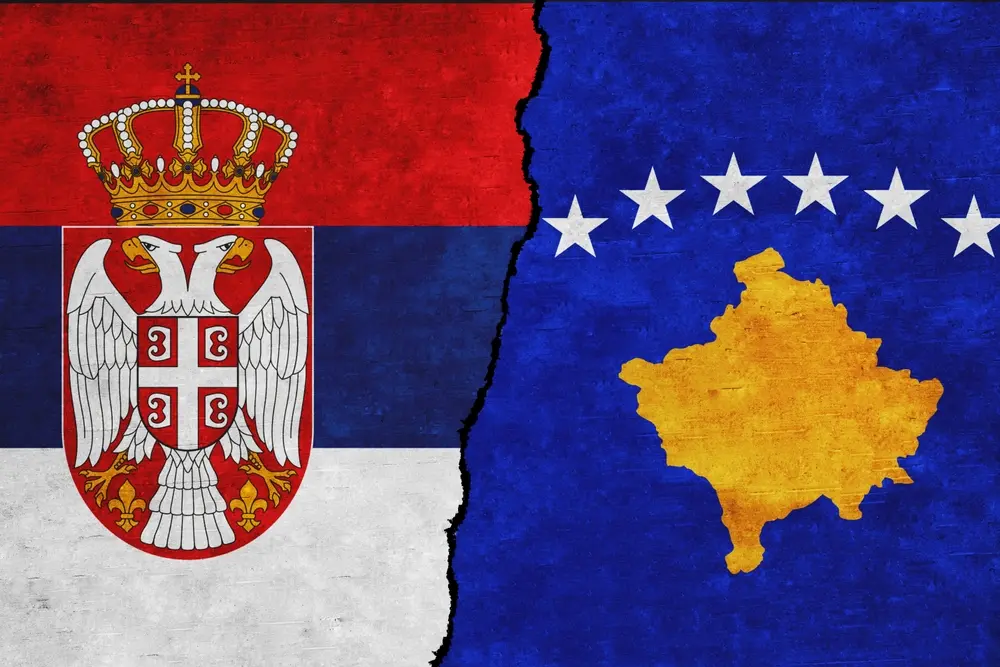
Serbia-Kosovo, shared economic development held hostage by shortsighted politics
Elites in both Kosovo and Serbia avoid raising the issue of cooperation with the other side, because “doing so would amount to admitting that normalization brings benefits rather than mere concessions.” An interview with Bojana Selaković, coordinator of EU Konvent
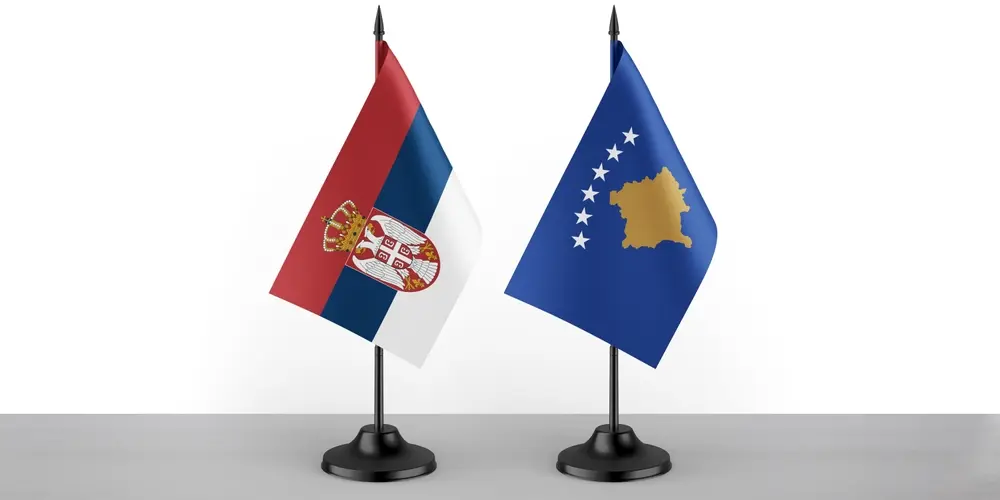
© Selman GEDIK/Shutterstock
© Selman GEDIK/Shutterstock
If the economic impact of normalizing relations between Serbia and Kosovo can be so positive for both countries, why is the issue of benefits for trade, businesses, and citizens so neglected in public debate?
“The economic incentives are real, yet none of the political elites have used them as an argument to their own societies, presumably because doing so would amount to admitting that normalization brings benefits rather than mere concessions,” warns Bojana Selaković, coordinator of the National Convention on the European Union (EU Konvent), a consultation and cooperation platform established to include civil society in the EU negotiation and accession processes of candidate countries.
In an interview with OBC Transeuropa, Selaković analyzed the findings of a paper on strengthening relations between Kosovo and Serbia through economic cooperation, highlighting the shortcomings of the political normalization process, which have had serious repercussions on the economies and civil societies of both countries.
“What has been missing so far is a serious effort to present these economic arguments to citizens as a reason for normalization,” as the entire dialogue conducted to date “has lacked transparency and involved no participation from businesses, local communities, or the general public.”
From Serbia’s perspective, what might be the main economic incentives for pursuing closer economic cooperation with Kosovo?
Discussions regarding economic incentives for normalization tend to be limited to abstract figures concerning GDP growth or investments that “might” materialize.
A more tangible incentive is the elimination of daily costs stemming from the unresolved status: non-tariff barriers, the duplication of customs procedures, the inability to mutually recognize standards and certifications, and the systemic legal uncertainty weighing on companies operating across the administrative line.
This is not an abstract gain, but a concrete cost already borne by transporters, farmers, and small and medium-sized enterprises in southern Serbia.
There is a second incentive, arguably even more important. Regional markets can function at full capacity only if all participants have a clear status.
Serbia has an interest in becoming a regional logistics and manufacturing hub, yet that hub loses value if a part of the region remains systematically excluded from it due to unresolved issues.
In a climate where the wartime past has once again moved to the center of public debate – in Serbia due to the state funeral of Ratko Mladić, and in Kosovo due to the verdict against KLA leaders – it is unlikely that economic arguments for cooperation will rise to the top of the agenda for either side.
Serbia plays a significant role in regional trade and value chains. Could greater economic integration with Kosovo strengthen this position, or might it generate new costs for Serbian businesses?
Both scenarios are possible, and this is not a contradiction: it depends on who sets the terms of integration.
If economic cooperation were based on reciprocal and transparent rules, Serbia could strengthen its position as a regional logistics and manufacturing hub. If, however, cooperation develops under conditions where political relations remain unstable and subject to unilateral measures – such as import bans, blockades, or sudden regulatory changes – then businesses on both sides face a risk that is political rather than economic in nature; a risk that typically translates into higher costs for insurance, credit, and logistics.
This political risk is greater today than it was at the start of the normalization process, not lesser.
The political crisis in Serbia and the prolonged institutional deadlock in Kosovo – combined with waning interest from the EU and other international actors in the region amidst shifting geopolitical priorities – have rendered relations between the two societies effectively less normal than they were over a decade ago, when the dialogue began.
Under such conditions, any argument – however economically rational – becomes an easy target for domestic attacks branding it as “betrayal.”
Serbian companies currently operating within the “grey zone” of Kosovo’s status have an interest in seeing that status clarified. This is because uncertainty, rather than cooperation itself, makes up the greatest cost today, and that uncertainty is now further amplified by rising nationalism on both sides.
Could closer economic ties between Kosovo and Serbia make the entire region more internationally competitive, particularly in attracting foreign investment?
Comparisons with Central and Eastern Europe are often framed incorrectly, as a race measured by speed or market size. That is not the right basis for comparison.
Countries like Poland, Romania, and the Baltic states attracted foreign capital primarily because EU membership integrated them into a single legal and regulatory area: investors knew that the same rules, courts, and contract enforcement mechanisms applied there as in the rest of the Union.
The Western Balkans do not enjoy this advantage, nor will they until they join the EU. What the region can realistically offer today is something different: functioning, at the very least, as a single, predictable market among its members, even prior to full accession.
This is precisely where the direct link to Kosovo-Serbia relations lies.
If investors have to contend with border crossings that are liable to be blocked, duplicated customs procedures, and legal uncertainties stemming from the unresolved status issue, then the Western Balkans offer neither the speed of Central Europe nor the predictability that a small, interconnected region could otherwise provide.
The region does not compete with Central and Eastern Europe as individual economies but should compete as an integrated whole; yet, unresolved relations between Belgrade and Pristina hinder precisely that cohesion.
Closer economic cooperation between Kosovo and Serbia could alter this perception, but only if accompanied by visible progress regarding the rule of law and institutional stability in both countries. The current situation, however, is moving in the opposite direction.
What mechanisms or political conditions would be required to ensure that future agreements between the two countries are actually implemented?
In my view, this is the central issue, because the history of the dialogue between Belgrade and Pristina is, above all, a history of agreements signed but not implemented.
Part of the problem lies in the very structure of the process. From the outset, the dialogue has been conducted opaquely, without the public being privy to its contents, and almost exclusively within narrow circles of political elites on both sides.
When citizens, businesses, and civil society lack any overview of what has been agreed upon or why, they have no reason to trust the implementation process and no mechanism to demand it. Ultimately, it is a missed opportunity.
A dialogue that could have built social trust has instead remained a closed process among leaders; this is precisely why it has been so easily undermined whenever the political climate soured.
To avoid repeating this pattern, at least three elements are needed: an independent mechanism to monitor implementation, featuring clear deadlines and measurable indicators; a direct link between implementation and progress in the EU accession process, ensuring that delays entail a real, rather than merely rhetorical cost; and the genuine involvement of businesses, local communities, and civil society in monitoring, as they are the first to feel the impact when an agreement exists on paper but not in practice.
Without transparency and inclusivity in the negotiation process itself, no implementation mechanism will possess the legitimacy needed to survive a change of government or political pressure.
Should economic normalization progress substantially, ought Serbia and Kosovo to view it primarily as a bilateral economic process or as part of a broader strategy aimed at more deeply integrating the Western Balkans into the European economy?
This is a false dilemma. Economic normalization between Kosovo and Serbia cannot be a purely bilateral process, as it takes place within the framework of regional initiatives – CEFTA, the Common Regional Market, the Berlin Process – that already link both economies to the rest of the region.
The region’s ultimate goal must remain EU integration – not as an abstract geopolitical formula, but as a concrete framework providing direction and pace to bilateral steps. Without such a framework, any bilateral concession easily degenerates into a trade-off of political capital rather than as a step toward a functioning regional market.
At the same time, we must be realistic about the current situation. Ongoing political crises in both Serbia and Kosovo are stalling almost every process, whether bilateral or regional.
Under these conditions, insisting that normalization be viewed solely through the lens of a “broader European strategy” can serve as a pretext for avoiding concrete bilateral issues such as customs, standards, and infrastructure, that can and must be addressed regardless of the prevailing political climate.
A realistic approach involves viewing bilateral measures as a litmus test for the viability of broader regional integration.
If Kosovo and Serbia cannot resolve concrete issues between themselves, even amidst a crisis, it is hard to believe that the region as a whole could function as an integrated market within the EU.
This moment serves as a warning: normalization must not be held hostage by the current political climate in either Belgrade or Pristina. Were that to happen, the region would remain at the mercy of every future crisis, rather than building something capable of withstanding them.
Found an error in this article? Please contact our editorial team at redazione@balcanicaucaso.org.
This publication is the result of activities carried out within the "Contribution of the economic cooperation to Kosovo-Serbia normalisation", a project co-funded by the Italian Ministry of Foreign Affairs and International Cooperation. All opinions expressed represent the views of their author and not those of the co-funding institution.
Featured articles
 the students' voices
 Investigation
 students' protest