Albania’s intelligence chief placed under house arrest
The case of Vlora Hyseni, director of the Albanian State Intelligence Service (SHISH), has erupted in Albania. Hyseni has been suspended and placed under house arrest on charges of aiding and abetting the alleged perpetrator of a crime and disclosing classified information
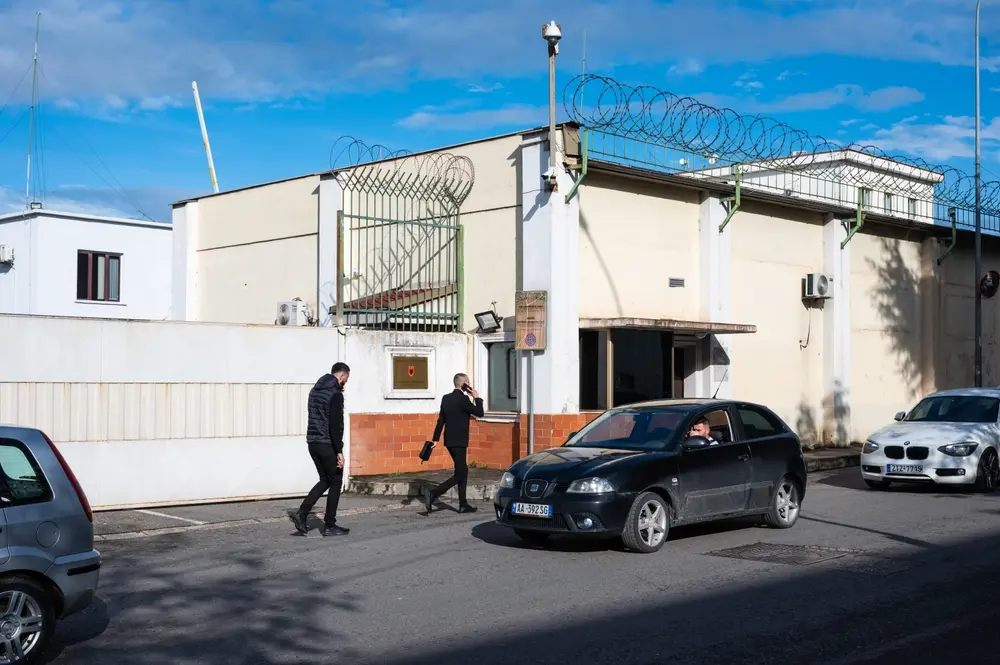
The State Intelligence Service or SHISH in Tirana, Albania © Werner Lerooy/Shutterstock
The State Intelligence Service or SHISH in Tirana, Albania © Werner Lerooy/Shutterstock
Albania’s State Intelligence Service (SHISH) director, Vlora Hyseni, has been suspended from office and placed under house arrest as part of a widening investigation by the Special Prosecution Office against Corruption and Organized Crime (SPAK).
Hyseni is accused of assisting an alleged perpetrator of a crime and disclosing classified information. A decision by the Special Court of First Instance for Corruption and Organized Crime on 21 September imposed house arrest and suspension from public duty.
The case has raised concerns because the investigation links Albania’s intelligence service to a broader criminal probe into public procurement at the National Agency for Information Society (AKSHI), the institution responsible for much of the country’s digital public infrastructure.
According to reports on the investigation, prosecutors suspect that Hyseni passed confidential information to businessman Ergys Agasi, who is himself under investigation in the AKSHI case.
From Kosovo intelligence to Albania’s top intelligence post
Hyseni, who holds both Albanian and Kosovar citizenship, began her intelligence career in Kosovo. She joined the Kosovo Intelligence Agency (AKI) in 2010 and became its deputy director in 2019.
At the end of 2020, she temporarily headed the agency following the resignation of its director, Kreshnik Gashi.
In June 2021, Kosovo President Vjosa Osmani and Prime Minister Albin Kurti signed a decision dismissing Hyseni as deputy director. The public decision did not give a specific reason for her dismissal.
It ordered her to hand over materials under her administration and to continue observing obligations concerning classified information. Kosovo authorities did not publicly provide a detailed explanation of the decision.
Two years later, Hyseni moved to Albania and became a security adviser to Prime Minister Edi Rama. In March 2023, Rama proposed her appointment as head of SHISH, and President Bajram Begaj formally appointed her the following month.
Her previous dismissal in Kosovo became a subject of political debate at the time. Opposition MP Gazment Bardhi called for Albanian authorities to seek information from Kosovo about the reasons for her removal. Rama dismissed the allegations circulating at the time as “rumours”.
A senior intelligence official with international contacts
During her tenure, Hyseni developed a significant international profile.
She accompanied Rama to the 2023 NATO summit in Vilnius and in 2025 took over the chairmanship of NATO’s Civilian Intelligence Committee, which brings together representatives of civilian intelligence services from member states.
She also held meetings with security and intelligence officials in the United States and Brussels.
The current investigation therefore has implications beyond the alleged conduct of an individual public official. It concerns the handling of sensitive information by the head of an intelligence agency that is responsible for identifying and assessing threats to Albania’s national security.
There is, however, no publicly available evidence so far that Albania’s international intelligence partners have been compromised as a result of the case.
The AKSHI investigation
The allegations against Hyseni are connected to one of SPAK’s broader investigations into public procurement.
The AKSHI investigation concerns 19 procurement procedures worth approximately 5.9 billion lek (€59 million). Prosecutors suspect that the procedures were manipulated to favour particular companies.
Among the people investigated is Ergys Agasi, a businessman and former public official. Agasi previously headed the State Inspectorate of Environment and Forests before moving into the private sector. His business interests later expanded into technology, including through EA Solution.
SPAK suspects Agasi of playing a role in a scheme to manipulate AKSHI tenders. He was declared wanted at the end of 2025 and arrested in August 2026 after around eight months on the run.
The investigation has also reached senior figures in Albania’s security and law-enforcement institutions. Former State Police Director General Ilir Proda was questioned by SPAK in connection with the case, while police officers and other officials have also come under investigation.
Agasi was arrested alongside Uljan Shpataraku, a former senior police official in Elbasan.
Another person linked to the investigation is Ermal Beqiraj, identified as Agasi’s business partner. Beqiraj was arrested in France in July after a light aircraft carrying him entered restricted airspace over the Penly nuclear power plant.
According to SPAK, French authorities subsequently identified assets belonging to Beqiraj in France that Albanian prosecutors suspect were acquired with criminal proceeds. The prosecution says he transferred part of the alleged illicit proceeds to France, where he purchased a castle, two apartments and motor vehicles, while more than €2 million was allegedly deposited in bank accounts.
Why the Hyseni case matters
The Hyseni investigation adds a new dimension to the AKSHI case. What began as an investigation into alleged manipulation of public technology contracts has expanded into questions about access to and possible disclosure of sensitive state information.
The central allegation against Hyseni is not that she participated in the alleged manipulation of AKSHI tenders, but that she allegedly provided confidential information to a person at the centre of that investigation.
The case therefore puts two sensitive areas of state power, public digital infrastructure and national intelligence, within the same criminal investigation.
For Albania, where SPAK has increasingly targeted senior officials and politically connected business figures, the investigation will also test the extent to which institutions responsible for national security can operate independently and protect sensitive information while major corruption investigations are underway.
The allegations against Hyseni, Agasi and the other individuals remain subject to judicial proceedings. No one has been convicted in connection with these allegations.
Found an error in this article? Please contact our editorial team at redazione@balcanicaucaso.org.
Tag:
Featured articles
 the students' voices
 Investigation
 students' protest