Life in the Albanian mountains, a tale of two villages
Separated by a border but connected by the same Pindus mountain range, Demati and Dardha tell parallel stories of communities that once thrived, then emptied, and are now, cautiously, beginning to imagine what comes next
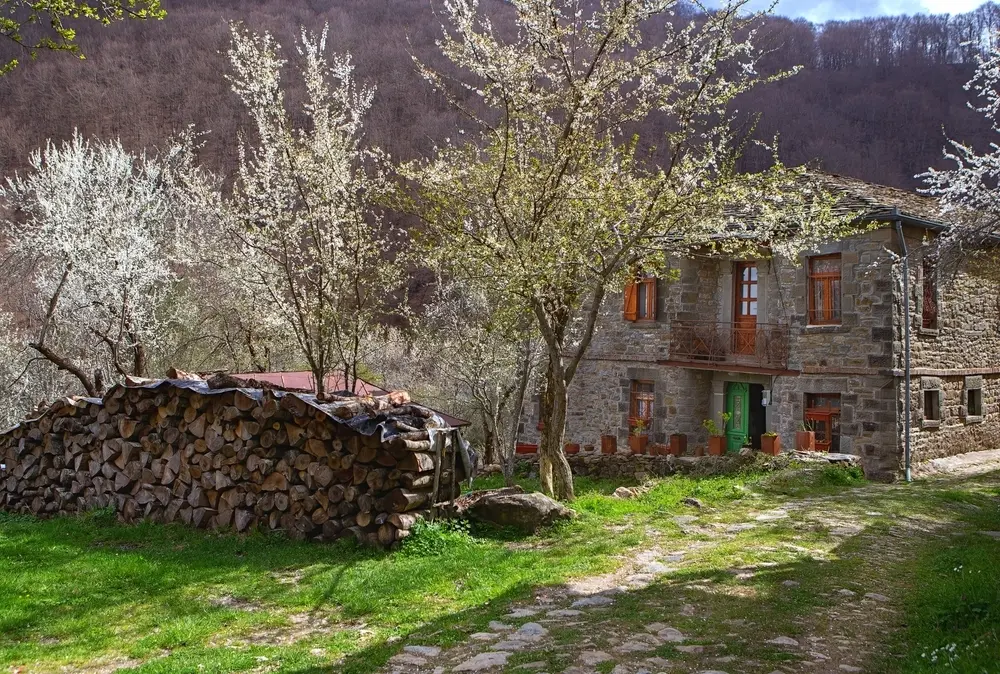
An old traditional village house in Dardha.
An old traditional village house in Dardha. © Sualdo Dino/Shutterstock
Dardha was founded in defiance — of Ottoman rule, of forced conversion, of the lowland order that threatened everything its founders wished to preserve. Established in the 17th century by Orthodox Albanians fleeing persecution, the village took shape as a refuge, high and deliberate, at around 1,344 metres above sea level in the folds of the Pindus range. That founding impulse – to protect what mattered, to hold on – left its mark. Over the following two centuries, Dardhë produced an unlikely concentration of talent: some 24 notable iconographic painters between the 18th and early 20th centuries, alongside mathematicians, publishers, and politicians. Albania’s current Prime Minister Edi Rama traces part of his origins here.
Yet, prosperity and departure have always moved together in Dardhë. Long before the post-communist exodus, families from the village were already forming the first Albanian communities in the United States and Romania. Sotir Peçi, Josif Pani, and Gjergj Konda founded the Society Besa-Besë, the newspaper “Kombi”, and ultimately the federation Vatra; America-based civic institutions that their homeland could not yet offer them. It was a pattern that never fully reversed. After the fall of communism, the flow intensified: much of the population moved to Korçë, Tirana, Greece, Romania, or the United States, part of the sustained rural exodus that has reshaped mountain communities across Albania in the decades since (Lerch, 2016). By 2013, the toll was legible in the starkest of ways: only 40 people appeared on the electoral roll, the vast majority of them pensioners.
Walking through the village today, the narrow alleys and traditional stone houses speak of centuries of mountain life and of long absence. The first person to walk me through these streets is Pavlina Evro Ylli, former Consul General to Greece, once legendary athlete, and proud native of Korça. She navigates the cobbled streets with the ease of someone who carries a place inside them. Together we walk the narrow alleys, wildflowers still dusted in frost and bearing the tentative promise of spring. We then make our way up to the ski slopes carved into the surrounding forest, past the characteristic wooden chalets that dot the hillside, the snow still thick underfoot and the air sharp with pine. We stop where the stone houses give way to open hillside, the valley of Korça spread wide and luminous in the distance. Together with locals, over rakia and warm lakror up in the snow-dusted mountains, the conversation keeps returning to the same question: what does it take for a place like this to believe in its own future again?
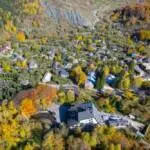
Interreg-Ristor: revitalise abandoned mountain villages in Greece and Albania
The cross-border cooperation with Greece
During fieldwork in the village, residents described a gradual shift in recent years: properties being purchased by Albanians living abroad, the houses coming back to life as seasonal retreats. For those who stayed, it has meant some work, some income, some company in the warmer months. Like their counterparts in Demati across the border, however, some residents quietly voiced a concern familiar to depopulated mountain communities everywhere; that tourism and outside investment, if left unguided, might eventually serve newcomers more than those who never left. It is not a crisis, nor an inevitability; but it is the kind of unease that a project like Interreg-RISTOR, at its most attentive, is well-placed to hear.
The Interreg-RISTOR project is co-funded by the EU under the Interreg IPA cross-border cooperation programme 2021-2027 between Greece and Albania.
At the centre of the village stands a historical municipal building, long unused, which will soon become RISTOR’s Innovation Hub for Sustainable and Inclusive Tourism. Coordinated by the Municipality of Korça in collaboration with the Municipality of Zagori, Impact Hub Athens, P2P Lab, and the Observatory for Children and Youth Rights, the hub is designed to connect residents with training and resources, and foster tourism that respects both heritage and nature. By 2027, it will serve as a platform for workshops, cultural projects, entrepreneurial support, and community initiatives, allowing residents to shape the village’s future rather than simply watch it change around them.
The parallels with Demati, RISTOR’s partner village across the border in Greece, are striking. Both communities sit at altitude, thinned by decades of emigration, and both are now being asked to imagine a different trajectory; one where remoteness, quietness, and authenticity become assets rather than liabilities. The expected outcomes across both sites are tangible: over 100 local professionals will receive training, over 30 new tourism products and services will be developed in both regions involved. Overall, the program aspires to reach its goal of having over 2,500 visitors anticipated annually. But the ambition runs deeper than metrics.
The project aims to strengthen social cohesion, support local producers, and demonstrate that a community can open itself to new possibilities without surrendering its identity. In Dardhë, that possibility feels real. The ski slopes are busy in winter, the guesthouses are filling, and a new generation of questions is being asked about what sustainable mountain life can look like. The Innovation Hub will not transform the village overnight, but it offers something perhaps more valuable: a room, literal and figurative, where that future can be discussed on local terms.
Found an error in this article? Please contact our editorial team at redazione@balcanicaucaso.org.
This article was produced as part of the EuSEE project, co-funded by the European Union. However, the views and opinions expressed are solely those of the author(s) and do not necessarily reflect those of the granting authority, and the European Union cannot be held responsible for them.
Tag: Coesione UE | EuSEE
Featured articles
 Investigation
 students' protest
 Montenegro Pride 2026