Greece, life at the edge of the high mountains
In the remote village of Demati, initiatives supported by the EU’s Interreg program are quietly giving new life to abandoned spaces and a fading community
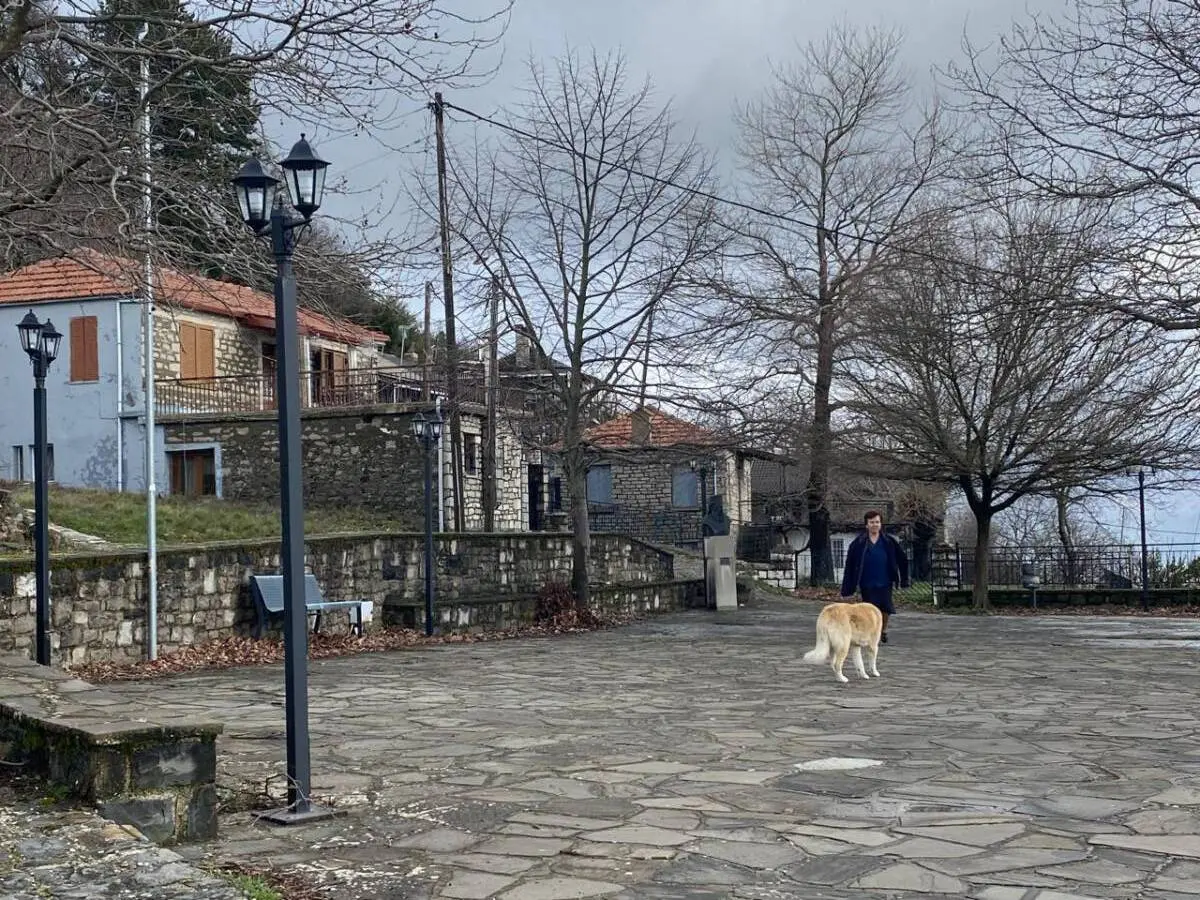
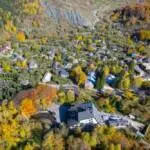
Demati village in Greece
Demati village in Greece. Photo Mary Drosopoulos
Driving to Demati, in eastern Zagori, feels like entering a different rhythm of time. The slopes of the mountain rise steeply, narrow and winding. For someone visiting from the city, the contrast is striking. But for those who live here, it is simply part of daily life. Roads that feel precarious are ordinary to locals. Houses that seem empty are part of the landscape.
At the entrance of the village, the first stop is a building that serves as its cultural association. It is the only place where one can park their car; a modest pause before the steep streets and stone paths lead further into the central square. From the outside, it looks like little more than a brick building with a small porch, unassuming and quiet, blending into the rugged surroundings. Yet inside, it’s decorated as a traditional Greek ‘kafené’; normally, a space for gathering, coffee and vivid conversation, though on this morning, it feels more like a quiet museum of village memory. Its shelves are lined with ethnographic artifacts: woven textiles, old photographs and tools once used in everyday life.
When I step inside hesitantly, a local woman asks briefly what I want. During the few minutes I remain, she stands silently at the door, clearly in a hurry. I can’t help but notice the contrast between the building’s ordinary façade and the life it holds, or once held. The space feels suspended, almost waiting for the village to come alive around it again. When we leave, the woman closes and locks the door behind us.
The population data alone tells a striking story: in 1981, Demati’s population was recorded at 427 people, but by 1991 it had collapsed to just 41. The abandonment of Demati was not a single event but a layered collapse across roughly a century. After union with Greece following the Balkan Wars, emigration toward urban centres began eroding the population. World War II struck with particular ferocity: the villages of the East Zagori mountain (Zagorochoria) were burned in German reprisals, with 1,679 houses destroyed and 171 lives lost across the region. The Greek Civil War (1946–1949) then dealt the killing blow, forcing nearly all remaining residents to flee. What followed was a quieter but equally decisive wave: post-war urbanisation, and in Demati’s case, mass emigration to Philadelphia, USA, where an entire diaspora community eventually took root.
Today, the village counts only four permanent residents, with most homes owned by families who return from America during the summers. One of thοse who have stayed is Ms. Vasileia, born and raised up there in the mountains. A pensioner now, she has lived through decades of change and depopulation, yet, as she explains, she does not feel lonely; the routines of her days, shaped over a lifetime of agricultural work with animals, are full and familiar. Her calm presence offers a grounding contrast to the first impression I received in the village.
Interreg-Ristor: revitalise abandoned mountain villages in Greece and Albania
The Interreg programme in Demati
Zagorochoria villages are vulnerable to depopulation, while facing the challenge of preserving traditional forms of architecture and building practices, alongside modern residential needs. Since the 1980s, state initiatives have aimed to preserve the traditional character of the villages and the natural landscape, and in September 2023, UNESCO added Zagori to its list of Cultural Landscapes. However, the tourism recovery that has helped some central and western Zagori villages has largely bypassed Demati, which remains authentically quiet; a double-edged quality.
A major effort to revitalise the area is the Interreg program, part of the EU cohesion policy, which supports cross-border initiatives to sustain rural communities. Specifically, Demati is part of the Interreg-RISTOR project (Rural Innovation centers for Sustainable and Inclusive TOuRism), co-funded by the EU under the Interreg IPA cross-border cooperation programme 2021-2027 between Greece and Albania. The project focuses specifically on the village’s former school building, which will be fully restored and converted into an Innovation Hub for Sustainable and Inclusive Tourism. It will serve as a modern collaborative space where local residents, tourism professionals, and visitors can develop skills, exchange knowledge, and co-create sustainable tourism initiatives, while preserving Demati’s architectural heritage and natural environment.
This initiative is coordinated by the Municipality of Zagori, in cross-border collaboration with the Municipality of Korça and other local partners. The project ensures that young people, women, families, creative professionals, and small-scale producers will be actively involved as beneficiaries and co-creators.
Christos Zgiavras, president of the Demati community, is on his way to hunting, and yet he stops to answer a few questions. The encounter is brief and formal, a glimpse of the village’s cautious approach to outsiders, one more reminder that visitors are still unusual here.
“We are supportive of ideas that are meant to strengthen the village and ensure its long-term vitality,” says Zgiavras. “The Interreg program is an important initiative for the future of Demati and its surroundings; we are committed to that.”
From classrooms to community
The main focus is the old primary school, an elegant building that stands tidy and well-kept, with a playground that seems ready for every swing and slide. Yet not a child is in sight; an almost surreal echo of a space that once rang with youthful voices. The Primary School once stood as a center of community life until it fell silent in the 1980s when the last residents left, as part of a large wave of mass migration to the United States. Today, the last two local students remain connected to the village, though their daily lives have taken them elsewhere. “One studies in another city, while the other attends high school in the nearby village of Kato Pedina”, explains Zgiavras.
It is from this school building that, since 2023, Christina Papakyritsi and the team behind the ‘High Mountains’ social cooperative enterprise have been running projects combining cultural, educational and agricultural work. Their activity includes building solidarity networks, fostering mountain production and alternative tourism and offering training and infrastructure to people living or choosing to start a life in rural mountain areas — all aimed at strengthening local economies and social cohesion beyond conventional market logic.
To understand the village as it now stands, one must begin with Christina’s story. She spent years working in marketing in Athens; a career that was outwardly stable but inwardly confining, shaped by deadlines, office routines, and the creeping sense that life was narrowing rather than expanding. She came of age during Greece’s economic crisis, a period that drove thousands of young Greeks to seek futures abroad. But Christina chose a different kind of departure: rather than leaving the country, she left the city, trading corporate life for the possibility of building something real in a place that still had room for it. She and her partner Antonis now divide their time between Ioannina and Demati, where they have begun cultivating a small greenhouse; a quiet but deliberate act of rootedness in a landscape long shaped by leaving.
Having previously heard President Zgiavras describe how he had welcomed the young couple “with open arms”, I refrain from asking Christina whether she or her friends from the big city had ever been met with this subtle reluctancy that I had sensed as an outsider in my encounters with locals. Instead, we talk about this other couple from Athens who is planning to relocate soon.
“It is encouraging to see the community growing. This place offers a more sustainable quality of living. This doesn’t mean that everything is easy. Life in the mountains is very different from city life. For those who would think of joining, securing a house to stay could also prove challenging at first. Traditionally, locals did not rent their homes, as there was no real need — but attitudes are slowly shifting”.
Walking through Demati, one can sense the subtle caution of a village protective of its ways: locked doors, quiet streets and watchful eyes hinting at a long-held rhythm of life. Its name itself (δεμάτι), meaning “a bundle or a bound gathering, a concentration of people” may reflect something essential about its character. According to local historian I. Mantos, the village “was one of the most concentrated of the region, with streets and narrow alleys,” and some interpretations hold that its inhabitants were historically known for being tightly bound and united against whomever they perceived as a foreigner.
By creating the Innovation Hub and engaging residents directly in training and collaborative tourism initiatives, Interreg-RISTOR might help the community see the tangible benefits of change, showing that newcomers and new ideas can strengthen, rather than disrupt, life in the high mountains.
“To have real impact, you need to build meaningful relationships and this takes time, it means sitting at the kafene to have coffee with the local people”, says Vasilis Niaros, core member of the P2P Lab, one of the implementing organisations. Marina Paraskevaidi, fundraising and Partnerships Manager at Impact Hub, stresses the importance of ongoing engagement: “The Impact Hub has a longstanding presence in the Epirus, this is an important project building on our consolidated experience in the region”.
Found an error in this article? Please contact our editorial team at redazione@balcanicaucaso.org.
This article was produced as part of the EuSEE project, co-funded by the European Union. However, the views and opinions expressed are solely those of the author(s) and do not necessarily reflect those of the granting authority, and the European Union cannot be held responsible for them.
Tag: Coesione UE | EuSEE
Featured articles
 Investigation
 students' protest
 Montenegro Pride 2026