Elections in Serbia, a crucial vote
With parliamentary elections scheduled for October 25, Serbia is bracing for one of the most politically uncertain moments of the last decade. We spoke with political analyst Mirko Dautović about the atmosphere in the country, the significance of the student movement, the risks posed by the upcoming elections, and the potential reactions from the international community
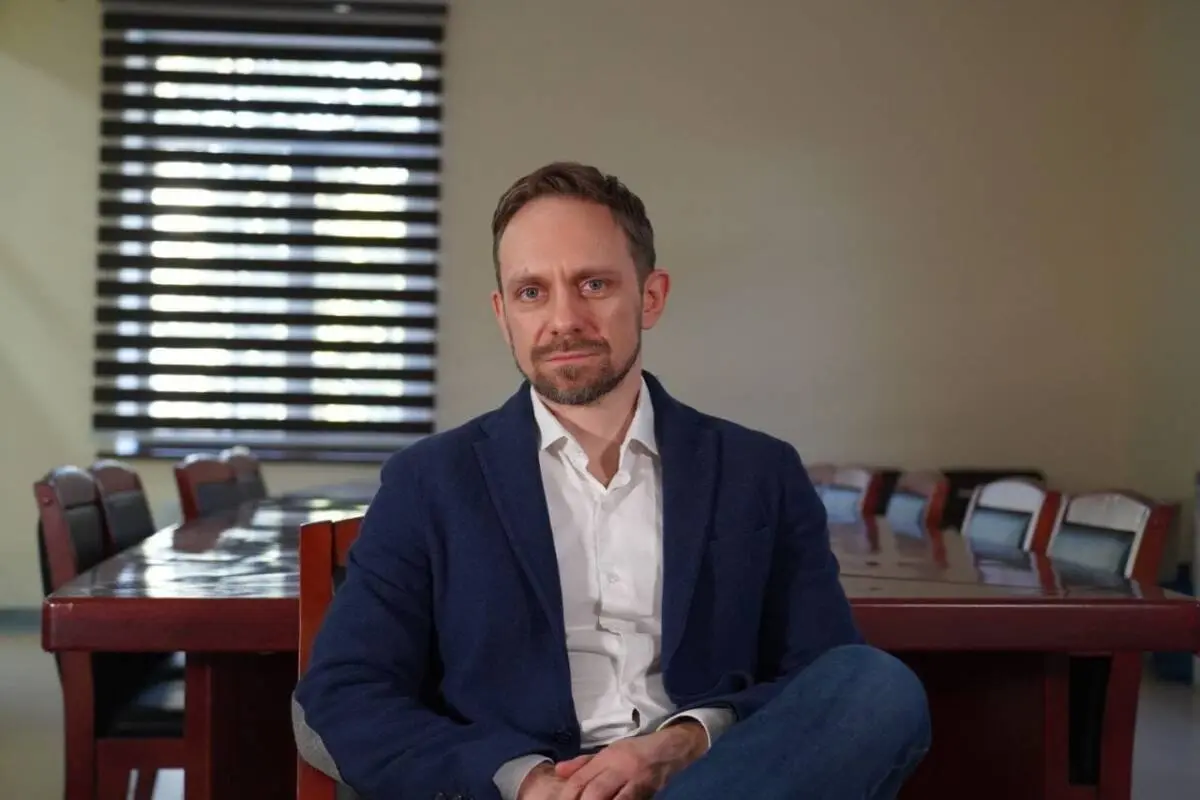
Mirko Dautović – foto D. Nenadić
Mirko Dautović - photo D. Nenadić
In what kind of atmosphere are Serbian citizens awaiting the elections scheduled for October 25th?
The Student List and the citizens who support it are demonstrating great energy, and their numbers on the streets are growing. The atmosphere at the demonstrations and rallies organized by the students is festive. The students have united citizens in the hope that the government of the Serbian Progressive Party (SNS) will be toppled.
On the other hand, at the rallies organized by the ruling party — usually in the immediate vicinity of the student gatherings — the atmosphere is somber and lacks energy, with very few participants, who often appear as if they were coerced into attending. In contrast, the events organized by the Student List have seen high turnout, and those citizens who intend to vote for this list are confident in its victory.
In your view, what exactly do the students mean when they speak of victory?
According to the latest available polls, conducted about a month ago, neither the Student List nor the Serbian Progressive Party enjoys support exceeding 50%. The Student List is projected to secure between 40% and 45% of the vote. In this context, even in a worst-case scenario where the Student List does not win outright, it could still secure enough votes to prevent the SNS from forming a government on its own.
Such an outcome would inevitably destabilize Vučić and his party. If Vučić were to succeed in forming a government after the elections, it would likely be short-lived, dependent on the support of so-called satellite parties and lists. That is the worst-case scenario. However, support for the Student List has grown over the last month, and it is possible that it has already surpassed 50% of the vote, while the SNS has remained at 40%. This is the current balance of power. It should also be noted that some of Vučić’s former supporters would rather stay away from the polls than vote for the Student List.
Will Serbian citizens truly participate in democratic elections on October 25th — much like citizens in other countries, especially those in the European Union?
One of the most significant issues in Serbia concerns the integrity of these elections, as well as previous ones. The electoral roll is particularly problematic; it is inaccessible to the public and even to the Commission tasked with verifying, auditing, ensuring the accuracy of, and updating the list itself. Despite multiple requests, members of this Commission have not been granted full access to all the relevant databases.
There is a suspicion that the SNS has secured votes by manipulating the electoral roll — a claim for which there is no definitive proof at present, yet this conduct is highly telling and sheds light on the situation ahead of the elections.
A member of the Commission for the review of the electoral roll reported that when the Ministry of the Interior was asked about the number of identity cards issued since May of this year, it responded that 235,000 had been issued between May and September. It is suspected that some SNS members may have obtained false identities to cast multiple votes. All of this undermines the legitimacy of the upcoming elections.
The voting process for Serbian citizens residing abroad is also problematic. Despite a higher number of registered citizens compared to the previous elections, the Central Election Commission (RIK) — acting on a proposal from the Ministry of Foreign Affairs — has approved the opening of fewer polling stations than in the last round. This is particularly true in foreign cities home to Serbian citizens who left the country because of the SNS regime.
We are talking about highly educated individuals —doctors, engineers, IT experts — to whom the regime has sent a clear message: if you are not happy in Serbia, feel free to leave. This is the situation for our fellow citizens in places like Tel Aviv or Abu Dhabi, where no polling stations will be opened at all. In Russia, meanwhile, polling stations will be available in Moscow and Sochi, with the latter located on the premises of a private company, but nowhere else in the country, effectively preventing many Serbian citizens living in Russia from casting their votes. Even in Vancouver, which hosts a large Serbian community, the polling stations will remain closed. This confirms that Vučić is determined to hinder voting within the diaspora, well aware that many Serbian citizens living abroad oppose the current regime in Belgrade.
I anticipate blatant electoral fraud; therefore, it is of critical importance that the Student List provides a large number of poll watchers and that civil society organizations deploy a sufficient number of observers. Furthermore, it is essential to involve international observers who can bear witness to any potential fraud or acts of violence perpetrated by the ruling party.
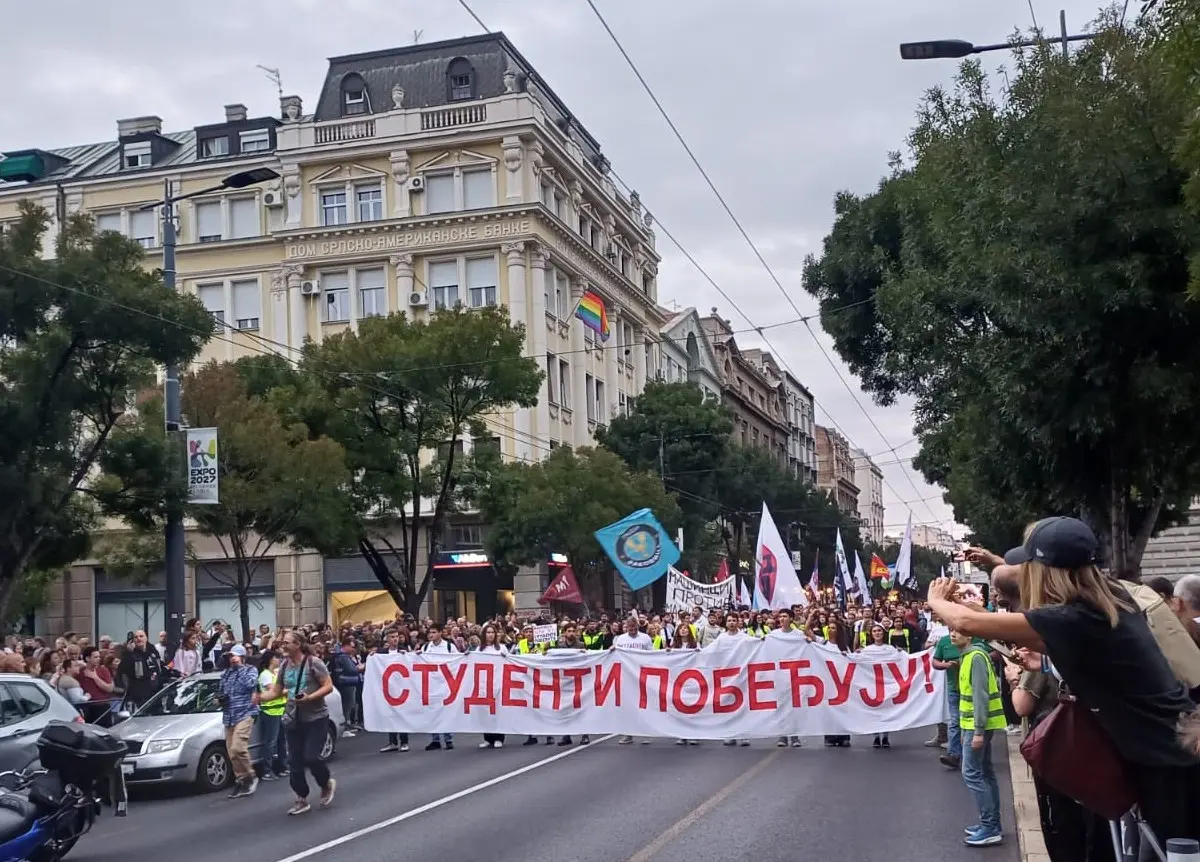
Student march in Belgrade, Serbia – “Students win” – Photo by D. Nenadić
How do you envision election day and the situation in the aftermath of the vote in Serbia?
If Vučić realizes he is trailing, he might announce the annulment of the elections. It is also possible that his supporters could incite incidents, which could then be used to justify halting the voting process; I cannot even rule out the declaration of a state of emergency. I expect the worst from the current government, because for the SNS, given its involvement in corruption scandals, remaining in power is an absolute imperative. For both the SNS and Vučić, these elections are an all-or-nothing gamble, which is why I expect Vučić to do whatever it takes to win.
In a context such as the one just described, is there any chance that the “Student List” could emerge victorious in the upcoming elections?
The Student List is composed of candidates selected using the same method employed by students during their protests: through “plenums.” This is a form of direct democracy. The plenary assembly of each faculty proposed candidates, and the final decision was reached through the consensus of all the plenary assemblies across Serbian universities, with the option to veto (exclude) specific individuals.
This exclusion process was applied in cases where a candidate’s credibility had been compromised — for instance, due to past associations with parties in either the government or the opposition — or because of the potential risks and exposure to direct attacks from the ruling party. Only those candidates with a strong record of positive attributes and minimal negative baggage remained on the list. Through its media outlets, the SNS targeted and demonized individuals perceived by the public as potential candidates for the Student List, making them so undesirable that their inclusion would have been detrimental to the Student List itself. This list is composed primarily of professors, but it also includes farmers, human rights defenders, environmentalists, and members of national minorities. Ultimately, the “Student List” has been compiled in such a way that conservatives and liberals, figures from the left and the right, nationalists, and pro-European voters can all cast a ballot for it. In short, it is a “catch-all” list.
Most of the candidates the students included on their list had no prior political experience — a reflection of the fact that the very concept of party politics is repugnant to many citizens. With this in mind, Vučić attempted to influence voters, aiming to make them so passive that they would stay away from the polls,but he proved unable to do so.
We see daily attempts to discredit the candidates of the Student List. According to regime-aligned tabloids, the lead candidate, Dr. Ilija Srdanović, allegedly owns property in Croatia — a claim that was immediately proven false. This is a tactic Vučić has long used successfully against opposition parties and figures. Yet, the Student List has withstood these attacks. Its method of selecting candidates through a “plenum” sets it apart. This list serves as an experiment in a new form of democracy, one based on the delegation of candidates rather than selection through political parties.
The upcoming elections in Serbia are increasingly taking on the character of a referendum: voters are simply choosing “for” or “against,” with a notable absence of clear ideological or value-based considerations. How can this situation be explained?
Today, the only ideology in Serbia is that of toppling the SNS government, halting corruption, purging the public administration of incompetent SNS appointees, recovering funds siphoned off abroad, and freeing the media from the control of the ruling party. In Serbia, we are fighting for basic democracy, with the hope that, once the current administration’s rule comes to an end, a free public sphere will emerge. Only then will we be able to speak of a functional democracy in Serbia.
Issues concerning Serbia’s potential EU accession and its relationship with Kosovo threaten to create a rift within the electorate. The SNS has sought to steer public debate precisely toward these topics in an attempt to divide the student movement. However, the students have not fallen for this; consequently, the primary focus remains the fight against corruption and a change in government.
Certain aspects of the student movement’s platform, developed by the students themselves in collaboration with professors and experts, such as the section on agriculture, are entirely sound. Nevertheless, major geopolitical questions, as well as the reckoning with the recent past and the legacy of the wars, have been deferred to a later time — largely because raising such issues would trigger ideological debates that are not currently a priority for the students.
Do you believe that unrest might occur on election day or in the days immediately following the vote?
Vučić will resort to violence, whether legal or physical. He has special units composed of criminals whose task is to beat up students and citizens. I wouldn’t be surprised to see them on the streets on election day, just as happened in cities where local elections were recently held. Let us not forget that Vučić controls both the police and the army.
This time, however, things are different. The enthusiasm among the students and the citizens who support them is very strong, so strong that even violence cannot counter it. On election day, October 25th, the most crucial factor will be a massive voter turnout, which would serve as a clear signal of a victory for the Student List. A few days prior, the Student List will hold its final rally in Belgrade’s Slavija Square; the scale of the turnout there will make it evident that Vučić cannot so easily secure a victory through violence.
In your view, how will Europe and the rest of the world react to the conduct and outcome of the elections in Serbia?
Until now, Vučić has managed his foreign policy with considerable success, pursuing his own interests while maintaining good relations with Berlin, Paris, Brussels, Washington, Moscow, Beijing, and Ankara. All these nations have benefited from this approach: Rafale fighter jets have been purchased from France; Russia has secured a base in Serbia for its operations; and Ukraine has received weaponry. Certain areas in eastern Serbia have been opened up to China for the extraction of copper and gold, and Vučić now intends to hand over western Serbia to mining companies for the exploitation of lithium. Trump has been promised the Generalštab building, a site in Serbia associated with great suffering due to the 1999 bombings. For a long time, Vučić enjoyed the support of Ursula von der Leyen, President of the European Commission, as well as that of German chancellors Olaf Scholz and Friedrich Merz. He also maintained very close ties with Hungarian Prime Minister Viktor Orbán.
All these so-called good relations were built on the exploitation of Serbia and the granting of benefits to others, while simultaneously ensuring that Vučić and his party remained in power. Recently, however, this support has faded — a fact clearly evidenced by the ongoing election campaign. None of his international partners have visited Serbia, despite invitations having been extended to figures such as Emmanuel Macron, representatives of the German CDU, and the Austrian People’s Party. There is no longer any explicit support from the United States, either; in fact, Republican Senator Wilson is waging a “mini-campaign” against Vučić. Western European nations, as well as the United States and Serbia’s other international partners, are aware of the results of recent opinion polls, which point with increasing clarity toward a defeat for Vučić.
Found an error in this article? Please contact our editorial team at redazione@balcanicaucaso.org.
Tag:
Featured articles
 Investigation
 students' protest
 Montenegro Pride 2026