Romania: rebel herbs and solidarity kitchens
In Iaşi, northeastern Romania, an association has been challenging an unfair and highly consumerist food system for years. Today, the bistro run by the association is at risk of closing, but the vision endures and is renewed: from alternative cuisine, a social enterprise is born
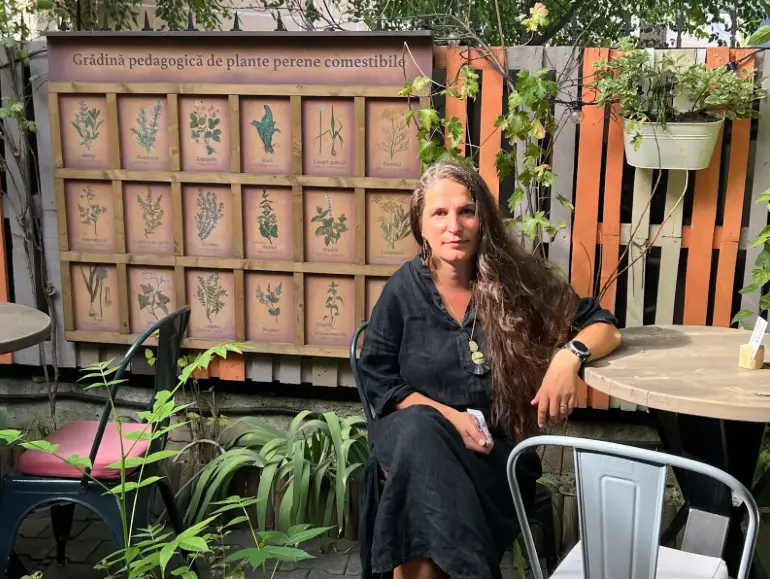
Anca Gheorghica is the founder of Mai Bine, the association that created CUIB. Photo: Marta Abbà
Anca Gheorghica is the founder of Mai Bine, the association that created CUIB. Photo: Marta Abbà
“What is right is not always legal, and vice versa. Laws often fail to promote what would bring justice. This contradiction is omnipresent”.
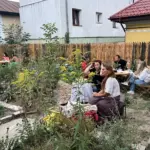
Anca Gheorghica says this while sitting at a table at CUIB, the restaurant she founded in the heart of Iași, in northeastern Romania. Anca’s bistro overlooks a central street, constantly crisscrossed by cars, but protected by a gate to which bicycles are locked. Once inside, the traffic fades away and you enter a cozy courtyard, a few wooden tables, and a cat moving among the flowerpots with the ease of someone who knows it is home.
Natural food prepared with exclusively Romanian ingredients, no rush to order, a shelf full of sprouts to choose from and take home. In the background, the climate stripes (the famous red-and-blue graph indicating temperatures from 1850 to the present) painted on the fence tell the story of a warming planet. Around it, a flowerbed unlike any other in the city: mallow, yarrow, hyssop—perennials that were once eaten but are now almost unrecognizable.
Gheorghica looks around, as if announcing a revolutionary idea, to understand the effect of voicing out loud the concept of justice that underpins everything she has created in recent decades. A concept that questions what we eat and who decides how to produce it, challenging the current “monopolistic and consumerist” food system.
CUIB is the most visible project of Mai Bine, the nonprofit organisation that Gheorghica founded in 2009 to demonstrate that “another world is possible” and that “economic activity cannot and should not be the only goal”.
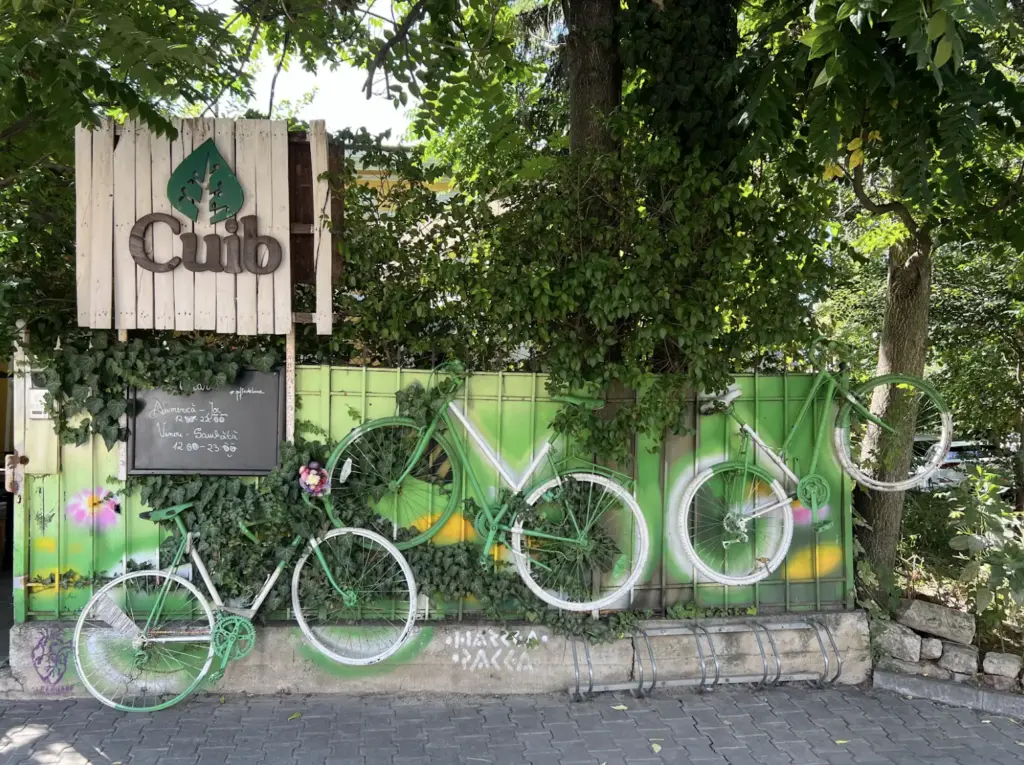
The entrance to CUIB – literally “a nest”, and in practice a welcoming, authentic space created by the Mai Bine association. Photo: Marta Abbà
Cultivating different foods and worlds
CUIB is an acronym for Centrul Urban de Inițiative Bune, [Urban Center for Good Initiatives], but in Romanian it also means “nest”. The paradigm Gheorghica challenges emerges before you even grasp it: as soon as you cross the fence, you come across a “rebel flowerbed”, containing eighteen species of perennial herbs cultivated since the project’s inception so that they would once again be recognised as food, not as weeds to be eradicated.
“They have fallen into oblivion, but they could feed us more sustainably”, says Gheorghica. “They do not need water or fertilizer. They are much more resilient than us”. A little further on stands an insect tree, made from recycled materials, surrounded by shelves where anyone can pick up sprouts for free, like a small seed library: no cash registers, no prices.
The bistro opened in 2013 and is the first and only certified restaurant in Romania for offering entirely vegetarian food, including local drinks. “It is not a bistro like the others, and that was exactly the idea”, explains Gheorghica. “We were not interested in making money. We wanted to show that another way of being in the world was possible”.
The association was founded in a city, Iaşi, which – despite being Romania’s second-largest city by population and one of the country’s most important university centers – often remains on the margins of green investment flows, reserved primarily for Cluj and Bucharest.
According to data provided by the association, in the seventeen years since its foundation, Mai Bine has completed over thirty projects with the contribution of more than two hundred volunteers, from promoting cycling and recycling to the social economy, following the idea that Gheorghica often cites: think globally, act locally.
The most recent project is Reboot, funded by the European Union. Thanks to European funding, the association has regenerated a plot of land a fifteen-minute walk from CUIB, in a more residential area. It is there, not in the bistro, that Mai Bine is now based.
For a decade, the land was overrun by an illegal landfill, built next to an abandoned building. “It took a long time to clear it, clean it, let it rest”, says Gheorghica. Work began in November 2025. Today, pumpkins grow hidden beneath the leaves, flowers intertwine with vegetables, and next to the garden stands a dilapidated house, left there as a reminder of where everything began.
Visit the photo gallery
From indignation to the power of example
Gheorghica was twenty-six when she launched the project, after years of living and studying abroad, in Belgium, Ghana, Finland, Spain and the United States. Her education ranged from a degree in biology and geography to a doctorate in economics. She also earned a master’s degree in human ecology. Leaving Romania seemed like a family destiny, as it had been for her own parents, who had emigrated to Italy and Spain.
During those wanderings, she discovered a lesser-known side of the “Western dream”, and a vocabulary – Fairtrade, workers’ rights, local agriculture – that no one had taught her in school. During a stay in London, in particular, she was shocked by a wealth she perceived as built on colonialism.
From that irritation, not a theory was born, but an organisation. Upon returning to Iaşi, after writing and calling those who worked on these issues with no response, Gheorghica decided to start on his own, starting with an almost environmentalist vision – bicycles and recycling – and culminating in a work that combines social, economic and ecological dimensions.
Over the past seventeen years, approximately three hundred people have worked or volunteered at CUIB. Not all have been equally impacted, but some have become true friends, others have made tangible changes in their habits.
Vadra’s new challenge
Robert Buburuzanu is the most concrete living proof of that commitment. He is thirty-four and the bistro’s chef. He arrived as a volunteer fifteen years ago, with a group of young people Gheorghica had helped organise. After a few years of volunteer work, he moved to the bar as a bartender, then to the kitchen, first part-time and finally with a full contract thirteen years ago. “Here I found trust, people who supported me. Initially, my place was in their kitchen, today it is in mine”, says Robert.
From this journey, Vadra was born, the social enterprise that Buburuzanu recently launched with the support of Mai Bine and thanks to funding obtained through the Alături de Voi Foundation’s Social Enterprise Accelerator. The enterprise’s headquarters is the Mayer House, a historic building that the association is renovating with support from the Investment and Development Bank. This location houses Mai Bine’s new headquarters, a community garden and the Vadra-named event and catering space.
On opening day, the courtyard is filled with children running and chasing each other. Buburuzanu, among them, teaches his seven employees from vulnerable groups how to make pizza dough. He shows them how to roll it out without breaking it, how much oil to pour, and when to bake. He is teaching these skills for the first time to those who are learning them for the first time, and as he does so, the anticipation of good, wholesome food begins to hover in the air.
Vadra caters private and corporate events throughout northeastern Romania. No meat, seasonal produce and small suppliers. “Tomorrow I am going to the market to get vegetables and preserves from a local farmer”, says Buburuzanu, almost amazed at how his passion has become his profession.
He almost does not dare say it out loud, but for him it is both the natural and courageous continuation of what he learned in thirteen years in the kitchen at CUIB: attention to individuals and the seasons, food as a trigger for interpersonal relationships.
Beyond the bistro
During these autumn months, Mai Bine is carrying out several initiatives: an event on seed conservation, a meeting in Moldova to build a bird sanctuary, and a food-themed escape room. The association is not stopping, but behind a multitude of initiatives, Gheorghica does not hide a more fragile balance sheet.
Managing Romanian public funds entails a burdensome bureaucracy that, after seventeen years of European projects, still seems almost impossible for her to handle alone. Furthermore, Mai Bine has never accepted corporate sponsorships or operations that resembled greenwashing: an independence that today clashes with the lack of stable funding.
But it does not end there. Romania’s economy has been experiencing a slowdown and stagnation in recent years, accompanied by high inflation, including food prices. In 2025, food inflation in the country was the highest in the European Union: 6.7%, more than double the European average of 2.8%.
“When people are worried about money, the first thing they give up is healthy food”, says Gheorghica. After more than a decade in business, she admits that this could be the last year for CUIB in its current form: perhaps it is simply not its season anymore.
The bistro’s fate presents us with questions that extend far beyond Iași and concern us all. If in times of economic crisis, the first cuts we make are organic and quality food, the transition to a diverse diet risks remaining a luxury of the good old days. CUIB and Mai Bine have been grappling with this challenge for seventeen years. Vadra, a newcomer, will have to confront the same dilemma, proposing alternative models.
Found an error in this article? Please contact our editorial team at redazione@balcanicaucaso.org.
 This material is published in the context of the Station4Transformation project, co-funded by the European Union (EU). The EU is in no way responsible for the information or views expressed within the framework of the project. Responsibility for the content lies solely with OBC Transeuropa.
Tag: Cibo | Station for Transformation