Bulgaria’s presidential election: record-low turnout and a tight race in the first round
Bulgarian voters deserted the polls in the first round of the presidential election on 25 October. The runoff, set for 1 November, will pit interim President Ilyana Yotova against former liberal caretaker prime minister Andrey Gyurov, who has unexpectedly closed much of the gap with the candidate backed by Progressive Bulgaria
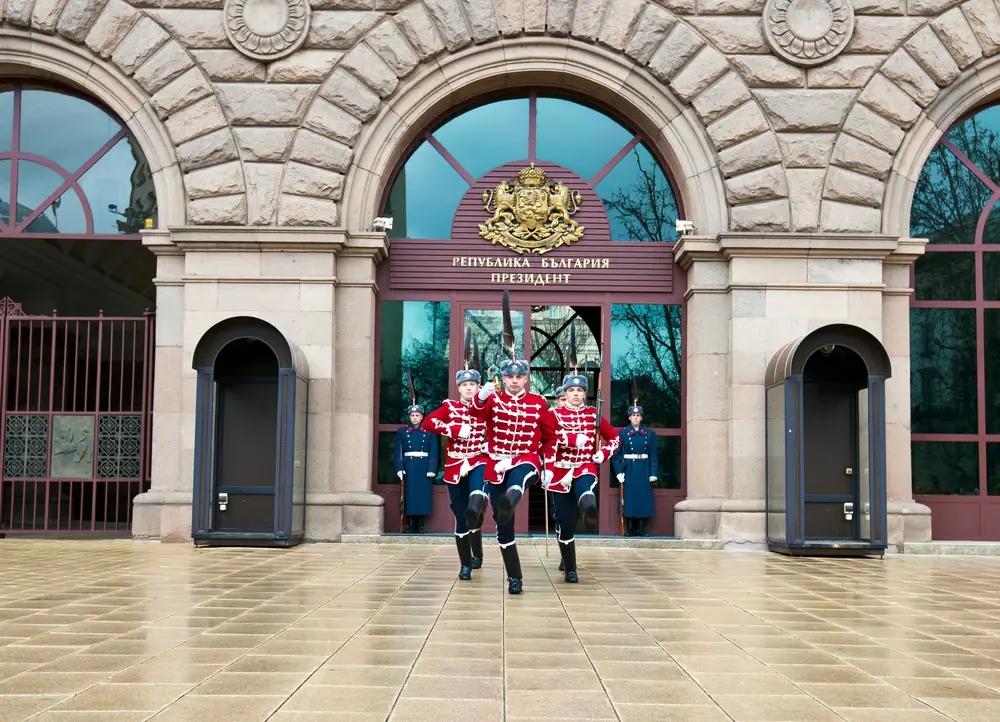
The Bulgarian presidency in Sofia © yevgeniy11/Shutterstock
The Bulgarian presidency in Sofia © yevgeniy11/Shutterstock
While voters in neighbouring Serbia flocked to the polls for historic parliamentary elections that marked the end of Aleksandar Vučić’s long political dominance in the country, Bulgaria recorded a historic low in turnout in the first round of its presidential election.
By the time polling stations closed, just 22.5% of eligible voters had cast their ballots, despite appeals from candidates and political parties and pre-election polls suggesting a much higher turnout.
Low turnout was not the only surprise. Pollsters had widely expected a runoff between incumbent interim President Ilyana Yotova, backed by the ruling Progressive Bulgaria party, and Andrey Gyurov, a former caretaker prime minister representing the liberal right.
That prediction proved correct, but the gap between the two candidates was far narrower than Yotova’s commanding lead at the start of the campaign had suggested. With almost all ballots counted, Yotova was leading Gyurov by less than three percentage points, with 34.7% of the vote against his 32%.
Third place went to Konstadin Konstadinov, the nationalist candidate from Vazrazhdane (Revival), who secured 12.6%. All other candidates trailed well behind.
The near-tie has left the race wide open ahead of the runoff, scheduled for 1 November.
Yotova’s Disappointing Result
Yotova’s performance was a disappointment. Before election day, polls had put the interim president just short of the 50% threshold needed to win outright in the first round. The setback also reflects directly on Prime Minister Rumen Radev and his Progressive Bulgaria party.
Although Yotova ran as an independent, she served as Radev’s vice-president for two terms while he was head of state. She became interim president after he decided to run for prime minister, and her candidacy was openly backed by the ruling party.
“I have the impression that some of us underestimated this election,” Petar Vitanov, the movement’s parliamentary group leader, said in an initial reaction. “It is clear that our opponents were better able to mobilise their voters than we were.”
Speaking to national broadcaster BNT, Asen Vasilev, leader of the liberal reformist party We Continue the Change, which supports Gyurov, described the result as a “red card” from voters to the Radev government.
“I did not expect such a collapse in support for Progressive Bulgaria. I believe this is a clear verdict on the ruling party,” Vasilev said. He pointed to the sharp decline from the 1.4 million votes won by Radev’s party in its landslide victory last April to the 500,000 votes Yotova received on Sunday.
What Explains the Election Results?
Several factors appear to have contributed to Yotova’s weaker-than-expected performance.
One is structural: a landslide victory would have placed much of the country’s key institutions under the control of a single political leader. Historically, Bulgarian voters have been wary of such a concentration of power.
Many voters also appear to have been unimpressed by Yotova and Progressive Bulgaria’s strategic ambiguity over the West-Russia divide and the war in Ukraine, which in recent weeks has spread into the Black Sea, reaching waters off the Bulgarian coast.
Following attacks on and the sinking of Ukrainian merchant vessels off Bulgaria’s coast, Radev -who has long favoured dialogue with the Kremlin – chose not to directly blame Moscow. The stance alienated some voters who had supported him in April and appears to have hurt Yotova’s chances.
Gyurov, by contrast, reiterated his call for Bulgaria to align more firmly with the Euro-Atlantic camp, a message that resonated with those who turned out to vote.
Two scandals that emerged in the final stages of the campaign may also have played a role. One concerned reports that Yotova had previously granted pardons to several drug traffickers on health grounds, decisions that drew criticism from numerous observers.
Another factor was the behaviour of GERB voters. Until now, the centre-right party had dominated Bulgaria’s political landscape, but it chose not to field its own candidate. With party leader Boyko Borisov offering no clear voting recommendation, polls suggest that GERB supporters – whose party is now Bulgaria’s second-largest – largely swung behind Gyurov.
The vote also underscored Bulgaria’s deep socio-economic divide. In the capital, Sofia, where wealth and the middle class are concentrated, Gyurov won 47% of the vote, compared with Yotova’s 27%. The balance gradually shifts in regional centres and smaller, often marginalised municipalities, where Yotova’s 45% contrasts with Gyurov’s 20%.
The Runoff Battle
The two candidates now have a week to recalibrate their campaigns, sharpen their messages and persuade voters to turn out for the runoff.
“The message of peace must be heard. We will reiterate it over the coming week. We will engage more convincingly with our voters,” Yotova said, reaffirming the central tenet of her platform: pursuing peace through negotiations with Russia.
Gyurov’s campaign is also centred on the East-West divide. The 1 November vote is once again being framed as a referendum not only on Bulgaria’s geopolitical alignment, but also on the values the country wishes to uphold.
Found an error in this article? Please contact our editorial team at redazione@balcanicaucaso.org.
Tag:
Featured articles
 the students' voices
 Investigation
 students' protest