The “normalization dividend” in relations between Serbia and Kosovo
Strengthening cooperation will “shift the focus from managing persistent uncertainty to creating shared, consolidated economic interests,” ultimately laying the groundwork for political reconciliation. An interview with Will Bartlett, author of the paper on this topic
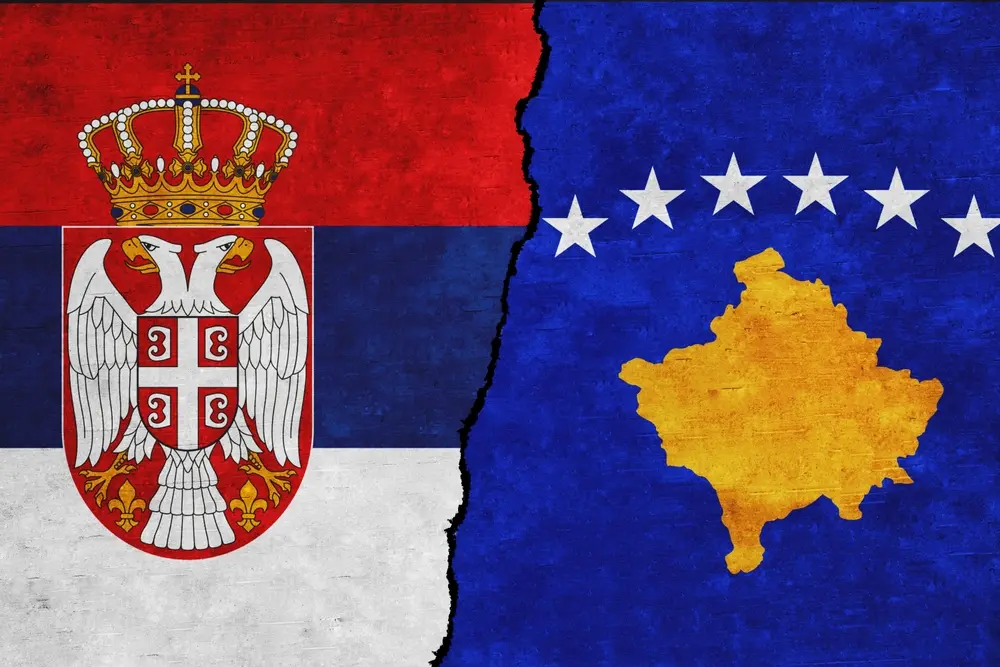
Bandiera della Serbia e del Kosovo © OnePixelStudio/Shutterstock
Bandiera della Serbia e del Kosovo © OnePixelStudio/Shutterstock
There is a factor that helps explain how the normalization of relations between Serbia and Kosovo could positively impact both countries, economically and politically.
This is known as the “normalization dividend.”
Will Bartlett – author of the paper “Strenghtening Kosovo-Serbia relations through economic cooperation: The role of regional economic integration,” a visiting professor at the College of Europe and an associate member of the LSEE (London School of Economics Research on South Eastern Europe) unit – explains this concept in an interview with OBC Transeuropa.
“The normalization dividend means shorter queues at the border, lower food and transport costs for households, and the opportunity for local businesses to build joint supply chains that attract European investment and create better-paid jobs.” It is a factor that promises to “transform political risk into concrete economic security.”
Given the massive impact of the failure to normalize relations between Pristina and Belgrade, “the economic normalization dividend will shift the focus from managing persistent uncertainty to creating shared, consolidated economic interests,” promising to make both economies “far more resilient” and to lay the foundations for political reconciliation.

Will J. Bartlett (private archive)
How do you view the relationship between economic and political normalization in practice?
The main finding of our research is that economic cooperation and political normalization reinforce each other, yet neither can substitute for the other. In practice, expecting economic ties alone to resolve fundamental political disputes is unrealistic.
Conversely, making every cross-border economic transaction contingent on a definitive political breakthrough has entailed heavy economic costs for both sides in terms of lost investment, fragmented supply chains, and missed opportunities under the EU Growth Plan.
Can economic cooperation advance without political normalization?
Yes, through concrete measures, provided that economic cooperation is insulated from day-to-day political negotiations.
We suggest that the best approach is to leverage existing regional agreements such as CEFTA and the Common Regional Market to overcome practical obstacles through, for instance, the mutual recognition of documents, more predictable border crossings, and improved administrative procedures.
When trade rules are predictable, businesses are more inclined to invest across borders. This dynamic creates what we term the “normalization dividend.”
As local businesses, supply chains, and labor markets become genuinely integrated into broader European value chains, the cost of political turbulence will rise sharply for all stakeholders.
Economic cooperation does not automatically lead to political reconciliation, but it fundamentally alters incentives: it gives businesses, workers, and policymakers a tangible, concrete stake in maintaining regional stability.
Ultimately, concrete economic progress makes it easier to support a definitive political solution, but the goal must remain to underpin – not bypass – full political normalization.
What would be the most significant tangible benefits of normalization for businesses in Kosovo and Serbia?
When we speak of the “normalization dividend,” we are not referring to an abstract economic theory, but to tangible, everyday improvements in living conditions and job opportunities for people on both sides of the border.
For businesses, the most immediate dividend is predictability and a reduction in friction.
Currently, trucks can spend hours or even days waiting at border crossings. Eliminating these delays through coordinated border checks and digital “green corridors” can reduce transport and logistics costs and lower consumer prices for goods.
If sanitary, phytosanitary, and quality certificates were mutually accepted without new political disputes, local producers could more easily access markets on the other side, free from arbitrary administrative barriers.
Finally, foreign direct investors generally seek larger markets; fragmented and unpredictable markets can deter industrial investment in the long term.
A more stable economic and political environment would allow local businesses on both sides of the border to collaborate more easily and become integrated suppliers within European supply chains in the automotive, agri-food, and technology sectors.
And what about ordinary citizens?
For them, the benefits of normalization should translate directly into household budgets and economic well-being.
This can lead to lower prices, as inefficient borders act as a hidden tax on food and basic consumer goods, given that open trade ties tend to lower the cost of daily living.
Furthermore, within the framework of the Common Regional Market, the recognition of professional and educational qualifications means that engineers, healthcare workers, technicians, and other professionals can work and train across borders without facing bureaucratic hurdles.
Not to mention that EU pre-accession funding and accelerated access to the Single Market are contingent upon constructive regional economic cooperation.
Normalization can ensure that ordinary citizens see tangible benefits arising from infrastructure modernization, digital connectivity, and investments in clean energy.
What are the main reasons why previous regional cooperation initiatives failed to fully realize their potential?
The fundamental problem was never a lack of vision or frameworks.
Initiatives such as CEFTA, the Berlin Process, and the Common Regional Market were conceived with the right objective: bringing the Western Balkans closer together and closer to the EU Single Market. The reason they did not yield the hoped-for results boils down to a few key obstacles. First of all, past regulatory frameworks suffered because routine economic decisions were repeatedly hampered by broader political disputes.
Whether the issues involved disagreements over representation, status-related footnotes, or bilateral tensions, technical bodies often found themselves deadlocked, bringing further progress to a standstill.
Secondly, regional cooperation frequently yielded high-profile, impressive declarations that nonetheless lacked tangible effectiveness on the ground.
In the absence of robust, depoliticized dispute-resolution mechanisms and independent monitoring, agreements on recognizing phytosanitary certificates or professional diplomas – or on opening “green corridors” – stalled whenever border agencies and technical regulatory authorities failed to implement them consistently.
For instance, although the System for Electronic Exchange of Data is operational between Kosovo and Serbia, border guards often fail to use it or obstruct its functioning for political reasons.
Furthermore, businesses make capital investments based on five-to-ten-year time horizons. When economic agreements are vulnerable to sudden unilateral measures, unreasonable obstacles, or bureaucratic delays, companies cannot risk building integrated cross-border supply chains.
Consequently, businesses default to local or strictly bilateral channels, leaving regional frameworks underutilized.
Does the EU Growth Plan address these critical issues?
The EU Growth Plan alters the incentive structure by introducing fundamental elements that were missing from previous initiatives: direct conditionality and gradual integration into the EU Single Market. Financial assistance and market access are now directly linked to internal reforms and constructive regional cooperation.
To fully realize the potential of these agreements, day-to-day trade and technical cooperation should be insulated from the daily grind of political negotiations, and implementation should take precedence over grand political gestures.
In other words, previous initiatives failed because routine trade was treated as a political bargaining chip, not because the underlying economic logic was flawed. Economic integration stalls if every customs clearance or technical certificate requires a diplomatic breakthrough.
What is needed now is the adoption of concrete measures, including binding implementation, independent dispute resolution, and predictable rules that allow businesses to operate.
What mechanisms or political conditions would be required to ensure that future agreements between Kosovo and Serbia are actually implemented?
The implementation gap has been the chronic weakness of the dialogue between Belgrade and Pristina. All too often, agreements have been hailed as diplomatic breakthroughs at summits, only to dissolve into administrative hurdles or fresh political disputes at the border.
To ensure that future agreements are enduring and effectively implemented, four conditions – and their associated mechanisms – are essential.
First. Operational issues of a commercial and economic nature should be delegated to technical bodies with decision-making powers, such as joint customs committees, phytosanitary and veterinary agencies, and transport authorities.
Truck blockages caused by a missing stamp or certificate should be handled as technical regulatory matters within standard operating procedures, rather than escalating into a standoff at the prime ministerial level. Agreed economic cooperation should not require fresh political negotiation for every single transaction.
Second. Past regulatory frameworks suffered because resolving implementation disputes required political consensus, effectively giving both sides a veto.
Future agreements require clear, expedited dispute-resolution mechanisms – drawing on standard commercial arbitration models or technical review committees within CEFTA and the Common Regional Market – capable of ruling on compliance swiftly and authoritatively.
Third. Political goodwill is not enough; structural incentives are required. The EU Growth Plan provides the necessary enforcement leverage by linking the verified removal of trade barriers directly to tangible benefits such as inclusion in European “Green Lanes” and pre-accession funding.
If implementation is tied to gradual, irreversible access to the EU Single Market, domestic political calculations are more likely to shift decisively in favor of compliance.
Fourth. Implementation cannot be judged solely on the basis of ministerial statements but should be verified by the businesses that move goods and services on a daily basis.
Joint business platforms, such as the Western Balkans 6 Chamber Investment Forum (WB6 CIF) or other business associations, alongside freight forwarders and logistics operators, should be formally integrated into compliance monitoring. Providing the private sector with an official channel to report administrative obstacles is an effective way to create transparency and ensure institutional accountability.
In summary, successful implementation requires shifting the focus from high-profile political statements to predictable, verifiable administrative procedures backed by tangible European incentives.
Found an error in this article? Please contact our editorial team at redazione@balcanicaucaso.org.
This publication is the result of activities carried out within the "Contribution of the economic cooperation to Kosovo-Serbia normalisation", a project co-funded by the Italian Ministry of Foreign Affairs and International Cooperation. All opinions expressed represent the views of their author and not those of the co-funding institution.
Featured articles
 the students' voices
 Investigation
 students' protest