Transnational repression: The case of Georgia
Georgia has joined the group of countries that repress dissent beyond its national borders. For several years now, there has been a growing number of cases of opponents of the Georgian Dream party being reached abroad and subjected to illegal arrests, threats and intimidation. The third and final part of our in-depth analysis

© Artmim/Shutterstock
© Artmim/Shutterstock
Georgia has become one of the countries that use transnational repression. Freedom House has classified the Georgian government for the first time in 2025 among those that use repression beyond its borders, through kidnappings, deportations, assaults, threats and intimidation, and that actively cooperate with other governments engaging in transnational repression.
Georgian citizens abroad
Georgia’s repressive mechanisms appear to be at work in two geographic areas: the Middle East and Europe. The most striking case is that of Giorgi Bachiashvili, a former associate of Bidzina Ivanishvili and former head of the Co-Investment Fund. On 24 May 2025, Bachiashvili was arrested in the United Arab Emirates.
According to his testimony before a Tbilisi court, he was taken from Abu Dhabi and transferred first to Dubai, where he was held blindfolded for two days, denied access to his family and lawyers. He was then transferred to Georgia aboard a Georgian Airways plane. His lawyers called the operation an unlawful cross-border abduction, citing the complete lack of a formal extradition procedure.
Bachiashvili’s account has been disputed by Georgian authorities. According to the State Security Service, the arrest occurred at the land border. Former senior Interior Ministry official Irakli Shaishmelashvili disputed the Georgian authorities’ version that Giorgi Bachiashvili was arrested in the so-called “green zone” border, stating that such transfers occur “hand-to-hand”.
Shaishmelashvili further stated that Russian and Belarusian intelligence services assisted the Georgian Dream-led government in locating and kidnapping Bachiashvili, claiming that he saw representatives of both services operating within the State Security Service.
While not independently verified, these claims are significant given Shaishmelashvili’s previous position within the security apparatus. Shaishmelashvili has since fled the country and obtained political asylum abroad. Transparency International Georgia reported that Bachiashvili was illegally detained for two days and then blindfolded and loaded onto a plane bound for Georgia.
The case has been described as a possible irregular rendition: a coercive transfer outside the normal extradition framework, followed by detention in Georgia.
Cases of attacks against politically exposed Georgians abroad have also emerged. On 13 January 2025, in Abu Dhabi, Lasha Gabitashvili was involved in a physical attack with three Georgian Dream MPs (Irakli Zarkua, Viktor Sanikidze, and Gela Samkharadze) following an exchange of politically motivated accusations.
The story continued after Gabitashvili returned to Georgia, where he reported being attacked by three masked men while walking his dog, and subsequently stripped of his citizenship.
Levan Moseshvili, an activist with the opposition party Girchi-More Freedom, reported being attacked in Paris. While walking with his wife and son, a man approached him, asking, “Are you Levan?”, insulted him on political grounds, and struck him in the face before running away. Moseshvili linked the attack to his political activities and said that some social media users had previously threatened to “find him in Europe too”.
Around the same time, Inga Tsiklauri, a Georgian Dream critic living in Iceland, reported being threatened and intimidated by a Georgian citizen in Reykjavik, who came looking for her at her workplace.
These episodes have brought Georgia, in 2025, into the same group with Russia and Chechnya as distinguished by the exercise of political pressure beyond national territory, against people who sought a space of security or political freedom abroad.
Unlike Russia, Europe is a more problematic destination for Georgia due to its visa-free regime. Easy access to the Schengen Area instils a certain fear in those leaving the country to seek asylum abroad due to the possibility of being more easily targeted by punitive or forced repatriation missions.
Repressive cooperation
Georgia is a significant example of transnational repression also because of its cooperation with other countries that practice it.
In 2017, Afgan Mukhtarli, an Azerbaijani journalist and human rights defender living in Tbilisi, was kidnapped in Georgia and illegally transferred to Azerbaijan, where he was arrested and convicted. In 2024, the European Court of Human Rights, in the case Mukhtarli v. Azerbaijan and Georgia, found violations by Georgia, specifically the failure to conduct an effective investigation into the journalist’s abduction, ill-treatment and transfer.
Another case is that of Afgan Sadigov, an Azerbaijani journalist and director of the Azerbaijani broadcaster Azel TV. Sadigov moved to Georgia after facing criminal proceedings and pressure for his critical work against the Azerbaijani authorities.
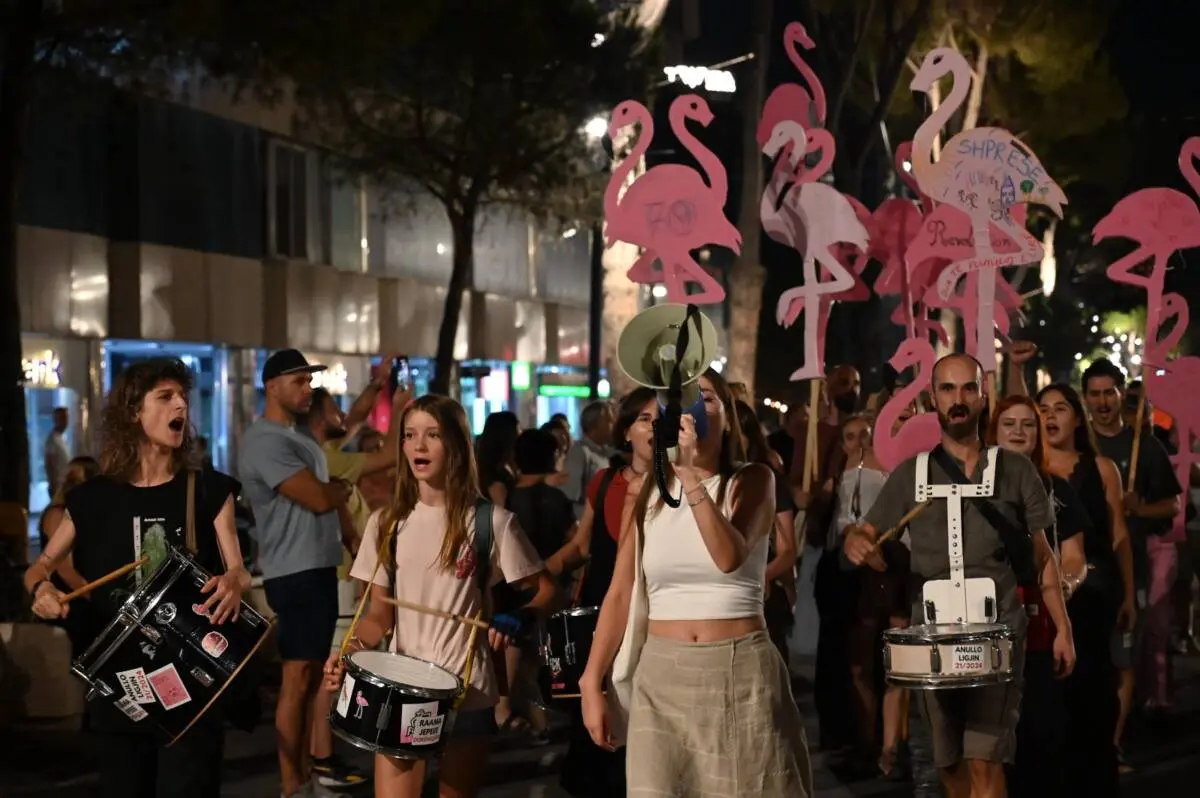
Arrested in Tbilisi in August 2024 on an extradition request, after the ECHR adopted a provisional measure preventing his transfer, Sadigov was released on bail in April 2025 and remained under threat of transfer to Azerbaijan for months. He has actively participated in the protests in Georgia, which have continued uninterrupted for over six hundred days.
Following the closure of the Azerbaijani criminal case on which the extradition request was based in April 2026, Georgian authorities lifted the restrictions on du Sadigov. A few days later, they re-arrested him for an administrative offense and deported him on 5 April 2026.
Human Rights Watch and Georgian human rights organisations view the case of Sadigov as indicative of possible cooperation between the authorities of the two countries and an attempt to circumvent the protection afforded by the ECHR.
In June 2026, Sadigov was arrested again in Azerbaijan. On 8 June 2026, he was detained by masked men wearing ordinary clothes and subsequently taken into pre-trial detention in connection with the same proceedings that had originally formed the basis of the extradition request.
The aforementioned cases show how cooperation between Georgian and Azerbaijani authorities can allow the transfer of opponents and critics of the Baku government across the border, exposing them to further detention, and making Tbilisi an active player in transactional repression.
Found an error in this article? Please contact our editorial team at redazione@balcanicaucaso.org.
Tag:
Featured articles
 New political movements
 History and memory