Rada Iveković, a life in translation
The book “A Life in Translation: The Transnational Feminism of Rada Iveković” was published earlier this year. The book’s three co-authors and editors, Chiara Bonfiglioli, Stefania Maffeis and Mara Montanaro, consider it “a femmage to Rada Iveković: a feminist homage that not only celebrates, but acknowledges, restores and revives”. Our review
dream team – ivekovic
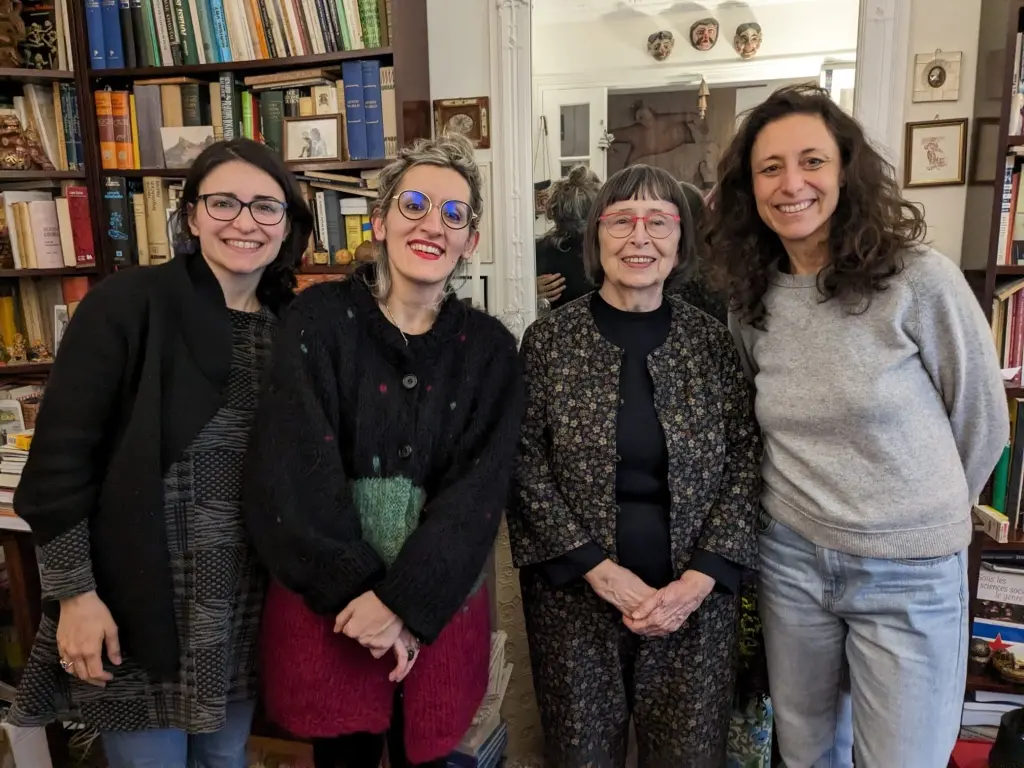
Chiara Bonfiglioli, Mara Montanaro, Rada Iveković and Stefania Maffeis in Paris, February 2024, at Rada Iveković’s home (private archive photo)
Rada Iveković needs no introduction: philosopher, Indologist, feminist, writer, translator, university professor, migrant and much more. “My problem is that I am eclectic”, she says answering one of the many questions in the latest book, published this year by the Italian publisher Ombre corte, in the Femminismi series.
The backbone, occupying about three-quarters of the book, is a beautiful and intense interview that Chiara Bonfiglioli, Stefania Maffeis and Mara Montanaro, the book’s editors and authors of interesting essays that introduce Rada Iveković’s thought, conducted a few years ago during a short stay in Paris, at the home of the philosopher and her partner Goran Fejić.
The title is apt: “A Life in Translation. The Transnational Feminism of Rada Iveković”, and the co-authors did a great job conducting the interview by bringing out the intense biographical moments, from childhood to the present day, which often unfold against the backdrop of historical events of international significance, such as the fall of the Berlin Wall and the breakup of Yugoslavia, or the lesser-known, but for Rada and her companions very important, the 1978 Belgrade gathering “Comrade Women”, the first international conference of the generation of the second wave of feminism, which did not have the support of the “official feminists”. (117)
Through her encounters with Italian feminists, she became aware that approaches differed from country to country: in Italy, women fought for the right to divorce and abortion, while in Yugoslavia these were already acquired rights. What the new generation of Yugoslav feminists wanted, says Iveković, “was the dismantling of hegemonic and violent patriarchy, something that was not foreseen in the project – conceived by men – of our socialism”. (124)
As the interview unfolds, we become familiar with Rada’s eclectic personality, along with the key concepts that permeate her thought. One of these is undoubtedly partage de la raison, in the dual sense of division and sharing. Iveković developed this idea during the 1990s, thinking primarily about translation, “in translation a third space is always created that intersects two spaces, for example cultural ones, that are somehow interconnected”.
In the middle is the translator, the invisible third term. “Because translation is often considered a binary operation, with a source language and a target language. But we forget the actual translator, who is always there, who translates herself and then changes the text she translates, in the translation, but also in the original, because she sheds a different light on the source text”. It is starting from these reflections that Iveković understands “the importance of overcoming binary constructions”. (169-170)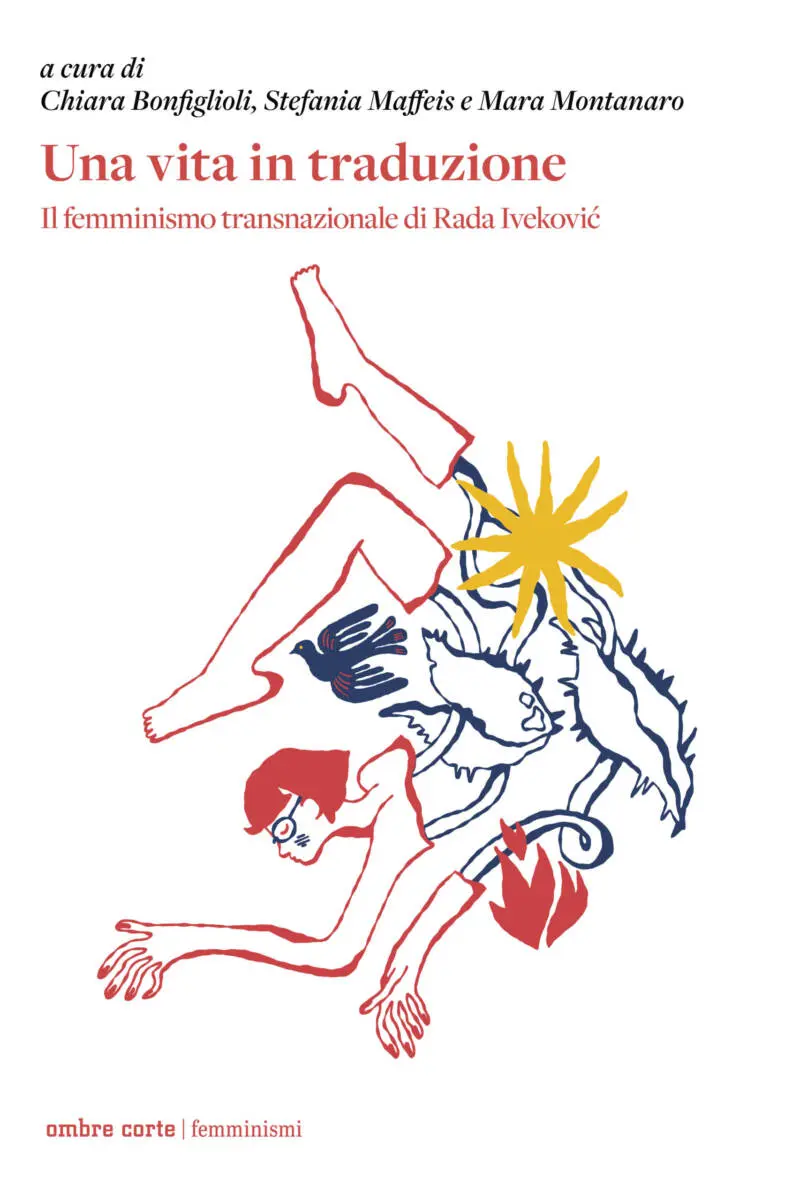
Her formative path is singular: she starts from India, from ancient Indian thought, to reach Western philosophy, Wittgenstein, Derrida, Deleuze, Guattari, Lyotard, Balibar and others. She learns from them, but does not spare them harsh criticism. She criticises them for their structural inability to see the feminine. “Philosophy remains a male discipline where there has been little reflection – especially among men – on gender inequality”. Iveković is deeply aware of what it means to be a female philosopher, what it means to embody the paradox of being a woman, a feminist and a philosopher. “No one is as existentially interested in philosophising as women”. (163)
But her criticism of French philosophers is also directed at their Orientalism. During her French period in the early 1990s, when she worked at the journal Transeuropéenes, a period she herself defines as “golden” and for which she thanks above all Etienne Balibar and Ghislaine Glasson Deschaumes, she published “Orients. Critique de la raison postmoderne” (Orients. Critique of postmodern reason). She was one of the first to speak about decolonial studies in France. Iveković, however, downplays the importance of this fact: “I did not realise that I was among the first to speak about it, and I probably was not. I read English, the French did not read it much at the time”. (172)
Her Indological education, the study of the early thought of the Buddha, places her once again in a space of transition, of translation: Sartre and Lyotard with Rada Iveković become Buddhists. “A piece of existentialism can absolutely be compared to philosophical Buddhism, by which I mean the first discourses of the Buddha and all of Nāgārjuna’s thought”, and further “Everything that concerns language in Lyotard applies to both Buddhism and Nāgārjuna”. (186)
Among her references, one cannot fail to mention the philosopher Radomir Konstantinović, author of “Filozofija palanke” (The Philosophy of Parochialism), an essay that became famous in Italy precisely thanks to the publication of Iveković’s book “Autopsia dei Balcani” (Autopsy of the Balkans). Palanka is a symbol of closure, narrow-mindedness, nationalism and exclusivity. The emergence of this phenomenon, the transformation of her own country into a palanka, forced Rada Iveković to give up on returning to Belgrade, where she grew up until high school, but also to Zagreb, where she studied at the university, and to start a new life in Paris at the age of 45. “I did not flee out of fear; I could have stayed, but I left out of radical disgust”. (p. 159)
Nationalism and patriarchy are linked by a common thread, and Iveković understands them precisely within intersectional thought: “Neither patriarchy nor nationalism are independent of each other, they only function together, even with caste and class relations”. (208) Rada Iveković cannot help but be inclined towards intersectionality as a possibility of crossing multiple dimensions. Her entire biography is a continuous oscillation and movement, a continuous trans, transition. From Yugoslavia to Italy, to Belgium and France, to India and South America.
Rada Iveković never stands still and is very careful not to hypostatise concepts and categories. Her philosophy is a philosophy of change and transformation. Her approach is transdisciplinary, crossing languages and geographies of the world. “The world is changing, do you think we are not translated?! As for epistemology and scientific ethics, I adhere to a trans perspective, in the sense that I have, perhaps because I approached philosophy from the Indian side and not the Greek and Western one, many doubts about ‘definitive’ knowledge, knowledge imposed as ‘true’, about academia, about the seriousness of universities and research, which in any case are in deep crisis today, as institutions, and have not managed to rebuild themselves on other principles by entering globalisation, having accepted to be part of the capitalist race for success through money and power”. (211)
Her life is in translation, in the constant crossing of languages: Sanskrit, Pali, Hindi, German, French, Italian, English and of course her mother tongue, which she calls common, and in whose defense, together with many Yugoslav intellectuals and artists, she signed the “Declaration on the Common Language”. Call it what you want, the important thing is that it remains a common good, because, actually, it has always been so. (206).
The book is enriched with three fine texts by the co-authors, that precede and introduce the interview, and by several essays by Iveković, published here for the first time in Italian. The volume is completed by numerous notes, full of insights and bibliographical references, and a series of contemporary and historical photographs. In one of these, Rada’s father, Mladen Iveković, sits at a table with Miroslav Krleža and Josip Broz Tito on the island of Brijuni in 1950.
The book is definitely worth reading and returning to. “This book”, the co-authors write in the preface, “is a femmage to Rada Iveković: a feminist homage that not only celebrates, but acknowledges, restores and revives”. Enjoy reading!
Found an error in this article? Please contact our editorial team at redazione@balcanicaucaso.org.
Tag: Women