Albania, between political stagnation and civic mobilisation
The nature of Albania’s political system, weaknesses of both government and opposition, significance of recent protests, and prospects for political change in the years ahead. An Interview with the political analyst Ermal Hasimja
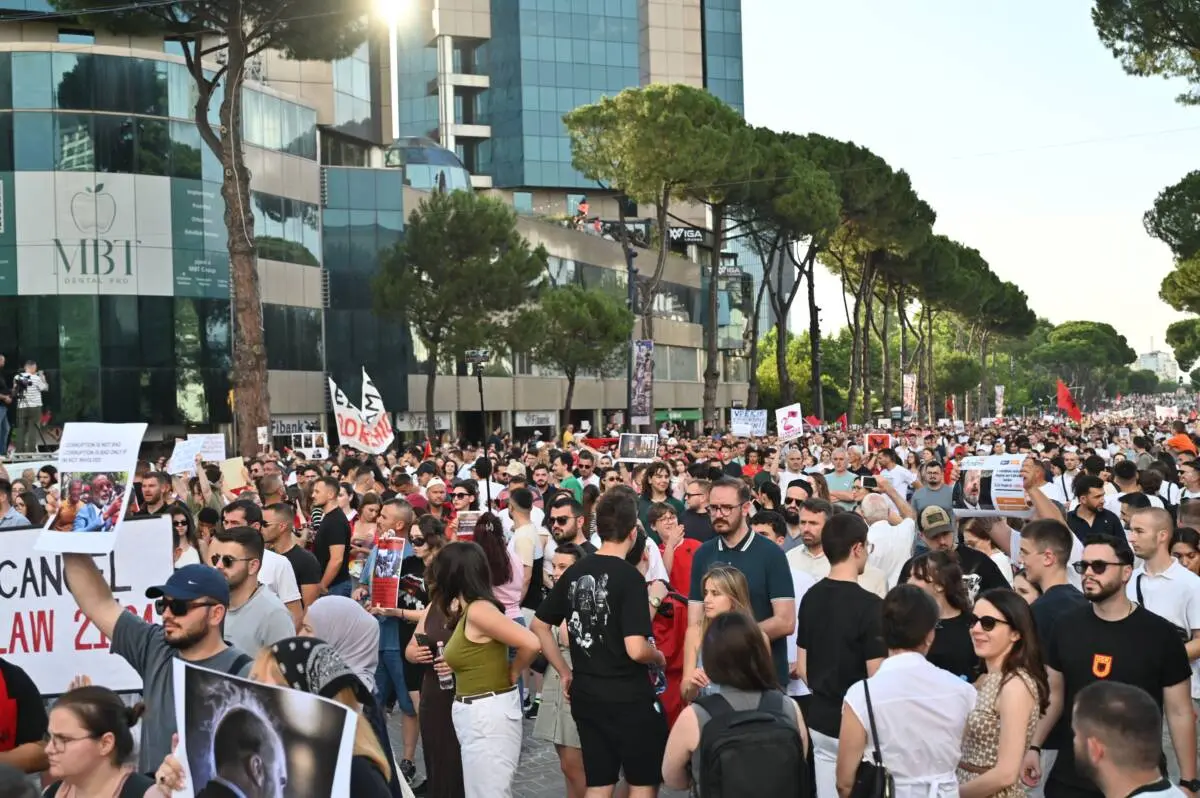
Flamingo protests in Albania -Photo by Erisa Kryeziu
Flamingo protests in Albania -Photo by Erisa Kryeziu
After more than a decade of uninterrupted rule by the Socialist Party, Albania is facing growing questions about the state of its democracy, concentration of power, and ability of political institutions to represent citizens’ interests. While the governing party remains firmly in control, the opposition continues to struggle with internal divisions and a credibility crisis.
At the same time, a new wave of civic mobilization has emerged. What began as environmental protests against a controversial tourism development project in Zvërnec, within the protected Vjosa-Narta ecosystem, has evolved into broader demonstrations expressing dissatisfaction with the government and Prime Minister Edi Rama.
In this interview, the political analyst Ermal Hasimja discusses the nature of Albania’s political system, weaknesses of both government and opposition, significance of recent protests, and prospects for political change in the years ahead.
Albania has been governed by the same party, the Socialist Party, for three consecutive terms, in a context where allegations of corruption are frequent and several former senior officials have ended up under investigation or in prison. How would you describe this political reality, and what does it reveal about the state of democracy in the country?
Albania is in a situation where the Socialist Party governs through a clientelist system, aided by the use of state institutions for party interests and with the support of organised crime. Meanwhile, the opposition is fragmented and still searching for a way to reorganise itself. The term electoral autocracy would be the most appropriate to describe the current situation. We are witnessing a lack of democracy and widespread abuse of power, all legitimised through problematic elections.
Albania is often described as a system in which the executive branch is exceptionally strong and dominant, while institutions designed to provide checks and balances are perceived as weak or only partially functional. How accurate is this assessment, and what are its consequences for the functioning of the state?
This model has been deliberately constructed to cement the power of the party leader and, subsequently, the prime minister. There is a long Albanian tradition of this kind of political organisation. The consequences are clear: the system of checks and balances in Albania is almost entirely fictitious.
The Socialist Party is frequently criticised for being highly centralised around its leader, with limited internal debate and little space for dissenting voices. How do you view this model of political organisation, and what impact does it have on internal party democracy and on the political system as a whole?
There is no internal democracy within the Socialist Party. In fact, after coming to power, Edi Rama effectively replaced the Socialist Party with what became known as the Rilindja (“Renaissance”) movement, composed of individuals whose careers depend entirely on him. He replicated this structure within the governing system itself. Rama acts as a monarch who distributes fiefdoms to his barons, who in turn manage the party hierarchy down to ordinary activists and even Socialist voters.
On the other hand, the Albanian opposition, particularly the Democratic Party, has gone through a prolonged period of crises, divisions, and leadership disputes, including the emergence of parallel structures within the party. To what extent has this weakened its role as a governing alternative?
The Democratic Party faces significant challenges and high expectations while operating under extremely difficult conditions. Independent reports have confirmed the absence of genuinely free and fair elections in the country. At the same time, a large opposition party finds it difficult to keep its activists motivated over a long period, especially since some engage in politics primarily through the lens of personal interest. Remaining in opposition for an extended period is naturally exhausting.
The party has also struggled to renew its human resources, since an opposition party has fewer means to attract and motivate new people. In addition, the government has successfully promoted the narrative—never explicitly stated but constantly reinforced—that all political parties are essentially the same.
Following the latest internal elections in the Democratic Party, there was much discussion about reorganisation and the consolidation of leadership, but also criticism regarding the lack of genuine political renewal. Has the opposition managed to emerge from its crisis, or does it remain trapped by the same structural problems? Why has the Democratic Party been unable to move beyond the figure of Sali Berisha?
It appears that the majority of Democratic Party members continue to support Berisha’s leadership. At present, there is no challenger with a realistic chance of removing him from the top of the party.
It is often argued that the opposition has failed to present a clear governing alternative and that its communication with citizens remains weak. Is this mainly an organisational issue, or does it reflect the absence of a credible political project?
There is a credibility problem. The Democratic Party needs to achieve something similar to what it accomplished in 2005, but under far more difficult circumstances. Communication is not the central issue. Through its willingness to cooperate with other opposition parties, the Democratic Party has shown some positive reflection and adaptability, but rebuilding credibility requires much more than that.
In recent weeks, Albania has witnessed large-scale civic protests. Although they began as demonstrations against the Zvërnec development project, they have gradually expanded to include calls for Prime Minister Edi Rama’s resignation.
Albania has not seen protests of this kind—outside established political parties and without a clear partisan leadership—for many years. Why do you think this reaction emerged now, and what does this spontaneous mobilisation reveal about the way citizens are expressing dissatisfaction outside traditional political structures?
Younger generations are difficult to explain through older political models. The violent treatment and dragging of a protester by police may have been one factor, as well as a greater environmental awareness among younger people. Another factor may be the accumulation of many previous grievances that had not found an outlet.
In some cases, these civic protests have managed to mobilise more people and generate more energy than demonstrations organised by the parliamentary opposition. How do you explain this difference, and what does it reveal about the crisis of political representation in Albania?
There is a significant group of people who do not feel represented by the opposition parties, and even less by the Socialist Party. However, when election campaigns arrive, the two major parties still mobilise and attract the overwhelming majority of votes. We will have to wait and see how these protests are reflected in future elections.
Several new political parties entered parliament after the latest elections, including Mundësia, Shqipëria Bëhet, and Lëvizja Bashkë. For the first time, new political forces outside the two major parties have gained a more visible parliamentary presence. Yet their influence remains limited compared to the overall balance of power. How do you assess this development? Does it represent the beginning of a broader reconfiguration of Albanian politics and a channel for citizen dissatisfaction, or merely the fragmentation of the opposition without a real capacity to change the system?
The emergence of new parties responds to a demand for new forms of political representation. However, it will take time before they become truly convincing alternatives.
Looking at the broader picture—a consolidated government, a weakened opposition, and powerful but politically unorganised civic protests—how do you foresee the evolution of Albania’s political system in the coming years? Is there room for a genuine reconfiguration of the political landscape or the emergence of a new dominant political actor?
There is still a demand for new forms of representation. Most likely, Albania’s political landscape will undergo significant reconfiguration over the next five or six years.
Found an error in this article? Please contact our editorial team at redazione@balcanicaucaso.org.
Featured articles
 Investigation
 students' protest
 Montenegro Pride 2026