EU-Armenia, ever closer
Over the past three years, relations between Armenia and the EU have accelerated at an unprecedented pace. This rapprochement has affected the energy, economic, and security sectors
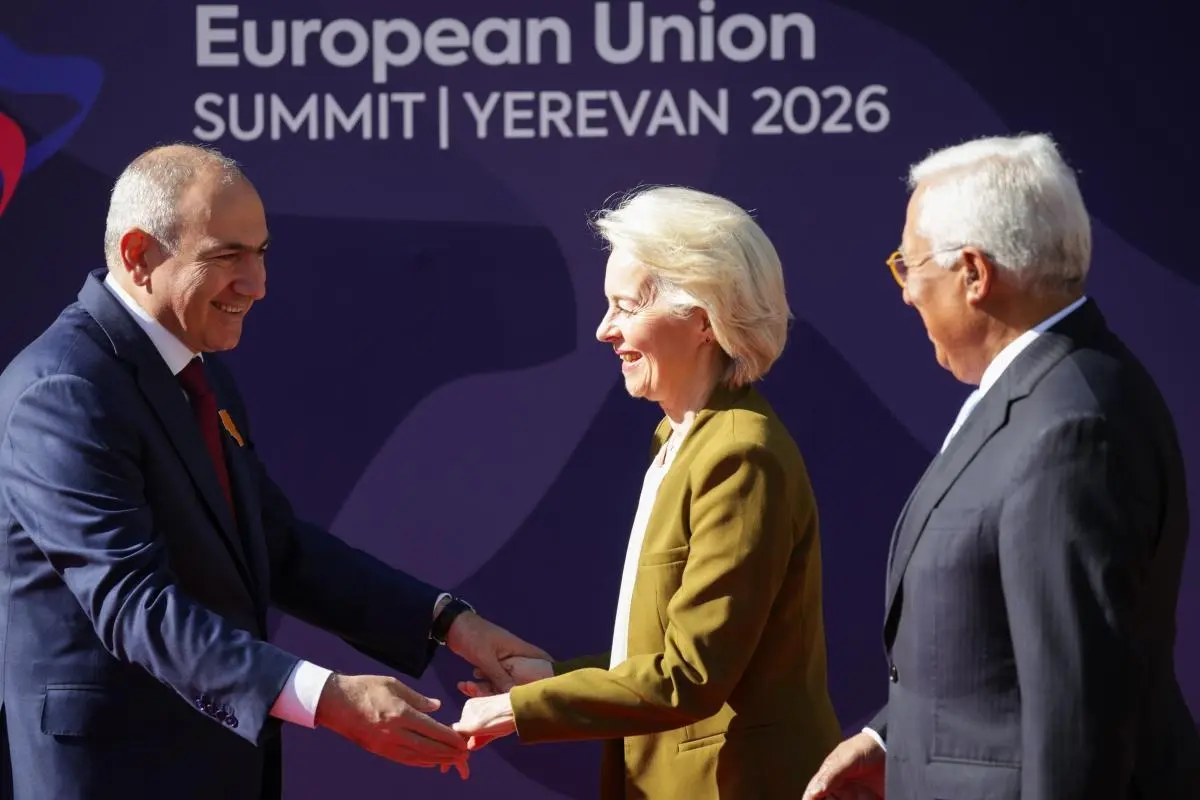
Nikol Pashinyan, Ursula von der Leyen, António Costa
Nikol Pashinyan, Ursula von der Leyen, António Costa, may 2026 © EU
Over the past three years, relations between Armenia and the European Union have undergone an unprecedented acceleration through the progressive institutionalisation of political, economic, and security cooperation. A key moment in this process was the two-day series of EU-Armenia events held in early May, beginning with the eighth summit of the European Political Community and followed by the first-ever EU-Armenia summit.
These major events took place within the broader framework of Armenia’s gradual rapprochement with the European Union, a process that gained further momentum in March 2025, when the Armenian parliament adopted legislation formally expressing the possibility of an eventual EU membership. A few months later, in December 2025, Brussels and Yerevan adopted a new Strategic Agenda for the EU-Armenia Partnership, setting out the priorities for bilateral cooperation in the years ahead.
The partnership is grounded in the Comprehensive and Enhanced Partnership Agreement (CEPA), which entered into force in 2021, and in the European Union’s steadily expanding engagement in the South Caucasus country. Following the deployment of the civilian European Union Mission in Armenia (EUMA) in February 2023, the EU extended its mandate in February 2025 for an additional two years. In April 2026, Brussels also decided to deploy the European Union Partnership Mission (EUPM) to Armenia, with the aim of strengthening the country’s resilience against external threats.
On the economic front, as the web portal Eurologus wrote, cooperation is supported by the €270 million EU “Resilience and Growth” Plan announced in 2024, as well as by approximately €2.5 billion in investments expected under the Global Gateway strategy. Armenia has also been included in the European Peace Facility, from which it is expected to receive €30 million.
The Summit
The first EU-Armenia summit held on 5 May marked the most advanced stage reached so far in relations between Brussels and Yerevan. The meeting concluded with the official signing of a series of letters of intent and sectoral agreements, publicly signed by the officials responsible for overseeing their implementation in the presence, as witnesses, of European Council President António Costa, European Commission President Ursula von der Leyen, and Armenian Prime Minister Nikol Pashinyan. The political substance of the agreements was summarised by von der Leyen in her closing remarks and formalised in the Joint Declaration adopted at the end of the summit.
In her speech, von der Leyen described Armenia as part of the “broader European family,” calling the bilateral relationship a “unique partnership” entering a new phase. The summit outlined a more structured framework of cooperation across strategic sectors ranging from connectivity and security to energy and visa liberalisation.
One of the central pillars concerns regional connectivity. The parties announced new initiatives aimed at facilitating transit and infrastructure links, including the modernisation of border crossings and the strengthening of Armenia’s role as a regional hub. A high-level dialogue on transport was also launched to coordinate investments and integration with European networks.
On the energy front, the summit confirmed European support for the development of renewable energy in Armenia, particularly in the solar sector. Brussels views energy cooperation as an integral part of Armenia’s strategy to diversify and reduce external dependency, within a broader framework of integrated energy security extending across the Caucasus toward the Black Sea.
Another key chapter focused on digitalisation and innovation. The EU expressed interest in supporting both public and private investment in Armenia’s technology sector, including digital infrastructure and projects related to artificial intelligence. The Commission presented this field as one of the areas with the greatest long-term potential in future cooperation between Armenia and the European market.
Security also featured prominently. The Joint Declaration reaffirmed European support for peace and stability initiatives in the South Caucasus and highlighted growing cooperation in addressing hybrid threats.
One of the politically most significant issues concerns visa liberalisation. During the summit, the first progress report on Armenia’s path toward visa facilitation with the EU was presented, a topic that has acquired strong symbolic importance in Armenian public debate in recent years. In this context, the launch of forms of cooperation with Frontex were also presented.
Finally, the summit placed particular emphasis on the social and economic dimensions of the partnership. Among the projects mentioned were demining initiatives and housing programmes for displaced persons, especially those affected by the consequences of recent regional conflicts, with particular attention devoted to the situation of Karabakh Armenian refugees.
In the Ambassador’s Words, a Sense of Satisfaction
HVG, OBCT and TSN met with the European Union’s Ambassador to Armenia, Vassilis Maragos, for a joint interview in Yerevan on 7 May 2026.
Asked about his expectations for this intense three-day series of meetings between Armenia and the European Union, the ambassador described the meetings as an excellent event with outstanding results. In his view, the summit did not represent a starting point, but rather the maturation of a process that had already been underway for several years. The European approach, he explained, is based on concrete and sector-specific cooperation aimed at strengthening the country’s resilience across the economic, energy, social and infrastructure sectors. The main objective is to support Armenia’s diversification in terms of markets, partnerships and strategic choices.
The ambassador repeatedly returned to the key word that resonated throughout these days of intense exchanges: connectivity. The EU is already working on strengthening transport and border infrastructure, including projects involving Georgia and Iran, while also supporting broader regional interconnectivity initiatives linked to the Middle Corridor and Black Sea connectivity projects. In this context, he stressed that greater interdependence and regional opening could create new economic opportunities, strengthen energy security and contribute to long-term stability in the South Caucasus.
Overall, the picture that emerged reflects a European approach based on targeted and gradual measures combining infrastructure, digitalisation and economic support, with the aim of strengthening Armenia’s ability to integrate progressively into regional and transnational systems of transport, markets, energy, mobility and cultural exchange. It is a broad opening for a country whose development has long been constrained both by its landlocked geography and by a severe condition of regional isolation. It is therefore unsurprising that a sense of satisfaction is palpable around this possible opening, this forward step after three extremely difficult decades of independence that began and ended under the shadows of wars.
The trip to Armenia was organised by invitation of the EUNEIGHBOURS EAST programme, funded by the European Union.
Found an error in this article? Please contact our editorial team at redazione@balcanicaucaso.org.
 This article was produced in collaboration with the Hungarina web portal EUrologus as part of PULSE, a European initiative coordinated by OBCT that supports transnational journalistic collaborations.
Tag: PULSE
Featured articles
 Political deadlock
 Economy and Dialogue