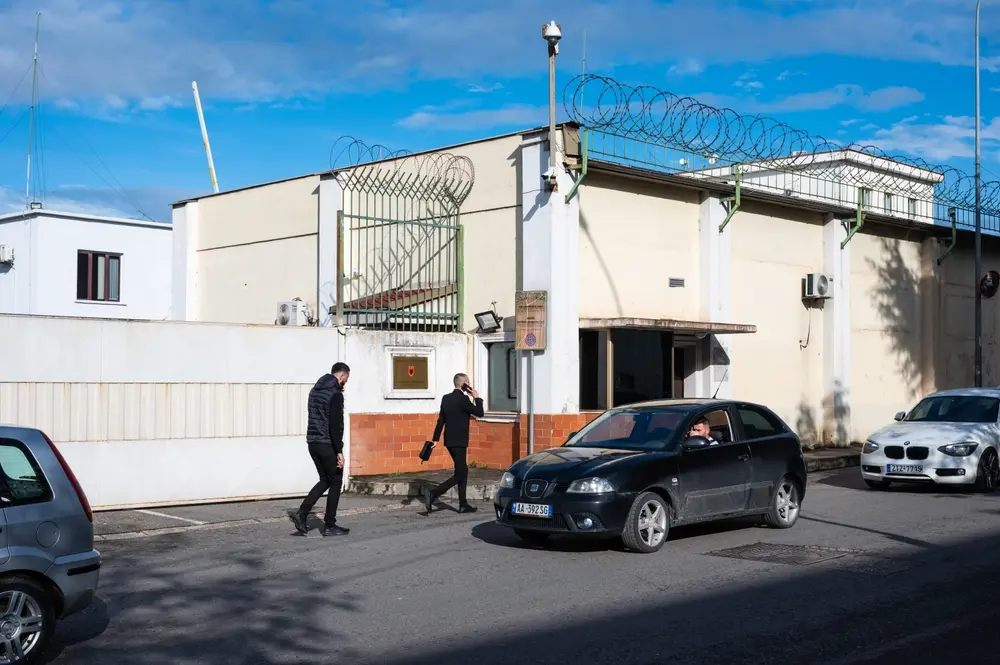
Albania, protests against bulldozers in the protected Pishë Poro-Narta area
Last Tuesday at midday, citizens and environmental activists gathered in front of the Ministry of Environment in Tirana to protest the construction works taking place in the Protected Landscape of Pishë Poro-Narta, part of the wetland complex, near the Vjosa Delta.
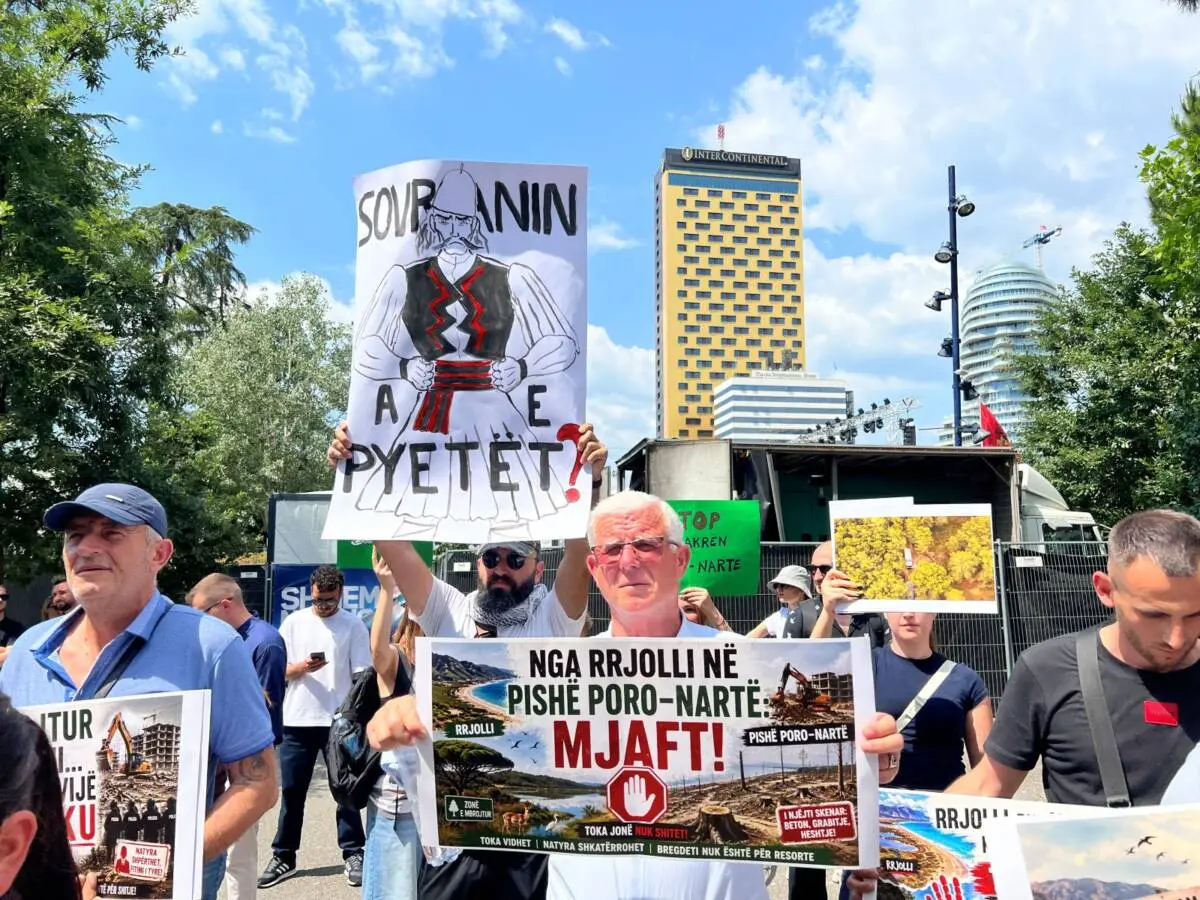
Protest in Tirana May 2026 – On the sign in the foreground: “From Rjolli (Northern Albania) to Pishë-Poro Enough!”
Protest in Tirana May 2026 - On the sign in the foreground: "From Rrjolli (Northern Albania) to Pishë-Poro Enough!" - Photo E. Kryeziu
The Pishë Poro-Narta area is located north of Vlora and forms part of the Narta wetland complex, near the Vjosa Delta. It holds the status of a “Protected Landscape,” which allows only limited interventions. For over a month now, heavy machinery has been seen in the area, boundaries have been marked, and barbed wire fences have been installed, effectively zoning the territory in preparation for construction works. All of this has happened without transparency from state institutions regarding who is building and what exactly is being built.
“For over a month now, machinery has entered the area illegally, removing forested zones, destroying dunes, and even blocking the connection between the sea and the lagoon,” said environmental activist Zydjon Vorpsi from the Preservation and Protection of Natural Environment in Albania (PPNEA) organization, speaking in front of the Ministry of Environment.
According to Vorpsi, all these interventions are being carried out without institutional monitoring, indiscriminately destroying the strictest habitats areas that cannot even be touched for scientific studies. “Everything has been taken over by anonymous machinery, with no signs and no information whatsoever,” he said.
Aleksandër Trajçe, head of PPNEA, stated that the protest in front of the ministry, along with others held in the protected area itself, concerns the future of both present and future generations. “There is no law functioning in that territory anymore. More than six to seven kilometers of coastline have been taken away from public access,” declared Trajçe, as wire fences now stretch all the way to the coast.
During a meeting with Minister of Environment Sofjan Jaupaj last Friday, the minister defended the position that the interventions in the area are merely geological survey works.
“Please raise those photos showing the roads being laid there. Showing the excavators heavily operating in the area, because those are the facts, not the stories fabricated in papers or institutions,” Trajçe told protesters holding placards displaying photos of heavy machinery inside the area.
Albania is in the process of fulfilling obligations to join the European Union, and among all accession chapters, Chapter 27, concerning the environment remains one of the most important.
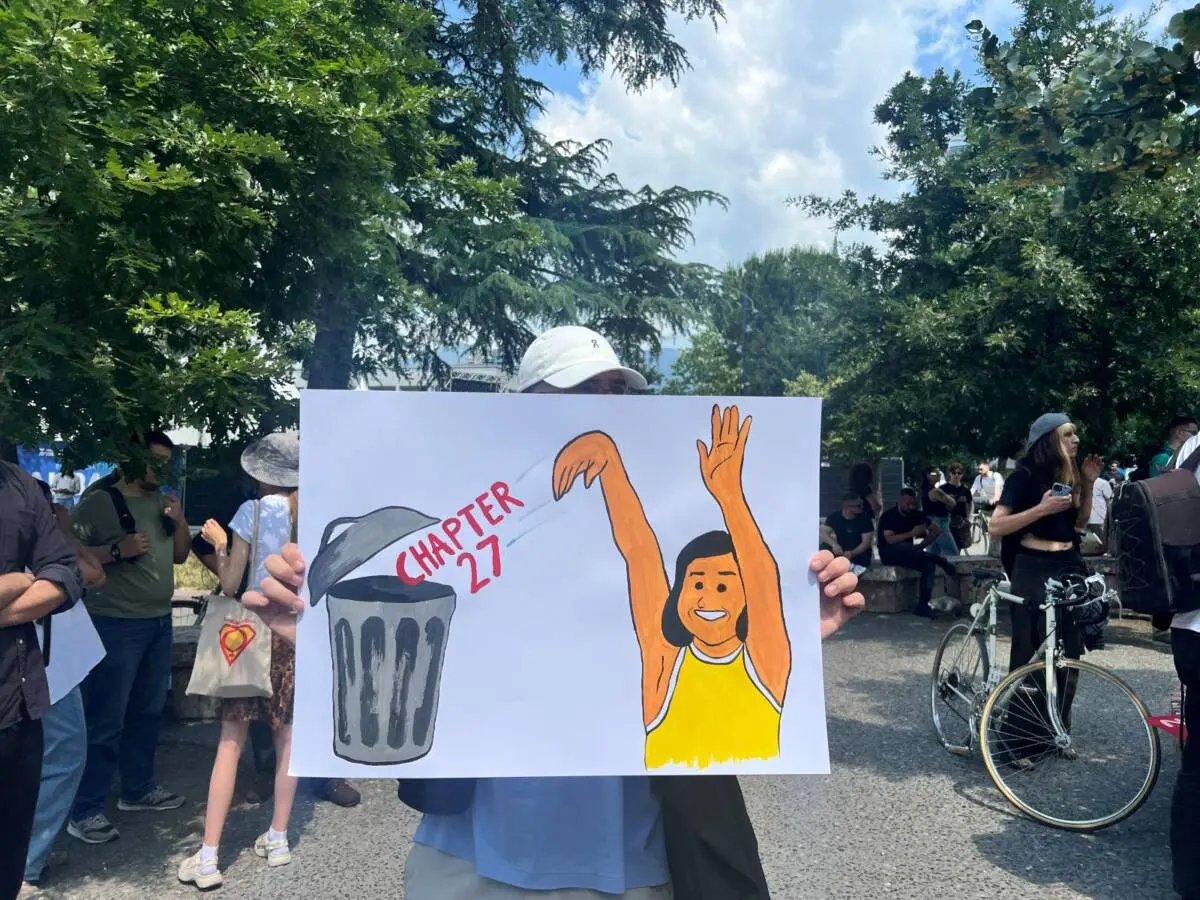
During the protest in Tirana – Photo E. Kryeziu
According to Trajçe, EU membership cannot happen with a state that deprives its citizens of access to seven kilometers of coastline. “To access 600 hectares of land that until yesterday anyone could freely enter, enjoy the beach, observe the hundreds of thousands of species living there — and now for almost a month it has become inaccessible,” Trajçe concluded.
For Mirela Ruko, representative of the new left-wing political party Lëvizja Bashkë (Together Movement, ndr), development cannot come through selling the sea, the sun, and nature. “When they tell us tourism is making us richer, we must ask: who is tourism actually enriching? Did you know that we are among the peoples who consume eight times less fish than other coastal populations? Did you know that we visit the sea on average only three days per year? And you tell me that this model being built today will bring us closer to the sea?” Ruko argued through a megaphone.
According to her, the main profit generated by the current development model in Albania is not tourism, but property speculation. “Those getting rich today are the ones who managed to take over public property, taking it away from residents from south to north and north to south only to sell it and enrich themselves,” Ruko concluded.
For Alben Kola, a prominent activist and tour guide, the Pishë Poro-Narta area had long been a favorite summer destination for his family. Now, he says, he must explain to his children why they can no longer cross the fences that have been erected there. Alben works in tourism, but according to him, this is not tourism.
“This is terrorism against Albanian land. I do not care about tourism growth when my fellow citizens cannot go to the beach we have inherited for thousands of years,” Kola said.
Another activist, Andi Tepelena, called on the Minister of Environment to resign if he is unable to protect the interests of Albanians. “I have one question for Sofjan Jaupaj: whom are you protecting? The interests of the Albanian people or the interests of the mafia?” Tepelena addressed the minister.
The area is one of the most important bird habitats in Albania, with around 200–300 recorded species, including migratory birds of international significance. Citizens and activists said they would continue organizing protests to defend national heritage.
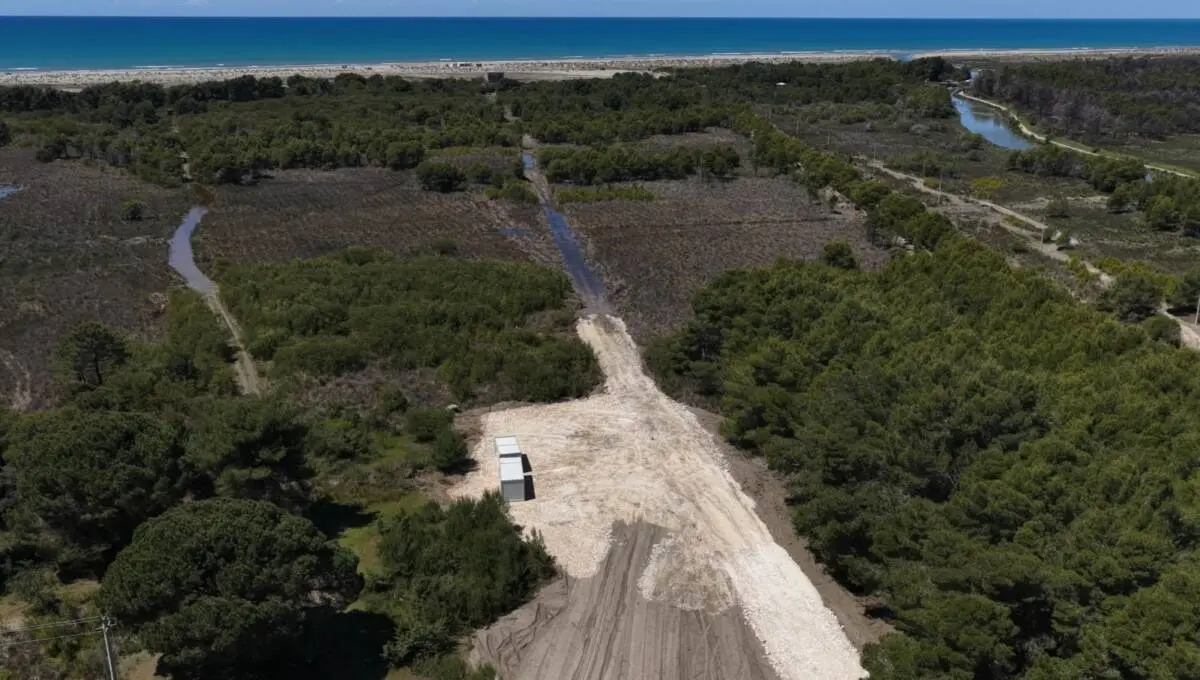
The protected area north of Vlora where they are excavating – Photo © PPNEA
“That’s where I learned to swim”
Brunela, a young woman who became known through an emotional speech delivered during one of the protests in Pishë Poro-Narta, grew up in the area. With a mother from Zvërnec and a father working in the lagoon, she told OBCT that “that’s where I learned to swim,” which she says is enough to explain her bond with the place.
“That’s where i learned to recognize fish underwater, collect mussels in deep waters, and walk across soft rocks. For me, it is one of those places that feels like home, and every piece of concrete poured there breaks my heart,” Brunela told OBCT.
According to her, the public reaction is not driven by private interests, but by the protection of a public space and natural heritage. She also denounced restrictions on beach access, saying several beaches had been fenced off without any warning to the local community. “They fenced off three beaches without any prior notice. This is a crime against people, but above all against nature,” she declared.
According to Brunela, the consequences are not only environmental, but also social and economic for families living in the area. “All the fishermen and livestock breeders in the area are left unemployed. Many people lose both financial security and their summer recreation,” she said. She also highlighted the lack of transparency toward local residents and the way projects are being developed in the area. “The concrete expansion of the area, without transparency toward local residents, brings them no benefit whatsoever. This is dignity turned into trade,” she concluded.
Minister of Environment calls the interventions as legal
During a press conference held on 7 May, the Minister of Environment Sofjan Jaupaj described the interventions in the protected landscape of Pishë Poro-Narta as being within legal parameters. “No degradation is taking place in the protected area of Pishë-Poro-Nartë. The area is categorized as a Category V Protected Landscape under the legislation on protected areas,” said Minister Jaupaj.
According to the minister, the works have been authorized by the National Territorial Council.
“Only the fencing of a private property has been carried out in order to conduct geological surveys,” Jaupaj stated. He also described as a malicious confusion the linking of Pishë Poro-Narta with the protected Vjosa River area.
“The Vjosa River is a Category II National Park, whereas Pishë-Poro-Narta is a Category V Protected Landscape. Category V is in fact the lowest protection category among protected areas, where a considerable portion of investments, including tourism infrastructure investments, are legally allowed,” Minister Jaupaj said while justifying the works.
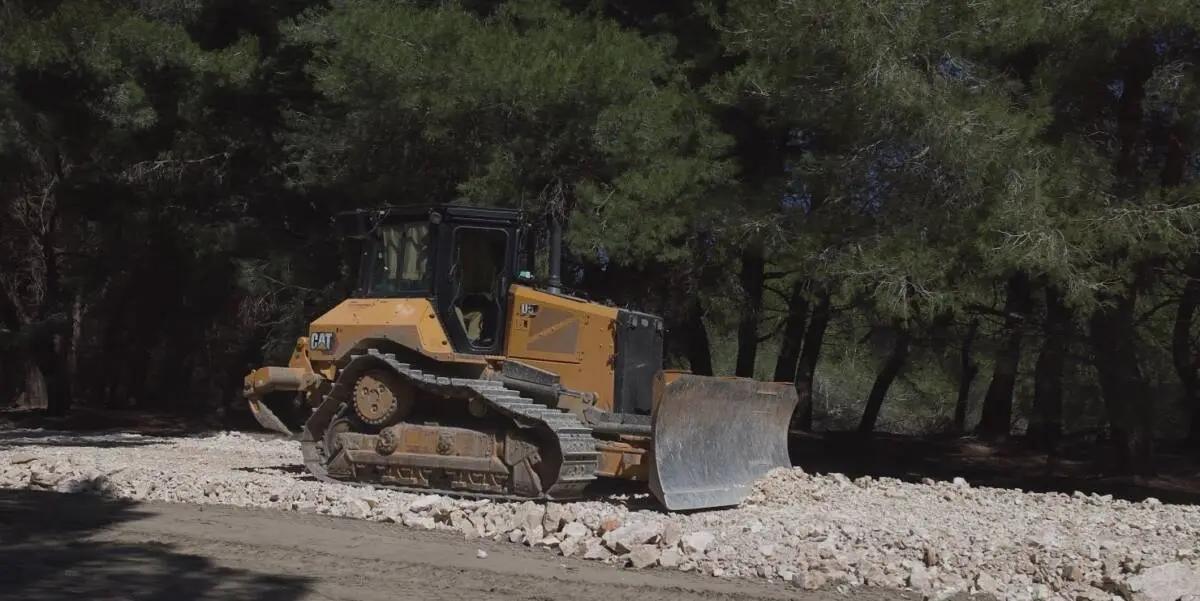
Bulldozer in the protected area – Photo © PPNA
No transparency about construction in the protected area
On site, the machinery and workers bore no identifying company logos. Workers were reluctant to provide information to the media, stating only that they were fencing off private land. Official information regarding what is happening in the area remains incomplete. Two weeks after protests and denunciations by environmental activists, the National Inspectorate for Territorial Protection (IKMT) publicly revealed the name of the company carrying out the works.
According to IKMT, the company responsible is “Zvërnec South Adriatic Development,” which is conducting preparatory works for fencing and road construction based on a permit issued by the National Territorial Council on April 29, 2026. However, the permit itself has still not been made public. IKMT clarified that the development permit has not yet been issued and that the current works are only preparatory.
Behind the company are Dutch citizen Nikita Maximovich Vinogradov and Bulgarian citizen Zoya Georgieva Gyurova, both previously unknown to the Albanian public.
The company plans to develop a project called “Zvërnec Peninsula,” which foresees residential buildings and hotels up to eight stories high, as well as a port, in one of the richest biodiversity areas along the Albanian coastline. While works have already begun, environmental activists continue to express concern over the lack of transparency regarding both the company and the project itself, which has still not been officially presented to the public.
International environmental organizations call for a halt to the works
The organization BirdLife Europe visited the site and denounced the destruction caused by bulldozers operating in the area. BirdLife Europe highlighted that the coastal forest serves as habitat for numerous bird species, including flamingos and Dalmatian pelicans, and is an important stopover point for millions of migratory birds.
The organization EuroNatur also reacted, stating that the works are being carried out without a transparent process and without respecting environmental impact assessment standards.
They further declared that such construction not only damages one of Europe’s most important natural areas, but also undermines the credibility of Albania’s EU accession process.
Found an error in this article? Please contact our editorial team at redazione@balcanicaucaso.org.
Featured articles
 Political deadlock
 Economy and Dialogue