Moldova, when a war creates a new opportunity for EU integration
If it wants to become an EU member in the foreseeable future, Moldova must make enormous efforts to make up for lost years. On the other hand, the EU must change its approach and truly make itself available to the authorities in Chișinau.
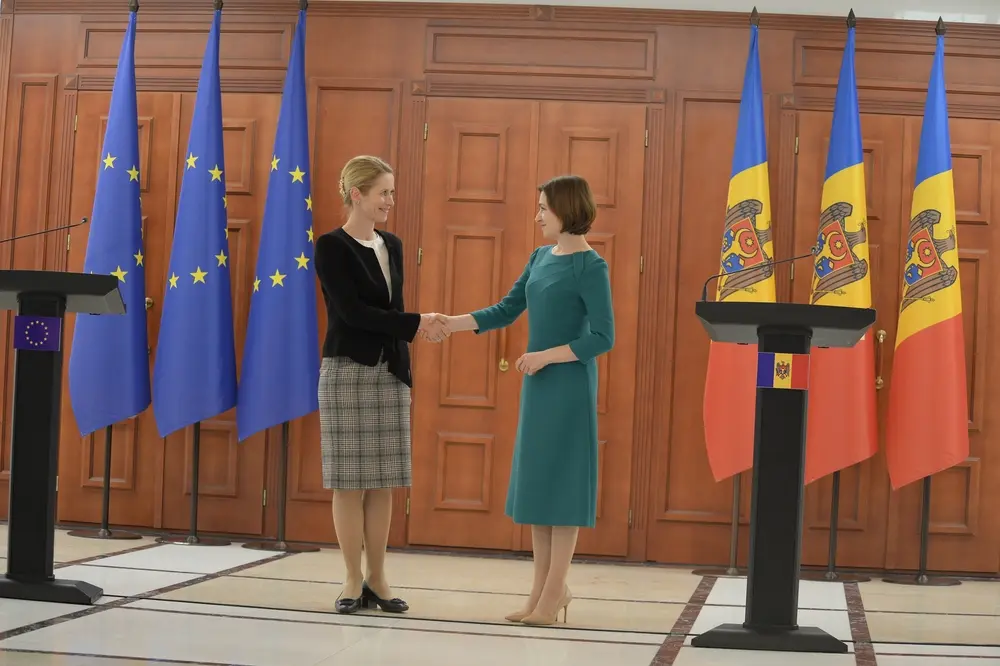
Kaja Kallas, Alta rappresentante dell’UE per gli affari esteri e la politica di sicurezza, e Maia Sandu, presidente della Moldova, 2025
Kaja Kallas, Alta rappresentante dell'UE per gli affari esteri e la politica di sicurezza, e Maia Sandu, presidente della Moldova, 2025 © Constantin Grigorita/Shutterstock
In order to revive the enlargement process, back in 2022 the EU proposed the “gradual integration” approach, meaning a step-by-step accession of candidate (and potential candidate) countries into key EU policy areas before formal membership, which remains the ultimate goal.
The driving part of this new approach is the Growth Plan that allocates money in exchange for reforms, following the logic of “more for more”. Every candidate country proposed a national Reform Agenda, stating which reforms it is going to implement in areas such as rule of law, judiciary, environment or energy sector. When they are successfully implemented, Brussels will reward them.
Gradual integration and Moldova
Moldova’s Growth Plan, worth 1.8 billion euros, follows the same logic. The Reform Agenda prioritizes sectoral integration, and aims to accelerate socio-economic and fundamental reforms and improve gradual access to the EU’s Single Market. This includes free movement of goods and supply chain integration, trade and transport facilitation, integration into the EU energy market and decarbonisation, access to the digital market, and participation in the Single Euro Payments Area (SEPA). The Growth Plan provides increased financial assistance to support the implementation of reforms and stimulate investment in the country.
Even so, Moldova’s Association Agreement with the EU—signed in 2014 — includes a Deep and Comprehensive Free Trade Area (DCFTA), which provides easier access to the Single Market, although this opportunity has remained for a long period largely underused due to pro-Russian forces’ influence in the country.
The breakthrough came at the end of 2020 when Maia Sandu took office as Moldova’s president, followed by the winning of the national elections by the pro-European Action and Solidarity Party. Since then, the executive and legislative branches of government have begun domestic governance transformation, and adoption of key reforms in judiciary, de-oligarchization, public administration and digitalization.
A new beginning
Prior to 2022, Moldova had a marginal position within the EU’s broader foreign policy agenda. Although situated along the EU’s eastern frontier between Romania and Ukraine, its strategic relevance was limited, and EU engagement primarily focused on economic and political cooperation through initiatives such as the Eastern Partnership, without a clear membership perspective.
Russia’s full-scale invasion of Ukraine profoundly altered Moldova’s geopolitical significance. Given its 1,222 kilometers long border with Ukraine and the presence of Russian troops in the separatist region of Transnistria, it emerged as a critical component of the EU’s evolving security architecture.
Moldova was granted candidate status in June 2022 with an unprecedented speed, reflecting a significant transformation of EU enlargement policy driven by geopolitical urgency.
Two years later, Brussels approved 1.8 billion euros for the country through the Growth Plan, supporting reforms in competitiveness, digital infrastructure, governance, social policy, and energy security. In September 2025, the Commission issued its first installment under the Growth Plan after confirming that Moldova had met four reform benchmarks, particularly in the field of energy security, a key priority given its historical dependence on Russian gas.
Last March the Commission released the second installment of 189 million euros, following Moldova’s fulfilment of 24 additional reform indicators.
In three years time, Moldova eliminated its energy dependence on Moscow, reducing it from 100% reliance to zero. It also joined SEPA in October 2025, entered the “Roam Like at Home” initiative in January this year, and significantly strengthened its investment framework.
Moldova’s good performance is a combination of political will, social consensus and external threat. With a strong EU stand, Maia Sandu and the government knew what they wanted to pursue. Nonetheless, the proximity of Ukraine’s war has reinforced the urgency of reforms, while public support for EU integration remains high. Moreover, the government has demonstrated an ability to translate EU conditionality into concrete policy outcomes.
If we compare Moldova’s case to Georgia, where the government after receiving candidate status, suspended accession negotiations, it is clear that geopolitical urgency and the EU’s will to integrate candidates is not enough and the process should be conducted by a government that is ready to seize the opportunity.
Challenges ahead
“We have made a commitment to our people that we will have the country ready for EU integration by 2030,” declared Maia Sandu to Le Monde a few days ago.
Despite the rapid progress, the 2030 goal is hardly achievable. For years, the country was isolated from the EU’s investment radar and under Russian influence which left consequences that the current government must address.
Low employment rates, inadequate salaries, significant skills mismatches, weak institutional capacity, bureaucratic inefficiency, corruption vulnerabilities continue to highlight Moldova’s deep socioeconomic and administrative challenges. In 2023, its GDP per capita stood at just 29% of the EU average, significantly below Montenegro, the next to be EU member, which reached approximately 50%.
Lack of human capital remains an additional challenge as the government is in need of people who will lead the accession process, as there are only 1.65 applicants per public service position. In this regard, Moldova is recruiting its own diaspora to fill the gap in the public sector, promising high salaries and other benefits from the Growth Plan.
A solution for Transnistria?
The Transnistria separatist region constitutes another long-term issue that can endanger the entire accession process of Moldova.
Transnistria, a breakaway region, effectively separated from Chișinău after the 1992 war, with Russian military intervention leading to the continued presence of Russian troops and its self-declared independence. As this territorial dispute appears to some extent like the one in Cyprus, the potential solution can be similar.
However, it looks like Sandu’s government is not in favor of this proposal, as officials in Moldova push more for “peaceful reintegration”. According to a leaked public document, the plan outlines a transitional reintegration period during which Transnistria would be governed by an internationally appointed administration. But, most importantly, the Moldovan government insists that EU integration should proceed separately from reunification with Transnistria, stating in the document that “the two processes advance at different speeds and follow distinct timelines.”
One indicator of this plan could be the current initiative to nationalize the tax and customs framework in the separatist region, impacting Transnistria’s exports to the European Union.
Transnistria is already part of DCFTA as 70% of Transnistrian goods were exported to the EU in 2025, and every third person in Transnistria voted for Moldova to join the EU in a referendum in October 2024. tIn the winter of 2024-2025 when Russia cut gas supplies to the region, the EU stepped in and prevented a crisis.
The EU and Moldova’s officials hope that once the results of the Growth Plan become visible, the people from Transnistria will see it and act in favour of peaceful reintegration. Even though the Growth Plan does not allocate money for this region, Moldova has access to funds that are dedicated to the situation of crises, like the one that happened in winter 2024.
Maia Sandu has made clear that EU membership is essential for Moldova’s survival as a democratic state, warning that otherwise, “the Kremlin’s goal is clear: turn us into a launchpad for hybrid attacks on the European Union.” If the EU wants to strengthen its position against Russia, it must adapt its enlargement process and not repeat past mistakes.
Found an error in this article? Please contact our editorial team at redazione@balcanicaucaso.org.
This article was written as part of the project "InteGraLe - Western Balkans vi-à-vis the Trio: single market, cohesion and regional policy for gradual integration into the EU." The project is supported by the Analysis, Programming, Statistics, and Historical Documentation Unit – Directorate General for Political Affairs and International Security of the Ministry of Foreign Affairs and International Cooperation, pursuant to Article 23-bis of Presidential Decree 18/1967. The opinions expressed in this publication are those of the authors and do not necessarily represent the views of the Ministry of Foreign Affairs and International Cooperation.