Albania, Italy | Migrations, Politics, Rights
Migrants: all the doubts about the Rama-Meloni agreement
Despite the inconsistencies and uncertainties around the agreement signed between Rome and Tirana for the reception of migrants on Albanian soil, and while awaiting the judgment of the European Court, work on the two centres has already begun in Gjadër and Shëngjin. We went to see how they were progressing
Migranti-tutti-i-dubbi-sull-accordo-Rama-Meloni
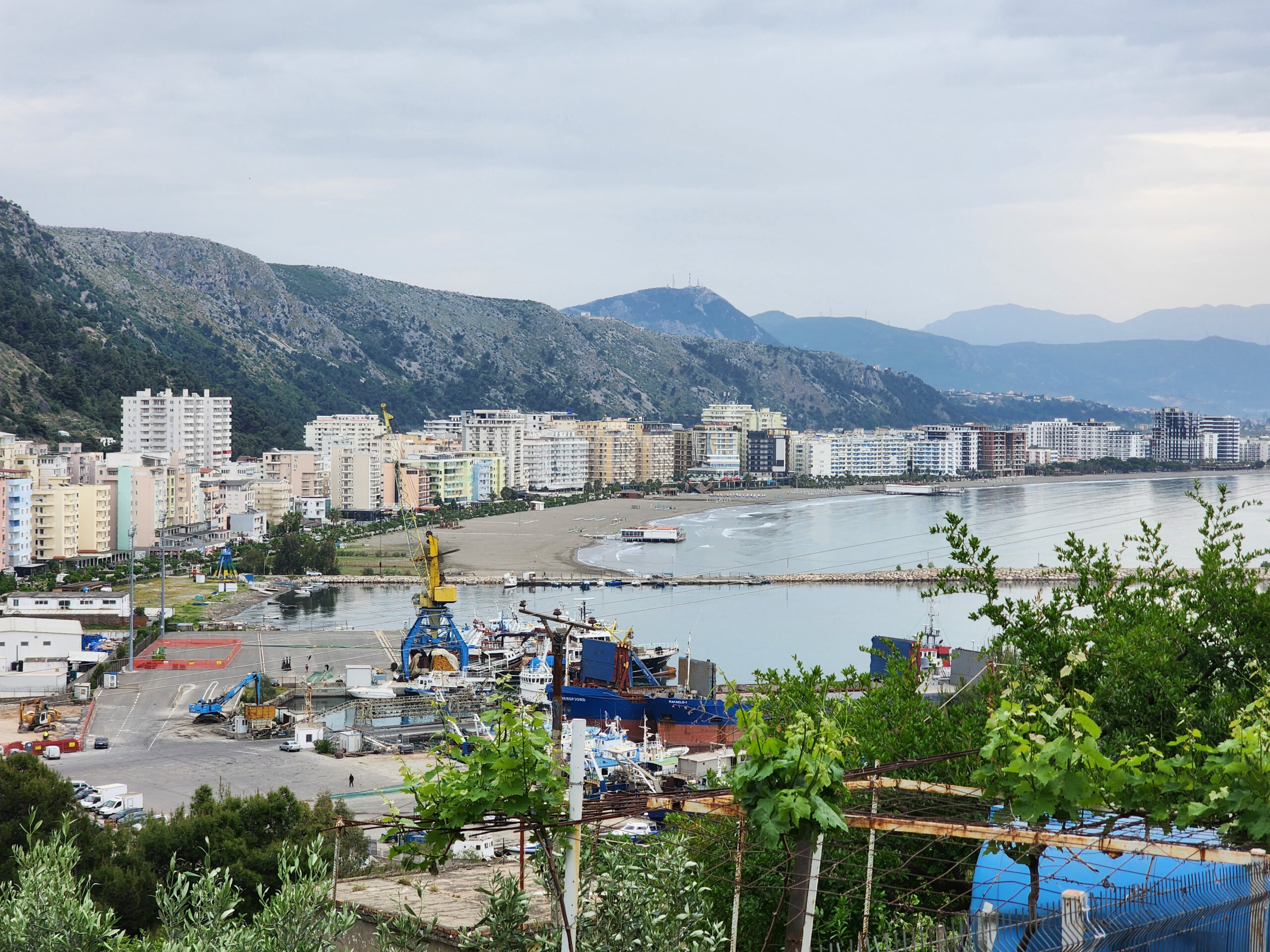
Shëngjin and its port (photo E. Gjatolli)
It’s Palm Sunday when we arrive in Gjadër, a small town 80 kilometres north of Tirana, where the governments of Italy and Albania are building a reception centre for migrants. A single, narrow street brings together daily life in the village, flanked by two bars, a grocery store and a Catholic cultural centre. When we arrive, the street is crowded with dozens of people, who have come to take part in the religious procession and ceremony.
However, it is a rare event. Like many other cities in rural Albania, Gjadër does not escape the dual challenges represented by declining agriculture and mass emigration, mainly towards Italy. The lack of job opportunities, drinkable water and often even electricity are – according to the residents – the features that most characterise life in the village.
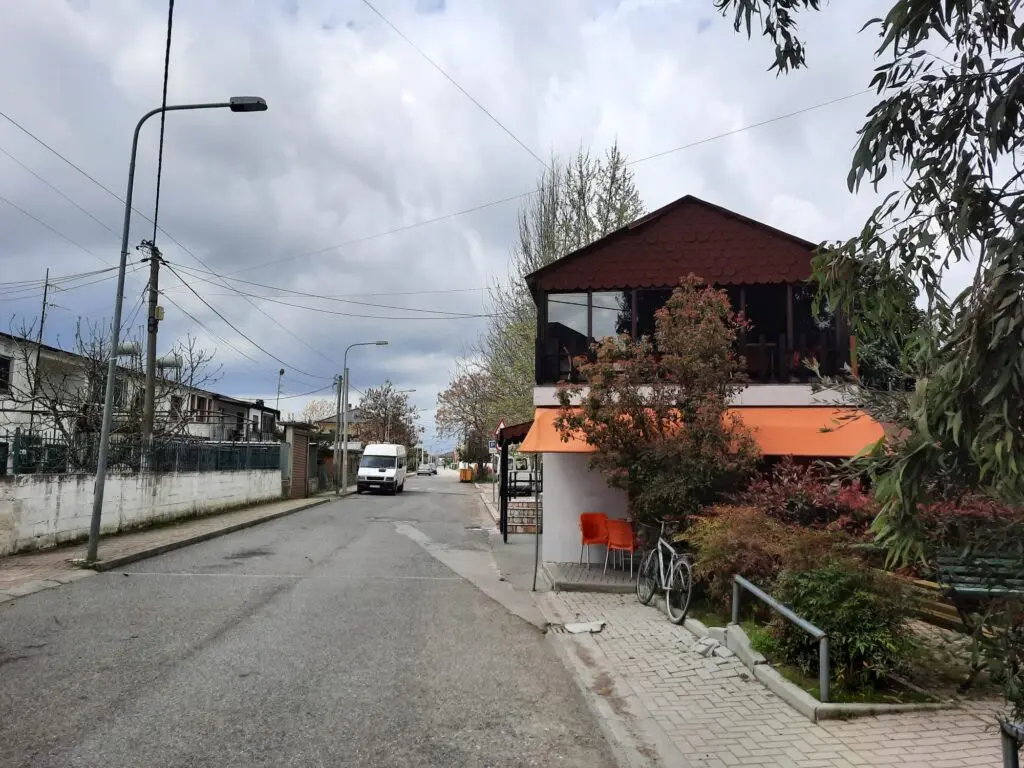 Gjadër (photo G. Vale)
What the Gjadër resident is referring to is the Italian-Albanian agreement signed by the two heads of government on 6 November 2023, a “Protocol for the strengthening of collaboration in migration matters”, ratified by the respective Parliaments last February and which provides for the construction of two facilities intended to host some of the migrants rescued in the Mediterranean by the Italian authorities for the period necessary to evaluate their asylum requests.
A first reception centre will be built in the port of Shëngjin, while the actual Repatriation Center (CPR) will be built here in Gjadër, in an old disused air base. “There are about 7,000 of us left here, and they want to bring another 3,000 people from Italy. Nobody knows where they are going to put them – Mark continues with disappointment – no one has stopped by to talk to us, not even the MPs we have elected”.
As we talk, construction has just started less than a kilometre away. Mark is aware of this, as is a friend of his, who prefers to remain anonymous and complains in perfect Italian: “Politicians are never seen here, during election campaigns they don’t even come to ask for votes, they send the criminal groups that represent them. And then they do what they want”.
A matter of friendship?
Mutual support for the Italian-Albanian agreement was emphasised by Italian Prime Minister Giorgia Meloni last November, when she defined the text as “an example and a model to follow”, inviting also the countries that are not yet part of the European Union.
With an equally warm opening, Albanian Prime Minister Edi Rama stated that “when Italy calls, Albania answers”. Without going into the merits of European policies on the management of migratory flows, Rama clarified that the agreement does not entirely resolve the problem, but “when geography becomes a curse”, Albania is ready to offer its contribution, an opportunity – he said – to reciprocate the Italian welcome in the nineties.
In detail, the Protocol (which is valid for five years, then renewable for another five) provides that the two facilities under construction in Shëngjin and Gjadër will have a maximum capacity of 3,000 people and will be used to evaluate residents’ asylum applications according to an accelerated procedure of 28 days maximum, allowing the transit of 36,000 migrants per year on Albanian soil. The operation responds to Meloni’s electoral promise to reduce migrant landings in Italy, which saw over 150,000 people arrive in 2023.
“Friendship must be demonstrated in times of need”, tells us the Albanian MP Denis Deliu, member of the Socialist Party (PS), in power in Tirana. Sitting in a café in the Albanian capital, Deliu explains that the agreement with Italy “does not entail any expenses for Albania”.
The Balkan republic has granted Rome the free use of two pieces of land – one in Gjadër and one in Shëngjin – which will be considered Italian territory, as is the case for foreign embassies. The cost initially estimated for the government of Rome is approximately 650 million Euros for the five years of validity of the protocol and the figure includes the construction and management of the centres, external surveillance entrusted to the Albanian authorities and the costs for personnel and transport to and from Italy.
A recent episode of Report , which caused the anger of the Albanian government and was broadcast following the publication of the construction tender issued by the Italian Ministry of the Interior, claims that the figure has already risen. Initially estimated at 30 millions, the management costs have, for example, already risen to 39, according to the same investigation. The remaining budget, according to Openpolis calculations based on a technical report , will finance other aspects of the operation, including 252 millions for the travel of officials, an expense which would have been avoidable if the centres had been built in Italy (plus 95 just for the rental of the ships that will transport the migrants to Italy, regardless of the outcome of their asylum requests).
The Albanian authorities, starting with Edi Rama himself, have denied any economic advantage from participating in the agreement with Italy. However, during the process of converting the protocol into law, new elements emerged regarding the construction and management of the facilities.
In particular, Albania will be entrusted with security management, under the supervision of the local police. Infrastructure works are also planned in the area designated for the two centres, with a total investment of 100 million Euros over five years. In general, the two centres will be Albanian-owned and granted for use for the duration of the agreement, i.e. for a maximum of ten years.
The one relating to the total budget is not the only inconsistency that looms over the project. The overall number of migrants who will be transported to Albania is equally unclear. The announcement from the Ministry of the Interior provides for a capacity of 1,024 people, for a maximum of 11,000 people per year, even in the case of managing asylum applications within 28 days. The same text also indicates a figure of 34 million Euros for the management of migrants and, considering that the daily expense for one person is around 33 Euros, it seems that the Interior Ministry plans to host a maximum of 2,822 migrants per year.
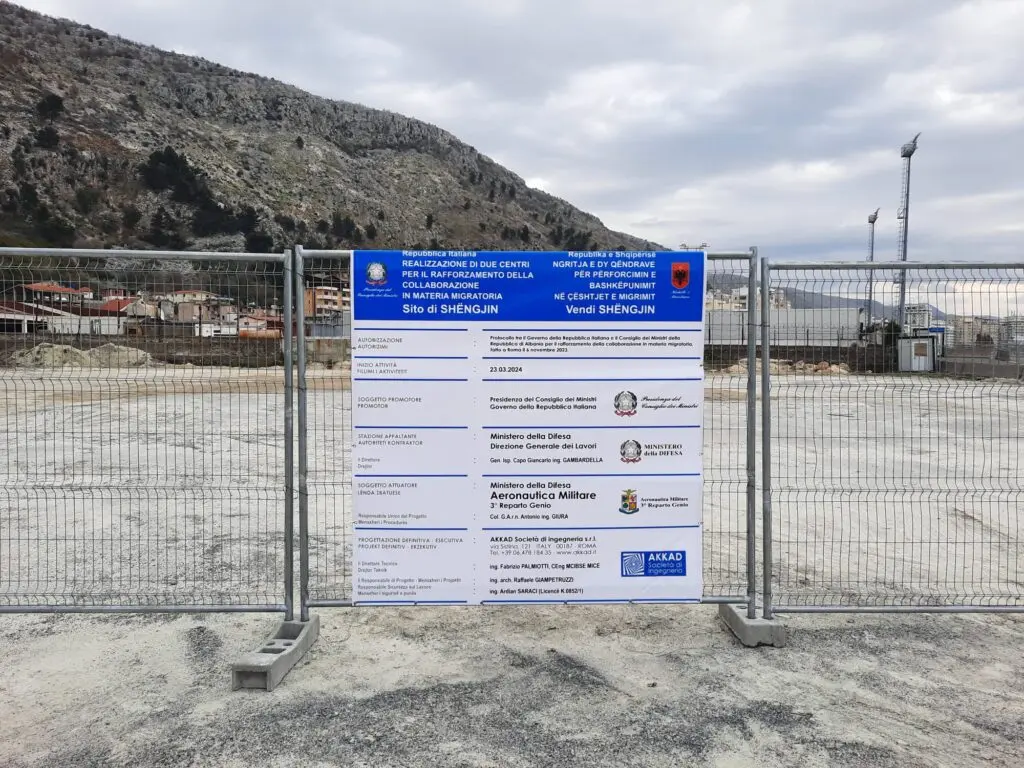
Demarcated area of the port of Shëngjin where the centre will be built (photo G. Vale)
Finally, another problematic point concerns the Italian company which has been assigned the management of the two future centres. “Medihospes”, a cooperative known in the past by the name of “Senis Hospes”, was involved in some journalistic investigations in 2015 due to its links with La Cascina, a company placed under commissionership for mafia infiltration.
“Minister Piantedosi should explain why his offices assigned the management of a centre for migrants in Albania for 151 million Euros without tender and to a company whose president of the board of directors, Camillo Aceto, was CEO of the Cascina, a cooperative commissioned for mafia infiltration in the investigation by the Rome prosecutor’s office into ‘Mafia Capitale'”, declared left-wing MP Angelo Bonelli at the beginning of May.
Criticisms of the project
After being signed in November 2023 and approved by the respective parliaments last February (in both cases without debate), the Italian-Albanian agreement recently also passed the scrutiny of the Albanian Constitutional Court, to which a group of deputies had appealed of the opposition.
Five out of nine judges ruled that the agreement for the construction of migrant reception centres in Albania is “compliant” with the Albanian constitution. According to the Court, the agreement does not imply changes to the national territory nor to the territorial integrity of the Republic of Albania. Furthermore, it is specified that in the areas involved in the migratory agreement, Albanian law will apply together with Italian law (in apparent contrast with what is said in the Protocol, which speaks of Italian jurisdiction alone). In short, although the ruling paved the way for the adoption of the agreement, it did not dispel doubts about its legality.
According to Dorian Matlija, director of the “Res Publica” Centre in Tirana, the agreement involves an abuse of the principle of extraterritoriality, usually applied to limited contexts such as diplomatic representations, “inhabited” by state officials. On the contrary, here it is a question of reception or detention centres, where the risk of accidents and crimes is presumed to be greater.
The ruling of the Constitutional Court confirmed the agreement, but highlighted that both jurisdictions will be applied, even if in law only one can prevail. In fact, Italy and Albania have different legislation regarding civil, criminal, work and family law.
Matlija warns that any investigations or restrictions on access to justice and to the courts, therefore not only those related to the right of asylum, could easily lead to violations of human rights. And in case of non-compliance, Albania will be responsible before international institutions and courts.
Many uncertainties also weigh on the permanence of migrants in Albania, especially in the event of refusal of the right to asylum and consequent repatriation to their countries of origin. Several Albanian experts fear that, in the event of delays or disputes over the agreement, migrants could remain in the country longer or try to escape from reception centres, creating management problems in a context which is still permeated by the activity of criminal organisations engaged in human trafficking.
A group of Albanian civil society organisations signed a petition against the agreement and urged the authorities to consider the complex issue of immigration in compliance with human rights and international obligations regarding the protection of people in difficulty.
These concerns were also echoed by Dunja Mijatović, Commissioner for Human Rights of the Council of Europe, according to which “the measures proposed in the protocol significantly increase the risk of exposing refugees, asylum seekers and immigrants to human rights violations. Transfer of responsibility across borders by some States encourages other States to behave in the same way, creating the risk of a domino effect that would undermine the European and global system of international protection”.
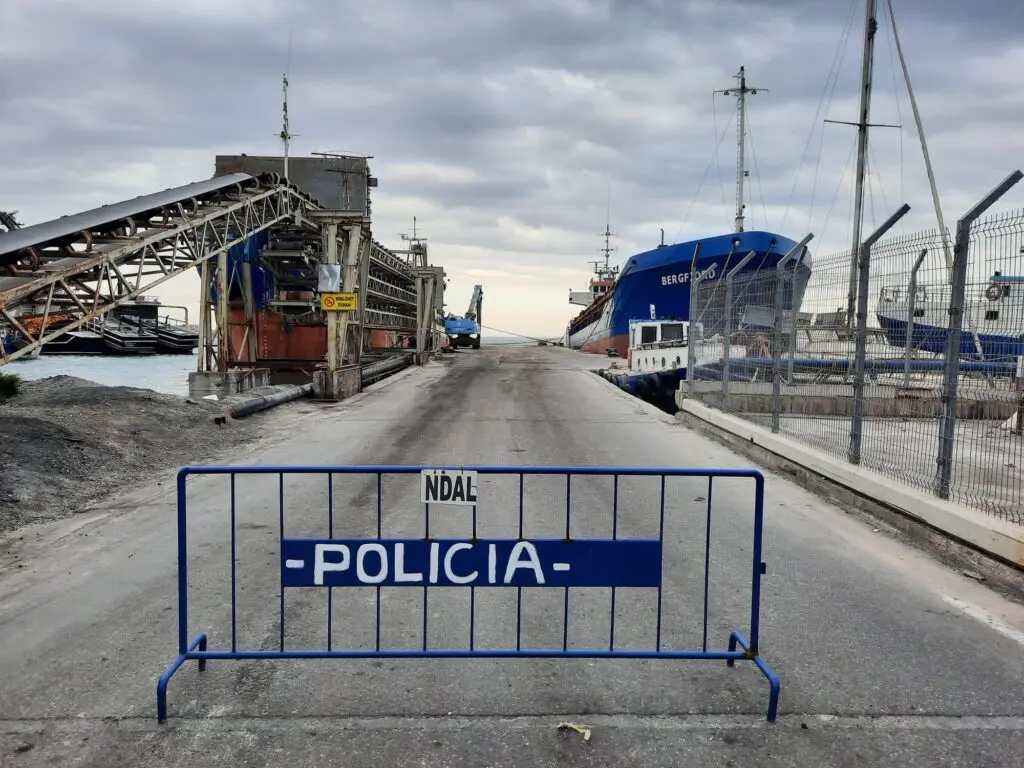
The docking pier at the port of Shëngjin (photo G. Vale)
In Shëngjin
“Shëngjin is not the right place for such a project. We live off tourism during the summer months. This centre can create problems”, says Fabio, 38, who has returned to live in his native Shëngjin after over 15 years in Italy. “I was a foreigner too, but I saw what Lampedusa has become. I don’t want the same thing to happen here”, continues this employee of a local municipal company.
Sander Marashi, director of the port of Shëngjin, however, says he is confident about the full continuity of both port and tourist activities, despite the arrival of migrants. “The port of Shëngjin – says Marashi – is a private company and its prerogative is the transport of goods”. With the 4,000 square metres kindly granted to the Italian side, the director considers his task completed: no damage, no benefit. Everything else is a political question.
Even at the Lezhë municipality headquarters, under whose jurisdiction the settlements of Shëngjin and Gjadër fall, socialist deputy mayor Elson Frroku assures that the migrant centres will not have any negative impact. “The citizens won’t even notice. The only thing we expect is a few more means of transport on our roads”, says Frroku, who adds: “Our municipality also already has experience in this matter, with the reception of Afghan refugees”.
In Shëngjin the Albanian government has in fact already put into practice a similar agreement. In 2021, after the Taliban returned to power, Albania agreed to host – at the request of the United States – around 3,000 Afghans fleeing from Kabul. Hundreds of them are still in a resort waiting to get visas for the United States.
“Before the Afghans, the Iranian dissidents arrived and before that the Uyghurs… Albania does not have a long-term foreign policy. Everything is decided by the Prime Minister and his goal now is to show that Albania is a reliable partner and that it deserves to join the European Union”, explains Ben Andoni, journalist and political analyst in Tirana.
In Shëngjin, however, there has already been a concrete consequence. The opening of the centre will involve the transfer of around fifty fishermen and their ships from the port of Shëngjin to that of Durres, 70 kilometres further south. “If they really move us we will protest. My family lives here. Durres is too far away”, complains a young fisherman who prefers to remain anonymous.
The European Court
However, the judgment of the European Court of Justice hangs over the agreement with Italy, as the Court must express its opinion on the validity of the so-called “Cutro Decree”, introduced by the Meloni government at the end of 2023 and on which the Italian-Albanian agreement is based.
Under the new law, Italian authorities can detain an asylum seeker for up to four weeks unless he or she posts a deposit of 5,000 Euros. The Italian-Albanian protocol excludes asylum seekers from being able to move freely on Albanian territory, so if the Court were to consider the Italian legislation not in line with the European one, the entire agreement could fall apart. Despite this risk, the Italian government decided to continue with the project and work began in northern Albania at the end of March.
“The agreement is based on the principle of immigration detention during the assessment of their asylum requests, a concept considered inadmissible according to European law”, activist Arilda Lleshi tells us in Tirana. For those, who, like her, oppose the agreement in Albania, it is not a question of taking a political side or being for or against immigration. Their concerns, she explains, concern the possible repercussions on the territory and local tourism on the one hand and, on the other hand, the issue of human rights for those who will be diverted to Albania without their consent, losing their freedom.
“With the complication arising from Albanian legislation, which makes the organisation of a referendum almost impossible, we now ask ourselves how we can oppose this agreement”, concludes Lleshi.
However, even if the European Court were to express a positive opinion, it is unlikely that asylum requests will be processed within 28 days. According to what Meloni claimed, in fact, the expectation of welcoming migrants in Albania is 3,000 people per month, but only if the requests are processed with the accelerated procedure, within 28 days, applying the rules relating to the so-called border procedure, to which the Albanian reception centre is equated.
However, according to several Italian non-governmental organisations, the waiting time to receive a response is usually around two and a half years, including two only for the first hearing and six months for the evaluation of the application.
Return to Gjadër
Returning to Gjadër, a line of bulldozers slowly travels along the narrow road that leads to the small town. The heavy vehicles pass the Catholic cemetery and disappear behind a rusty gate, which marks the entrance to the old air base, an abandoned military area hidden among the trees on the western bank of the Drin river.
Luigj, 62, watches with concern the comings and goings of bulldozers a stone’s throw from his house. “In 1978 the government demolished our house to build the air base. They gave us compensation, but not enough to rebuild the two-story house we had”, says this pastor, who now lives in a small one-story house with his wife and son Xhulio. The other two children emigrated to Italy. “It’s a shame to have to leave your country”, Luigj continues, his face red from the sun under his cotton hat. “I just hope they will be careful when they transport the migrants, because the road is narrow and my goats and sheep graze right nearby”.
This article was produced as part of the Collaborative and Investigative Journalism Initiative (CIJI ), a project co-funded by the European Commission. Responsibility for the contents of this publication lies with Osservatorio Balcani Caucaso Transeuropa and does not in any way reflect the opinion of the European Union. Visit the project page
Found an error in this article? Please contact our editorial team at redazione@balcanicaucaso.org.
Tag: CIJI | Italy-Albania migration deal
Featured articles
 Montenegro Pride 2026
 Political deadlock