Sarajevo, the museum preserving children’s war memories
The War Childhood Museum in Sarajevo brings together testimonies and artefacts from people who grew up amidst conflict, in Bosnia and Herzegovina and beyond. Collected with sensitivity, these memories provide opportunities for dialogue between divided communities
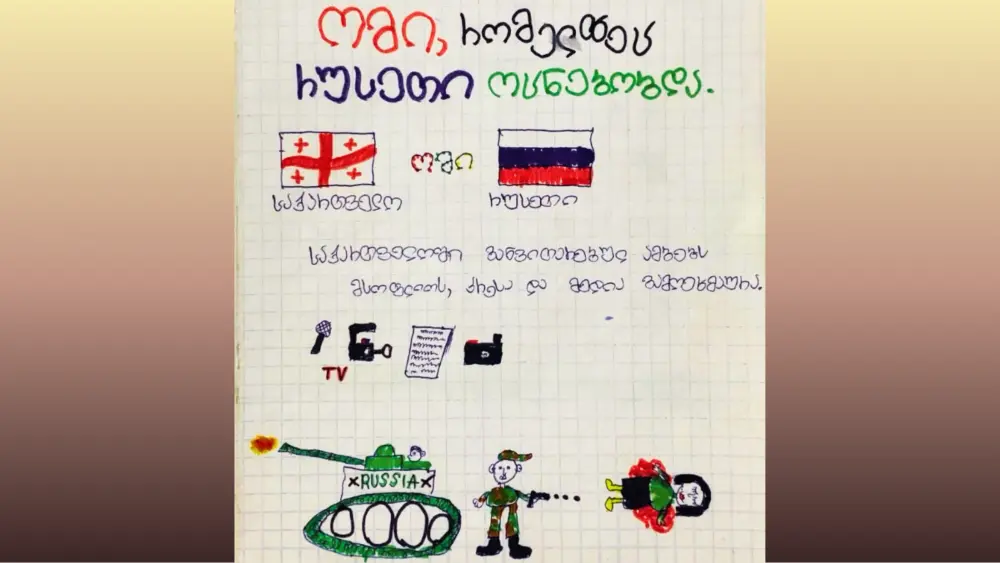
Tornike WCM
Tornike Kakalashvili's object in the WCM collection (© War Childhood Museum)
Jasminko Halilovic was just two years old when war broke out in his native Bosnia. Years later, looking for an answer to the question ‘What was a war childhood for you?’, he turned that question into something bigger: together with other former war children, he founded the War Childhood Museum (WCM) in Sarajevo in 2017.
The museum is a grassroots, human-centered cultural institution dedicated to preserving the lived experiences of children affected by war. Speaking to OBCT, Aynura Akbas, research coordinator at the WCM, said that Bosnian war survivors, with no support from state institutions, managed to establish a museum in an post-war environment that was “saturated with nationalist rhetoric about the war.”
“Jasminko Halilovic invited his peers, people who grew up during the war in Bosnia, to share short recollections of their war childhood. He wanted to preserve, memorialize, and archive his own war experiences and childhood memories. But at the same time, Halilovic wanted to forge connections with others who share this experience. This was the first step towards the creation of the museum that was driven by a collective effort to fill the gaps in history and start this kind of memory project that continues to this day,” Akbas explained.
Halilovic ended up collecting around 1500 memories and testimonies from former war children in Bosnia, as well as members of the Bosnian diaspora living in more than 30 countries. Later on, Halilovic published them in a book titled ‘War Childhood’ and, as the project evolved, many other people shared accounts of their war childhood experience.
“In this process, Halilovic realized that people kept not only their personal accounts of war, but oftentimes some physical objects that were related to their memories. He has met many of these people in person, and during these encounters people would often bring a photograph or mention a personal object that they have kept from the war period, such a handmade toy or a diary. More than 20 years after the war had ended, people still held on to objects – and that’s when Halilovic realized the strong connection between personal experience and physical objects,” Akbas explained.
In the very early stages of the project Halilovic received toys, diaries, letters, clothing, ordinary household items, and other kinds of objects that for people symbolized different things, such as hope, survival, or resilience.
“For some people, these objects were a connection to somebody they lost or somebody who was close to them during the war. When I think about resilience in our collection, several objects come to mind. A pair of ballet shoes worn by a contributor who kept attending classes throughout the siege of Sarajevo, a sports jersey from a person who continued going to volleyball practice during the war, a diary written in English by someone who felt that using a foreign language made it easier to process what was happening. Each of these objects speaks to the ways that children found to keep going,” Akbas said.
Promoting peace
Over time, the museum expanded its reach beyond Bosnia and Herzegovina. It has been documenting more than 20 conflict and post-conflict contexts around the world. According to Akbas, WCM has “a lot of traveling and temporary exhibitions, but Sarajevo remains the only place with a permanent exhibition.” Ukraine is, however, a partial exception as it is the first country where WCM managed to open an international office with a full-time staff, who is building a collection on the effects of Russia’s full-scale invasion. Furthermore, WCM has an administrative office in the Netherlands.
Research, education, and exhibition are the key areas of the museum’s work. As Akbas noted, the museum’s work extends beyond its collection, engaging with communities. For instance, WCM puts its collection to promote peace through educational workshops.
Akbas emphasized that this peacebuilding dimension is rooted in its survivor-centered approach. “Our educators design content and educational materials meant to build empathy and critical engagement with the legacies of war. The museum’s collection serves as a tool for fostering a culture of peace and mutual understanding. We use these personal objects and stories to help young people reflect on the consequences of war, and on the resilience and agency of the children who are most affected by it,” the research coordinator told OBCT.
The museum has managed to engage young people from all backgrounds and political entities of Bosnia and Herzegovina, which is not something to be taken for granted in a deeply polarized country. In addition, the museum offers teachers the opportunity to work directly together, helping hundreds of them to organize peace-focused classes and workshops in their schools.
“Structural and administrative barriers often make it difficult for communities to gather in Sarajevo, making the WCM’s alternative spaces for encounters particularly valuable in the Bosnian context,” the research coordinator explained.
The War Childhood Museum believes that storytelling can really change attitudes between divided communities and bring some positive results in terms of promoting peaceful coexistence and dialogue between all parties.
“Storytelling is at the heart of our approach. The exhibition is really a unique space where contributors often come with their children – and this becomes the first place where they share with their children their experience of growing up in a war. This signals to us that our museum is a safe space,” Akbas added.
Ethical dilemmas
While interviewed by OBCT, Akbas said that there are multiple ethical dilemmas that WCM has to be aware of when working with personal stories of war, marginalized histories or vulnerable communities.
“We have developed procedures, mechanisms, and policies that take into account all of these risks and ethical challenges. For example, we have developed child protection policies, adult protection policies, procedures for how to manage the interview process, and how to manage the documentation process. All our staff who work with survivors receive training in trauma-sensitive approaches before interviewing and documenting. There are many things in place to ensure that we are well prepared when working with survivors,” a research coordinator said.
One of the ethical decisions made by the museum is to let contributors take their object back, or redact parts of their story at any time with no questions asked. Besides, WCM gives its contributors the opportunity to remain anonymous or use pseudonyms. Akbas pointed out that all this is meant to ensure that “people feel that they own their story, and that once an object is donated, it does not necessarily become the museum’s permanent possession. In other words, the museum acts as guardian of what’s been donated, but the contributor remains its owner.”
Author’s note – In 2024 I learned about WCM and decided to donate my handwritten childish “newspaper” created during the 2008 Russian invasion of Georgia. At the time, I was 10 years old and I already wanted to become a journalist. As a creative child, I would often make my own newspapers, record videos of myself as if I were hosting a news program and interview passersby in my neighborhood in Gori, my hometown, using a homemade microphone. It was a game I truly loved, allowing me to express myself and finding it to be one of the best ways to relax and entertain. My pieces reflected on serious issues, mostly political ones as well as other topics that captured my interest, and were accompanied by my own drawings or pasted pictures from real magazines or newspapers into my handmade creations. I contributed to the collection of WCM with utopian hope that no child in the world will ever suffer from the horrors of war and those children who already experienced the devastating consequences of armed conflicts will find the courage to build a better, peaceful and fairer world for all.
Found an error in this article? Please contact our editorial team at redazione@balcanicaucaso.org.
Featured articles
 Investigation
 students' protest
 Montenegro Pride 2026