Georgia, the Orthodox Church at a crossroads
The death of Catholicos-Patriarch Ilia II, who led the Georgian Orthodox Church for nearly 50 years, marks the end of an era for the entire country, as for many he was a symbol of national unity. The next Patriarch will be elected soon
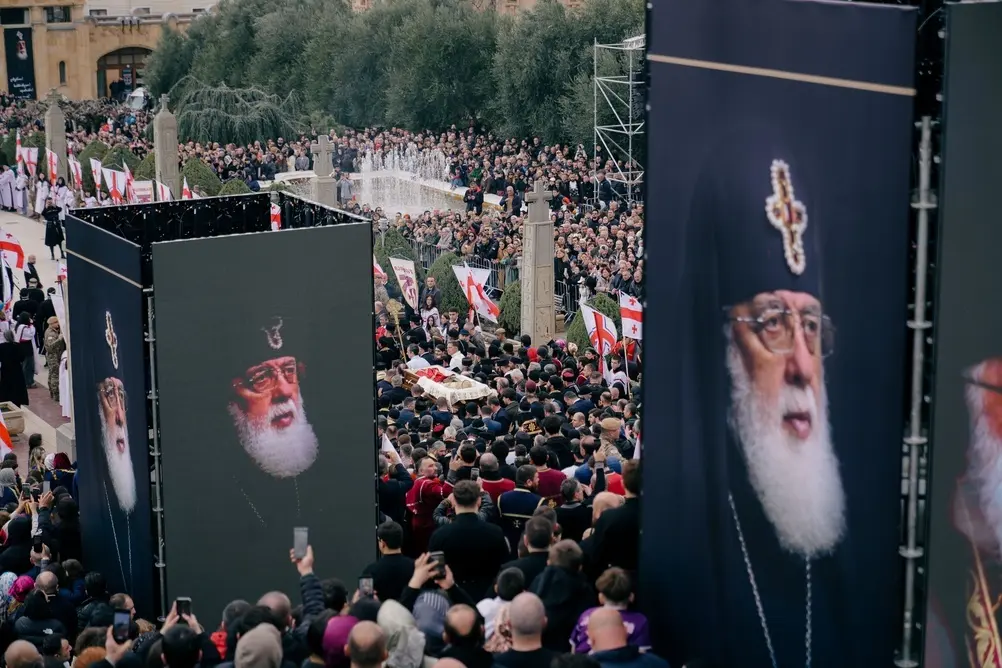
People attending the funeral service of Ilia II in Tbilisi
People attending the funeral service of Ilia II in Tbilisi, March 22, 2026 © CHEKI Photography/Shutterstock
Catholicos-Patriarch Ilia II, who led the Georgian Orthodox Church for nearly 50 years, died on March 17 at the age of 93. The end of the longest tenure in the Church’s history marks the end of a defining era in Georgia’s modern history.
Widely recognized as the country’s one of the most trusted institutions, the Church now stands at a crossroads as it prepares to choose a new Catholicos-Patriarch. The election shall be made within a maximum of two months after the patriarch’s death, that is by mid-May. Beyond spiritual leadership, Ilia II’s successor is expected to navigate a deeply polarized Georgian society while balancing the country’s complex geopolitical stance – caught between the West and Russia.
From Brezhnev’s USSR to independent Georgia
Ilia II became head of the Georgian Orthodox Church in 1977, when Georgia was part of the Soviet Union and the Church was suppressed under atheist rule.
“The Soviet system actually erected an artificial wall of alienation between the Church and society, and at the time serving as a clergyman was nothing short of hell,” Georgian historian and theologian Sergo Vardosanidze told OBCT.
Churches were attended by very few people, and iconic Georgian Orthodox churches – including Metekhi and Anchiskhati in Tbilisi – were repurposed as secular spaces such as a youth theatre and an artist’s studio. Although there were officially 15 dioceses, only 6 were actually functioning. There were 50 active churches and about 70 clergymen, most of them elderly.
This legacy was inherited by the young Patriarch, Vardosanidze says. “The first thing Ilia II managed to do was to slowly but deliberately break down this artificial wall of alienation. He reached out to the people, and in response, the people returned to the Church, particularly the youth,” the historian said. In parallel, Ilia II began transforming dioceses that existed only on paper into functioning ones. “Bringing the Church out of its marginalized position since 1977 can rightly be considered one of Ilia II’s key achievements,” theologian Shota Kintsurashvili told OBCT.
Another important achievement of Ilia II was securing formal recognition of the independence of the Georgian Orthodox Church and of its patriarchal status from the Ecumenical Patriarchate of Constantinople. This happened in 1990. Georgian Church autocephaly (independence) had existed in practice since the 5th century but had been abolished in 1811 by the Russian Empire, following the annexation of Georgia.
The legacy of Ilia II
Similarly to Vardosanidze, Kintsurashvili also refers to Ilia II as the “People’s Patriarch.” He had a talent for interacting with people and was able to build bridges with different segments of society. Kintsurashvili argues that this reputation was shaped by the political context of the time, including the collapse of the 1990s, renewed religious interest and the restoration of religious freedom.
According to Kintsurashvili, Ilia II at times maintained ‘somewhat friendly and cooperative relations’ with the authorities, but especially in post-Soviet Georgia, he sought to draw a clear boundary between the Church and the state that neither side should cross, and was mostly successful in this.
A landmark achievement of Patriarch Ilia II was the Constitutional Agreement of 2002 between the Georgian state and the Georgian Orthodox Church, which recognizes the Church’s special role in the country’s history and grants some privileges to it.
In Kintsurashvili’s view, Patriarch Ilia II left behind two “heavy legacies:” personnel policy and lack of wider theological knowledge among the Georgian clergy. Many of the clergymen he appointed to key positions lacked even basic theological education, and the broader problem of theological illiteracy among the Georgian clergy was not resolved.
“Ilia II invested much more time and energy, as Patriarch, in relations with the authorities, intellectuals, elites, and various groups than in resolving internal church problems and administrative issues,” the theologian said.
According to him, individuals without theological training were entrusted with the priesthood based on personal obedience or sympathy. Additionally, the Georgian Church does not have an ecclesiastical court, which Kintsurashvili describes as “unthinkable.”
He also notes that seminaries and academies of the Georgian Church remain largely closed systems with little connection to Western theological institutions. “Theology requires reflection, exchange, knowledge acquisition, translation, and the development and transmission of new ideas. This is not happening,” he said.
Challenges the Georgian Church faces
When asked whether the Georgian Church will be able to maintain its influence after Ilia II, Sergo Vardosanidze said this question can only be properly answered after the election of the new Patriarch. Hundreds of thousands of people attended the funeral of Ilia II in Tbilisi. According to him, “the sea of people who attended the funeral came out of personal sympathy for Ilia II, and they will need to be retained within the Church.” Any new Patriarch will initially struggle to step out of Ilia II’s shadow.
The historian said the future Patriarch should have the ability to engage in dialogue with ordinary people and listen to them, as Ilia II did. He should also remain firm in defending ecclesiastical independence and state sovereignty, without yielding even slightly.
In Vardosanidze’s view, Georgia’s geopolitical position is extremely complex, and Ilia II was “surprisingly sophisticated and subtle in his relations with everyone.” “The new Patriarch should be a serious diplomat. We are a small, vulnerable country in a difficult geopolitical region, and in such a context he should have strong maneuvering skills.”
Vardosanidze also noted that Ilia II did not divide Georgian society along political lines, which is why he was sometimes opposed by various political parties. “He always said that both government supporters and opposition members are my spiritual children. I cannot take the side of one group, no matter how much they ask me to,” the historian told OBCT.
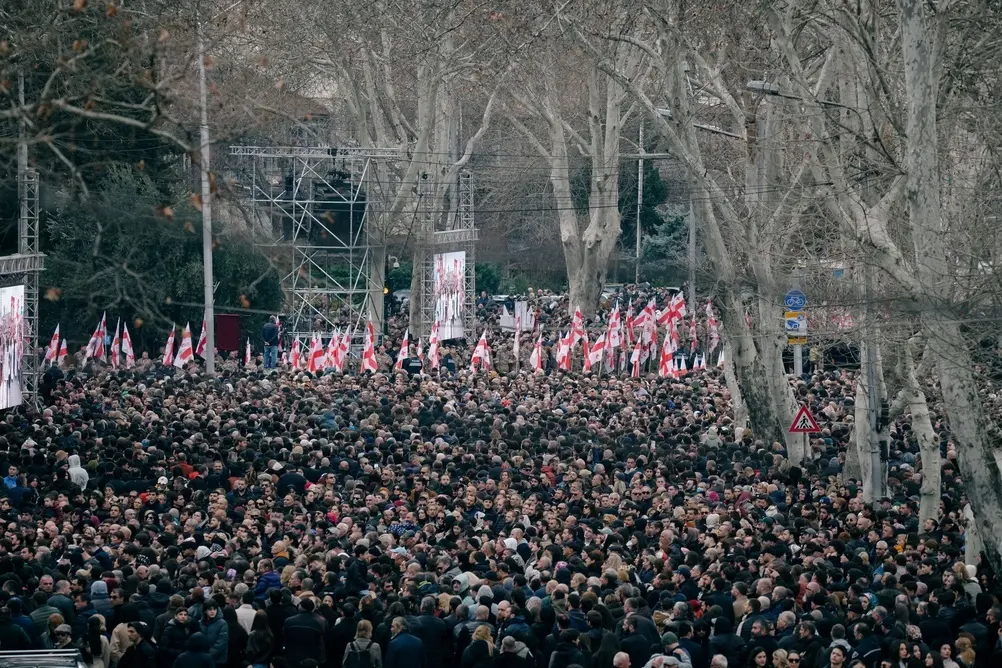
Crowd at the funeral of Ilia II in Tbilisi, March 22, 2026 © CHEKI Photography/Shutterstock
The election of the new Patriarch
From March 18 to March 22, from the moment his body was transferred to the Holy Trinity Cathedral until the funeral ceremony concluded, a continuous stream of mourners flowed into the cathedral, which remained open 24 hours a day for those wishing to pay their respects. A period of national mourning declared by the Georgian government was observed throughout this time, lasting until the day of the funeral.
When the Georgian patriarchal seat becomes vacant, the 39-member Holy Synod nominates three candidates, with each member entitled to propose one name, including their own. Eligible candidates must be between 40 and 70 years old.
An expanded council also including diocesan clergy and laity, representatives of monastic communities and theological scholarship, as well as other designated delegates, is successively convened. During this assembly, all participants may express their views on the candidates; however, voting is reserved exclusively for the members of the Holy Synod.
Risks of political and foreign influence
Both theologians argue that political attempts to influence the election of a new Catholicos-Patriarch have always existed. According to Kintsurashvili, Georgia’s geopolitical position makes such attempts inevitable.
Vardosanidze argues that “everything depends on the Holy Synod and its unity. If the Synod remains firm and united, no one will be able to influence the outcome.”
For Moscow, it is particularly important that Georgia has a new Patriarch who has certain ties with Russia
According to Kintsurashvili, the Russian ‘imperialist’ state, as well as the Russian Orthodox Church, has a strong interest in the developments within the Georgian Church. For Moscow, it is particularly important that Georgia has a new Patriarch who has certain ties with Russia.
“Putin views the Church as an instrument that can exert significant influence over the masses. In Georgia, where the Church has a very strong social influence, it is geopolitically important for Russia to ensure that a figure is elected who either has compromising information held by Russia or is ideologically aligned with Russian imperial Orthodoxy,” Kintsurashvili said.
Notably, Ecumenical Patriarch Bartholomew visited Tbilisi on March 22 to pay his respects to the late Ilia II and to conduct a funeral service for him.
In a March 31 statement, the Russian Foreign Intelligence Service has accused Ecumenical Patriarch Bartholomew of Constantinople of interfering in the internal affairs of the Georgian Orthodox Church, seeking to bring it under his influence, taking advantage of the passing of the Catholicos-Patriarch of All Georgia, Ilia II. Russian intelligence claimed that the Ecumenical Patriarch Bartholomew, who is considered “primus inter pares” among the patriarchs of the Eastern Orthodox Churches, “continues to persistently pursue a treacherous line aimed at splitting global Orthodoxy.”
Responding to this statement, Archpriest Andria Jagmaidze, Head of the Public Relations Service of the Patriarchate of Georgia, said that “such interference from another local church, no matter which church, is unthinkable for us.”
Russia and its Orthodox Church have long been in conflict with the Ecumenical Patriarchate of Constantinople. In 2018, the Moscow Patriarchate broke off its ties with Constantinople after the Ecumenical Patriarch Bartholomew granted autocephaly (independence) to the Orthodox Church of Ukraine, a move that provoked strong backlash in Moscow.
Found an error in this article? Please contact our editorial team at redazione@balcanicaucaso.org.
Tag:
Featured articles
 the students' voices
 Investigation
 students' protest