A corner of America in a corner of Kosovo
US forces withdrew from Kosovo more than twenty years ago, but the American presence continues to be felt in the country. An account of a visit to the ‘American Corner’ in Prizren
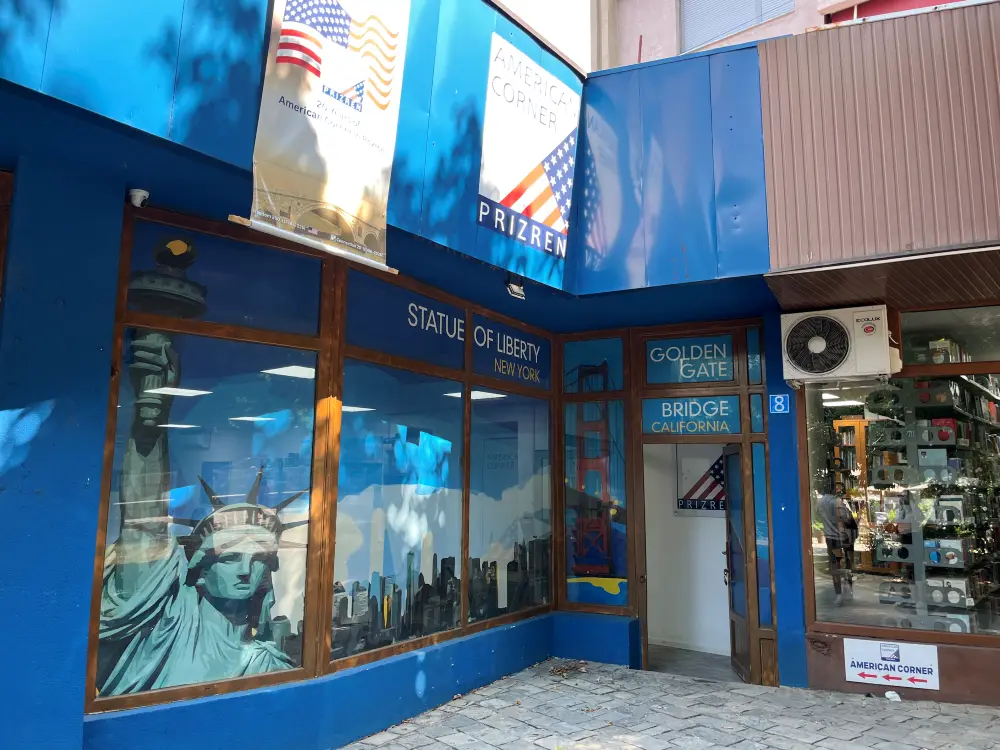
American Corner in Prizren
American Corner in Prizren, Kosovo (photo by I. Martinez Velasco/OBCT)
Kris, the local tour guide who picked us up in Tirana for a day-trip to Prizren in Kosovo, said the border between Kosovo and Albania didn’t always feel real, as the histories of the two countries were so intertwined. I was anticipating this. Once there, what caught me off guard was the strength of Kosovo’s relationship with a different country altogether: the United States of America.
The history of the 1999 NATO intervention in Kosovo, led by the U.S., is familiar. The campaign forced Serbian troops to withdraw, and eventually cleared the path for Kosovo’s declaration of independence in 2008. What is less obvious is how deeply the American presence remained afterwards.
In Prizren, Kris took us through a bridge to a small plaza. At the end of the square stood a low blue building attached to the public city library. Large windows were plastered with imposing posters depicting American landmarks, such as the Washington Monument and the Statue of Liberty. In the middle was a big sign reading ‘American Corner Prizren’, framed with American flags on either side.
The view looked strangely out of place among Prizren’s Ottoman mosques, Byzantine fortress and centuries-old stone streets. Yet, this American Corner felt central to Prizren as well, almost like a symbol of the next phase in Kosovo’s story.
Inside, English-language books filled the shelves. Some tables were set out, along with miscellaneous items like football and golf balls, American figurines and 3-D-printed art of American pop culture. One man, Besart, sat at a desk in the back of the room. There was no one else.
Besart, who has managed the centre for years, greeted me in effortless English and insisted on showing me the space. Alongside novels and encyclopaedias sat multiple copies of SAT preparation guides, the same books I had used years earlier when applying to American universities. It was a small indication that this place wasn’t simply showcasing American culture, but sought to integrate Kosovar youth into it.
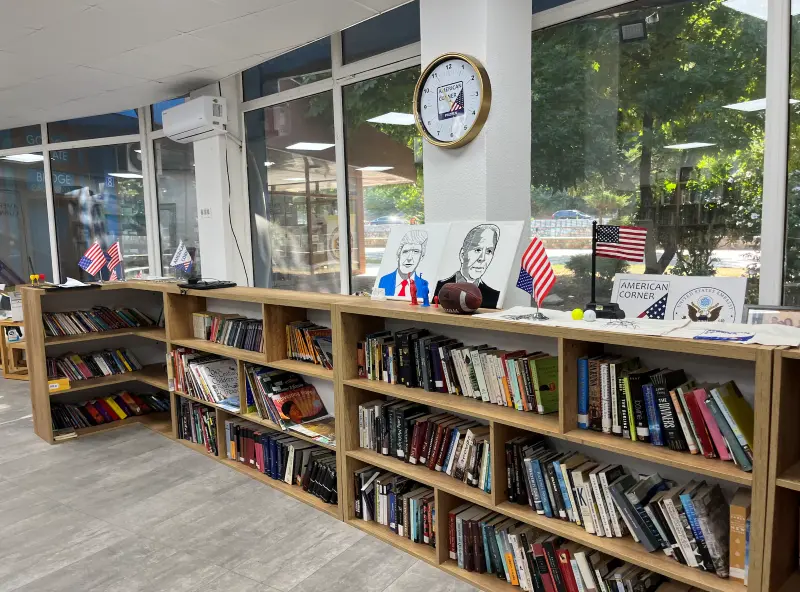
American Corner in Prizren (photo by I. Martinez Velasco/OBCT)
Besart then took me into a separate, wider room filled with tables and chairs, where they could hold conferences, host students, lead classes, or carry out different activities. As we stood in the empty room, he shared his view on the Kosovars’ love for Americans. According to him, ‘Kosovo is independent because of the United States.’
A network of cultural outposts
The American Corner in Prizren doesn’t stand alone, but is accompanied by other landmarks that make the U.S. present in public life across Kosovo. Pristina is home to an 11-foot statue of Bill Clinton, a Madeleine Albright Square and a George W. Bush Street, all tributes to American leaders who are credited with securing Kosovo’s future.
The Prizren corner officially opened in 2006 as part of the Inter-Municipal Library and as a partnership with the U.S. Embassy in Kosovo. Based on a memorandum of understanding between the two institutions, the local library provides the building and the staff, while the U.S. supplies the materials, technology, programming, training and strategic direction. The space is deliberately designed for public diplomacy to feel informal and accessible.
According to the 2024 U.S. State Department American Spaces Report, “Europe has the largest concentration of American Spaces globally and is the birthplace of the American Corner”. Within the continent, the Balkans are leading in that number. American Spaces is the global network of public diplomacy spaces led by the U.S. Department of State, which includes corners, binational centres, or other forms of diplomatic outposts.
The corners themselves emerged at the turn of the century as a more affordable and easier alternative to a traditional American cultural centre. Instead of building a facility from scratch, the U.S. could partner with central local institutions that provided legitimacy and trust for both American diplomats and local communities. The first were established in Russia before they spread worldwide to over 600 locations in over 140 countries.
American Spaces have genuinely made some impact, spreading educational opportunities and knowledge to areas often overlooked outside capital cities. They are meant to be people-to-people ventures, where locals can engage in conversation with Americans, exchange ideas, study, or access information, possibly leading to greater understanding and sympathy for the United States.
Growing difficulties
Beneath all of the displays of American culture and decades of bilateral efforts, something had recently changed. As we walked around the facilities in Prizren, Besart explained that substantial U.S. funding had ceased. Public Library financing keeps the building running, but American funds were the lifeblood of the American Corner, enabling its substance through programs, courses, initiatives, and resources.
Not all American funding stopped, but enough to feel the impacts; Besart did not want to elaborate further. Exactly why the reductions happened is difficult to determine. American Corners do not receive fixed annual budgets from embassies but rather funds for specific programs, equipment and initiatives, and fluctuations from year to year may simply reflect differing operational needs over time.
However, the timing of the difficulties for the American Corner in Prizren coincides with a broader retrenchment in American public diplomacy. The most notable – and impactful – sign of it was the dismantlement of USAID, which used to provide substantial support to many initiatives across the region and beyond.
As I left the American Corner and thanked Besart, I wandered back to the old town for coffee. I ended up at the Ernest Hemingway Lounge Bar. It felt quite fitting. In Kosovo, the country’s closest ally lingers not only in statues and street names, but in libraries, classrooms and even in the name of an American writer above a cafe door.
Found an error in this article? Please contact our editorial team at redazione@balcanicaucaso.org.