Bulgarian presidential election: Yotova wins, Radev celebrates
With nearly 58% of the vote, interim President Iliyana Yotova scored a clear victory in yesterday’s Bulgarian presidential runoff. The result strengthens Prime Minister Rumen Radev – her political mentor – while also endorsing Sofia’s conciliatory approach towards the Kremlin
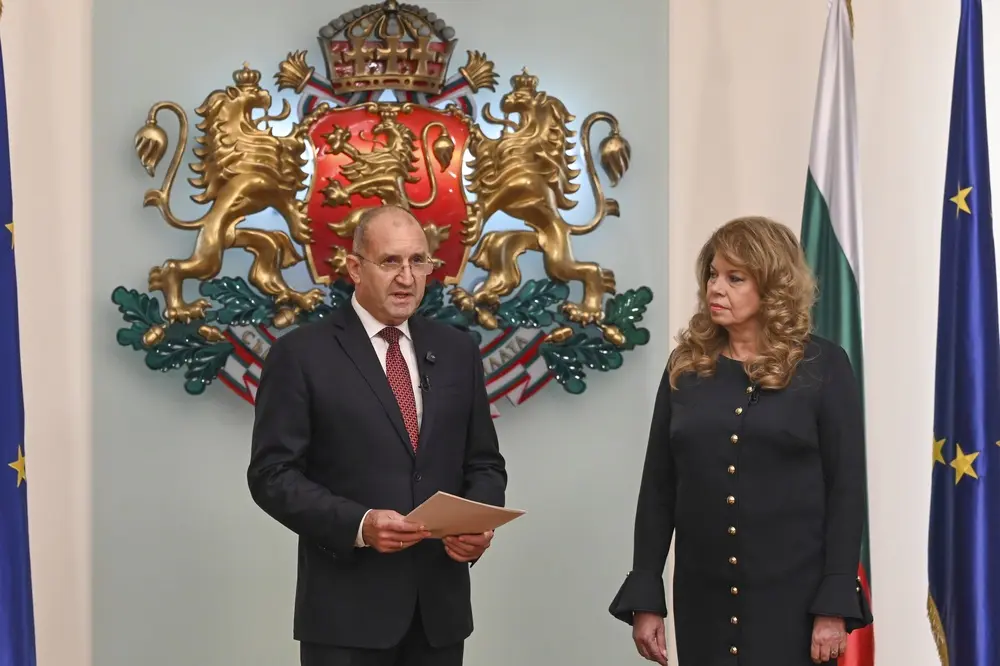
Iliyana Yotova and Rumen Radev © Anton Chalakov/Shutterstock
Iliyana Yotova and Rumen Radev © Anton Chalakov/Shutterstock
“I would like to offer a special word of thanks to Progressive Bulgaria. Mr Radev, we could not have done it without you.” The first political tribute from Bulgaria’s newly elected president, Iliyana Yotova, went to Prime Minister Rumen Radev, her political mentor and leader of the ruling party. Yotova comfortably defeated her rival, reformist Andrey Gyurov, in yesterday’s runoff.
Yotova officially ran as an independent, but her political career is closely intertwined with Radev’s. She served as his vice-president during his two consecutive terms as head of state.
When Radev resigned last winter to launch Progressive Bulgaria, which swept last April’s parliamentary elections amid a wave of protests that shook the country, Yotova became interim president. As the election approached, the new party threw its support behind her candidacy, indirectly but decisively.
Her victory yesterday makes her the first woman to be elected Bulgaria’s head of state. It is therefore a clear endorsement, above all, of the prime minister and his ruling party, which have now passed their first major electoral test since forming the new government.
The campaign, which quickly took on a bitter tone, particularly on social media, revolved around two main issues. The first was Bulgaria’s position amid Russia’s invasion of Ukraine. The second was the simmering confrontation between Progressive Bulgaria and the traditional players in the country’s political establishment.
The Ukraine factor and the war in the Black Sea
On Ukraine, Yotova repeatedly reaffirmed her position: dialogue with Moscow must be resumed. Her stance is fully in line with the approach Radev has pursued in recent years. A key part of this vision is opposition to supplying weapons to Ukraine, a move she considers dangerous and incompatible with efforts to secure a negotiated compromise.
The debate, which has traditionally divided Bulgarian public opinion between pro-Russian and pro-Western camps, has reached boiling point in recent weeks, as waters off the Bulgarian coast have turned into an active theatre of war.
At least six merchant vessels flying different flags but engaged in maritime trade with Ukraine have been attacked by drones in Bulgaria’s Black Sea exclusive economic zone. Some have been sunk, in attacks that have at times taken place just a few dozen kilometres from the coast.
The latest attack took place on 28 October, on the eve of the runoff. In this case, a crew member who managed to evacuate the vessel filmed the drone moments before impact. Several experts believe the remotely piloted weapon was Russian.
Radev summoned the Russian ambassador in Sofia but stopped short of directly accusing Moscow of responsibility for the attacks. These incidents have made navigation in the Black Sea – a vital area for Bulgarian interests – increasingly risky and difficult. Yotova has adopted the same position.
Gyurov and the pro-Western camp launched a frontal attack on Yotova, accusing her of bowing to Kremlin interests and steering Bulgaria away from the Euro-Atlantic camp. The interim president hit back, accusing Gyurov of seeking to drag the country into an open conflict with Russia.
The clash between ‘Progressive Bulgaria’ and the established parties
On the domestic front, the campaign revived the confrontation between Progressive Bulgaria and the traditional parties across the Bulgarian political spectrum. Radev defeated these forces last April on a promise of national renewal and an effective fight against nepotism and corruption.
In the first round, Gyurov secured the backing of the reformist We Continue the Change party and much of the liberal, pro-European right. Ahead of the runoff, just days before the vote, he also received the personal endorsement of Boyko Borisov, leader of GERB. The party dominated Bulgarian politics for a decade and remains, in the eyes of many, a symbol of the corrupt system brought down by last December’s protests.
Yotova had little difficulty portraying this alliance as an attempt by the political establishment to strike a backroom deal. She pointed to the overlapping interests of Borisov’s GERB and We Continue the Change, a movement founded to defeat GERB but which ended up governing alongside its political nemesis during the previous parliamentary term.
Demographics and voting
A closer look at the results also reveals other structural factors that shaped the outcome. Younger voters backed Gyurov. Generation Z, which played a leading role in the protests in Sofia and the country’s main cities, overwhelmingly supported the reformist candidate. His backing, however, declined sharply with each successive age group.
The traditional divide between Bulgaria’s urban centres and its more peripheral regions was also confirmed. Smaller towns and municipalities largely sided with Yotova, while Gyurov won by a comfortable margin in the capital, Sofia. The gender divide, by contrast, made little difference: Yotova secured the support of both men and women, defeating her rival by a significant margin among both groups.
Yet abstention emerged as the real winner once again. The heated political climate boosted turnout compared with the record low in the first round, but participation in the runoff still amounted to a meagre 29.1%.
Born in 1964, Iliyana Yotova spent many years as a journalist with Bulgaria’s public broadcaster BNT before joining the press office of the Bulgarian Socialist Party. In 2005, she was elected to the Bulgarian parliament as a Socialist MP. She later moved to the European Parliament following Bulgaria’s first European elections in 2007. From 2017 to 2026, she served as vice-president alongside Rumen Radev.
Found an error in this article? Please contact our editorial team at redazione@balcanicaucaso.org.
Tag:
Featured articles
 the students' voices
 Investigation
 students' protest