Serbia’s snap election: a view from Niš
All eyes will be on the capital, Belgrade, but Serbia’s snap election on Sunday, October 25, will also be decided in the country’s heartland. As in Niš, where Vučić brought his campaign to a close and students have been building a movement for change for years. Our report
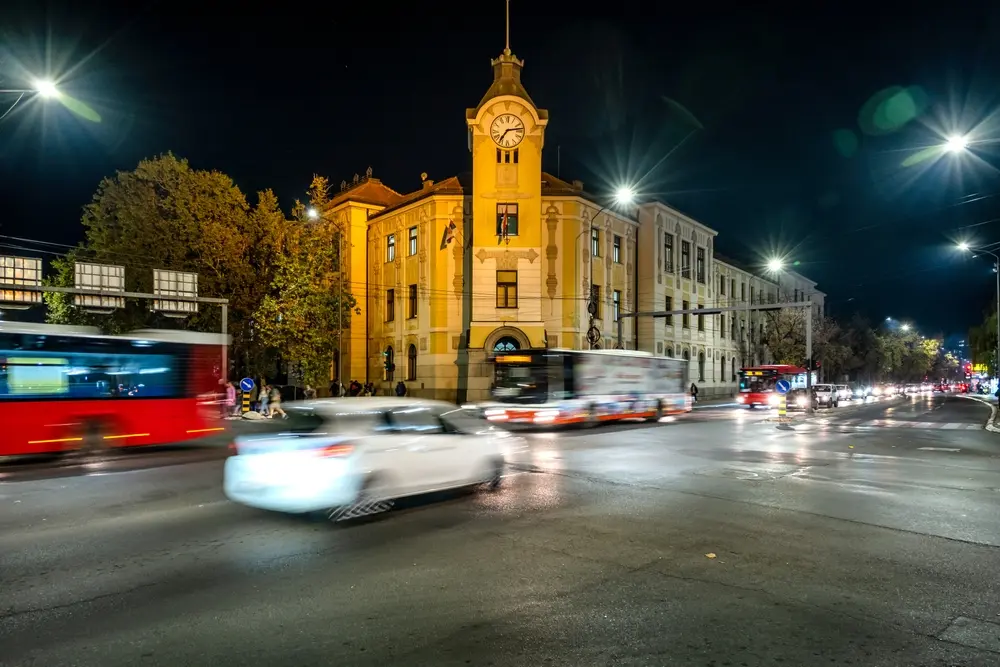
Niš, Serbia © WR7/Shutterstock
Niš, Serbia © WR7/Shutterstock
“Maybe we’re not as wealthy down here in the south, but we’re tough. We’re not used to bowing our heads. Vučić and his regime got the message back in 2024, when the municipality of Medijana became the first — and so far the only one in the country — to fall to the opposition. That’s why they staged their show here in town. They wanted to prove they were strong in Niš. But all they really showed was that they’re afraid. They know they’ve already lost.”
The students’ voice
Lenka Krstić speaks passionately and at a rapid pace. Her few longer pauses come when she stops to light another cigarette. We are talking in the spacious outdoor courtyard of the „Hush Hush bar in central Niš, Serbia’s third-largest city and the main urban centre in the south of the country.
A mechanical engineering student, Lenka joined the student movement shaking Serbia from its earliest days, following the Novi Sad tragedy. On Sunday, the movement hopes to bring Aleksandar Vučić’s long rule to an end.
When the station canopy collapsed on November 1, 2024, killing 16 people, Serbian students took to the streets to challenge the authorities and the corruption they blamed for the disaster. Now they are taking on the government at the ballot box, standing in early parliamentary elections under the list Studenti pobeđuju (“Students Will Win”).
“It’s been a difficult but exhilarating couple of years. They thought we were a distracted, indifferent generation. Instead, we’ve reclaimed our voice, and we’re going to make ourselves heard.”
With all eyes on Belgrade, where the student movement brought its election campaign to a close yesterday evening with a major rally in Slavija Square, Serbia’s hinterland has struggled to attract international media attention. Yet much of the country’s political future will be decided far from the capital.
“I’m convinced Vučić’s Progressives will perform poorly in Niš,” Ljubica Jocić, a journalist with Južne Vesti, an independent online outlet covering everyday life in southern Serbia, tells me over the phone. “The situation in the region has hardly improved in recent years, despite the former president’s boasts. Wages remain lower than elsewhere in Serbia, and life is generally harder — especially if you have no connections to the ruling party.”
The Serbian Progressive Party (SNS) rally
Perhaps that is precisely why Vučić’s Serbian Progressive Party (SNS), running in the election as part of the Ujedinjena Srbija (“United Serbia”) alliance, chose Niš for its final major campaign rally on Wednesday, October 20. The event took place in Kralj Milan Square, in the heart of the city, overlooking the Nišava River and facing the imposing Ottoman fortress that has stood for centuries as a defining landmark at the centre of Niš.
Money was no object. The ruling party deployed substantial financial, political and organisational resources to stage the rally. The city centre was closed for two days to prepare the square and install the stage and grandstands. Then hundreds of buses carrying Vučić supporters descended on Niš, bringing the city to a standstill for hours.
Joining Vučić on stage were former president and SNS founder Tomislav Nikolić and Milorad Dodik, the leader of the Bosnian Serbs. The rally culminated in a blaze of colourful balloons and fireworks, followed by a lavish barbecue for the thousands in attendance.
“Unlike Milošević, who was essentially a party apparatchik, Vučić has the street smarts of a man who knows how to survive. That’s kept him afloat even in the most difficult moments. But he’s an old-school politician, and he too underestimated the young men and women behind the protests. They understand the times we live in better than he does.”
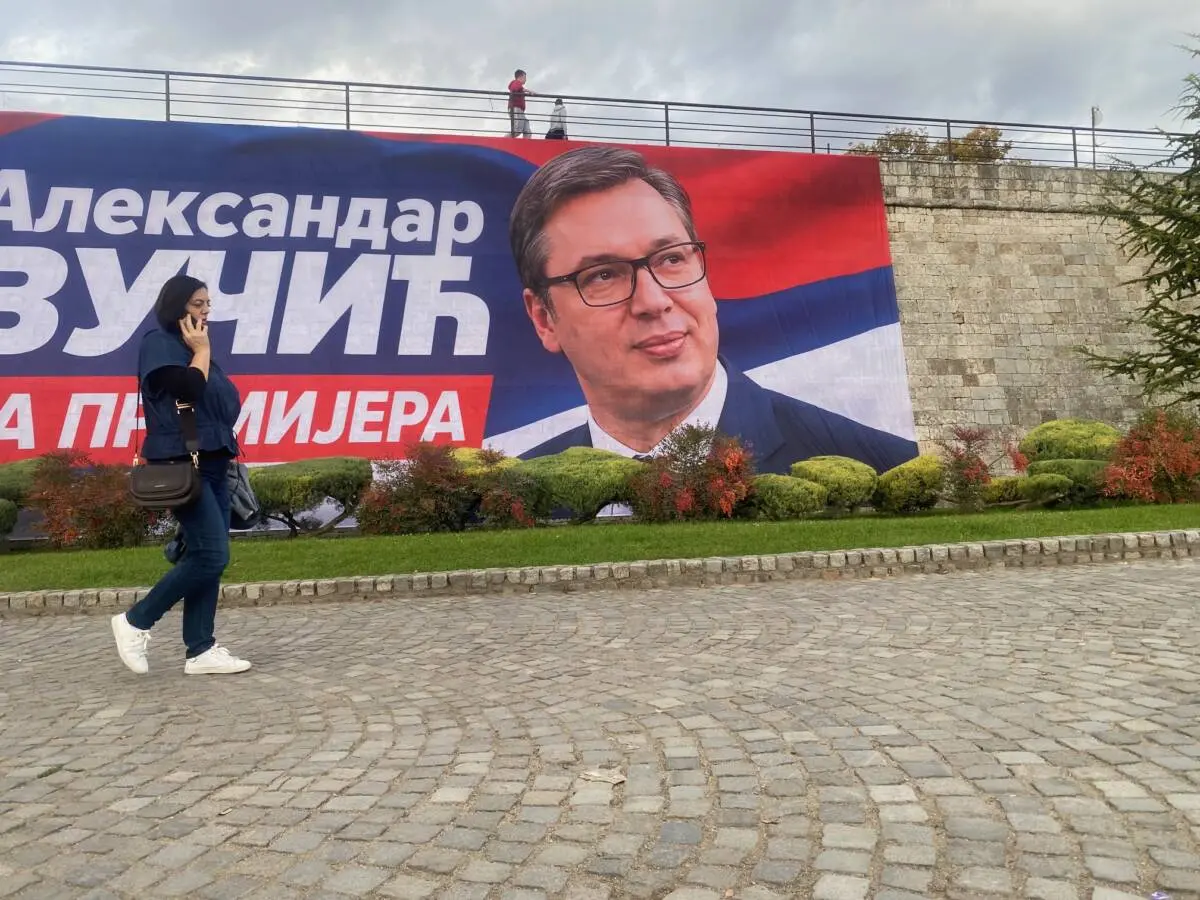
Niš, Serbia, 23 October 2026 – Photo: F. Martino
The youth’s strenght
I meet Dejan Stojiljković at Galija, Niš’s oldest and most welcoming kafana, or traditional tavern. One of Serbia’s most popular contemporary writers, he is also a journalist, the author of historical novels and comic books, and a screenwriter behind some of the country’s best-loved television series in recent years, including the crime drama Senke nad Balkanom (Shadows over the Balkans).
“Today’s young people have the same energy and drive as my generation, the one that took to the streets in the 1990s. But their awareness is different,” Stojiljković says. “We were cut off from the world, crushed by the regime, war and sanctions. Today’s young people are informed and connected. They really could finish the job we failed to complete back then.”
A chronicler of his country’s history, Stojiljković believes the word “historic” is no exaggeration when it comes to this election. “The system of power that has dominated Serbia for decades has never been so close to defeat. Whatever the results, the country that emerges from this election will be different.”
According to Dinko Gruhonjić, a journalist and programme director at the Independent Journalists’ Association of Vojvodina, another part of Serbia’s political periphery that could play a decisive role in the election, this prospect has been made possible by a crucial decision taken by the students.
“They don’t want to become politicians themselves. They want to change the way politics is done in Serbia,” Gruhonjić told the Czech outlet Deník Referendum. “That is precisely what sets the student movement apart from the opposition movements of the past.”
Dimitrije Nešović, an economics student and one of the leading organisers of the student movement in Niš, is firmly convinced that the movement can win Sunday’s election.
“Over the past two years, the movement has changed while remaining true to itself in terms of the values we stand for. It’s been an important process of maturation, especially now that we’re asking our fellow citizens not just to support us in principle, but to vote for us,” Dimitrije told me when he joined Lenka and me at “Hush Hush”.
Widespread monitoring to prevent electoral fraud
The student-list activists have prepared meticulously for election day. In Niš and the surrounding region, their representatives will be present at virtually every polling station, from the city centre to the most remote villages.
“We know they’ll try everything, legal and illegal, to steal this election. But we’re ready. We’ll fight to defend every single vote.”
The road to the ballot box has been long and complex. Alongside street protests and acts of civil resistance, the students of Niš have helped shape some of the movement’s most original thinking and political ideas.
In March 2025, inspired by the Edict of Milan issued by Emperor Constantine, who was born in Naissus — the Roman city that eventually became modern-day Niš — the young protesters drew up their own “Students’ Edict”. It set out the principles and ideals underpinning their drive for change: freedom, justice, solidarity, and a different vision of the state and the wider community.
“It was like taking a photograph of who we are and who we want to become, and handing it over to society — and perhaps, why not, to history,” Lenka tells me, unable to hide a note of pride.
Students in every village
But the students have also invested time and energy in reaching people in the most remote parts of the country. Through an initiative called Student u svakom selu (“A Student in Every Village”), they have taken their political message beyond social media and into face-to-face encounters with local communities.
“This was a crucial step throughout Serbia, but especially in our region, where so many communities are isolated — not just geographically, but also in terms of access to media,” Dimitrije adds. “People have been able to see our faces, talk to us and get to know us. I’m convinced we’ll see the results of that effort on Sunday.”
At the rally in Kralj Milan Square, Vučić spoke of his special relationship with Niš and the surrounding region. He touted improvements to infrastructure and wages and promised further investment and jobs in an area that has suffered severe depopulation and economic decline over recent decades.
“In reality, they’ve abandoned us to the mercy of people who are utterly incompetent. They continue to run the city only because of the outright fraud that followed the 2024 local elections,” Stojiljković says bitterly. “Serbia increasingly resembles a body with an oversized head and paralysed limbs. All the resources are concentrated in Belgrade, while the rest of the country barely survives. And that applies not just to the economy, but to social and cultural life as well.”
The media and freedom of expression
The same pattern is evident in the media landscape and the state of press freedom. Jocić says the past two years have brought a marked increase in pressure on independent media across Serbia, including Južne Vesti.
“For local media, things are even more complicated. The climate of intimidation has worsened in recent years. There may have been fewer serious incidents in Niš than in Belgrade or Novi Sad, but that doesn’t mean the pressure hasn’t affected our work.”
According to Jocić, local institutions have effectively built a wall around her outlet and other media organisations that refuse to support the government, doing everything possible to exclude critical journalists from public events and official channels of communication.
On Wednesday evening, the Južne Vesti newsroom decided not to cover Vučić’s rally in Niš in person.
“There have been far too many incidents of verbal and even physical aggression in the past. In situations like this, we simply cannot work safely.”
In his speech to the crowd, Vučić revived the issue of Kosovo. In front of the stage, a giant banner proclaimed that “Serbs are not a genocidal people” and declared pride in “Serbian heroes”. Some in the crowd chanted in support of general Ratko Mladić, who was convicted of genocide in Srebrenica and died last August.
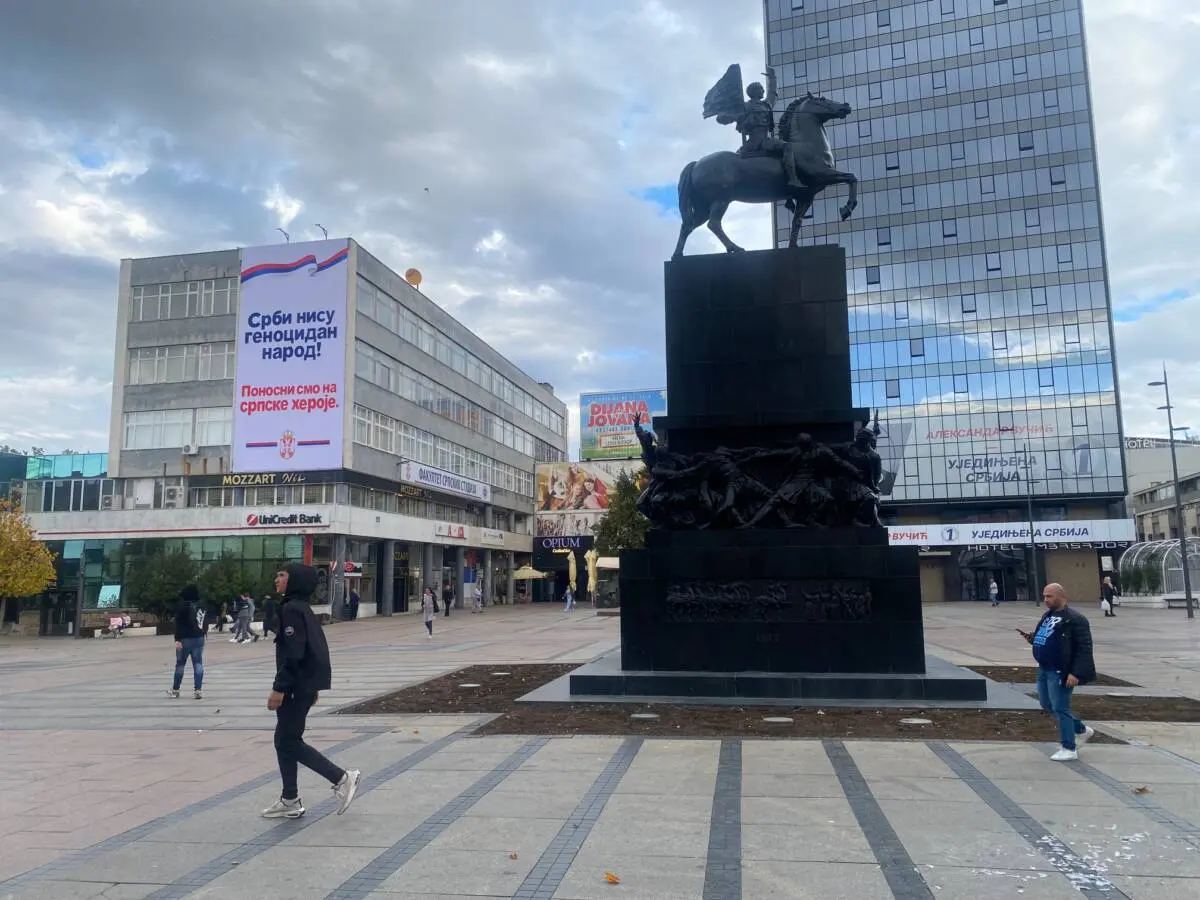
Niš, Serbia, 23 October 2026 – Photo: F. Martino
“For today’s young people, the tragic past of the Yugoslav wars really is the past — just as the Second World War and the passions surrounding it appeared to us to belong to an earlier generation,” Stojiljković says. “I look at my daughter: she’s focused on the future, and she doesn’t want it stolen from her by decisions made before she was born.”
For now, however, and for the foreseeable future, Kosovo remains central to Serbia’s public and political debate. Here in Niš and across southern Serbia, perhaps even more so, given the region’s geographical proximity to Kosovo and its ties to the Serb community that remains there.
The students appear acutely aware of the issue, but they do not want it to distract the country from what they see as its real priority: removing Vučić from office, and perhaps bringing him to justice.
“Formally speaking, the situation is clear: under the Serbian Constitution, Kosovo is an integral part of Serbia. Full stop,” Dimitrije says. “But resolving outstanding issues on the matter requires a genuine debate within the country, which has been impossible until now. We don’t even know the contents of many of the documents signed so far.”
The question of Serbia’s relationship with the EU also looms in the background. Gruhonjić argues that European leaders have tolerated Vučić’s authoritarian practices in recent years “in the name of what they perceived as regional stability — a strategy that soon acquired the label ‘stabilocracy’.”
“Europe has sent mixed signals to the movement over the years. There have been plenty of words of support, but when it came to taking action, nothing happened,” Lenka tells me, her voice tinged with disappointment.
“Our hope is that Europe won’t abandon us now, at the most crucial moment. That it will respond if Vučić tries to win again through pressure, electoral fraud and perhaps even violence. That’s what we fear. They know they’re starting from a losing position, but that makes them dangerous. This time, Europe must not stand by and watch.”
Found an error in this article? Please contact our editorial team at redazione@balcanicaucaso.org.
This article was produced as part of PULSE, a European initiative coordinated by OBCT that supports transnational journalistic collaborations. Ema Polívková (Deník Referendum) contributed to the article. 
Tag: PULSE
Featured articles
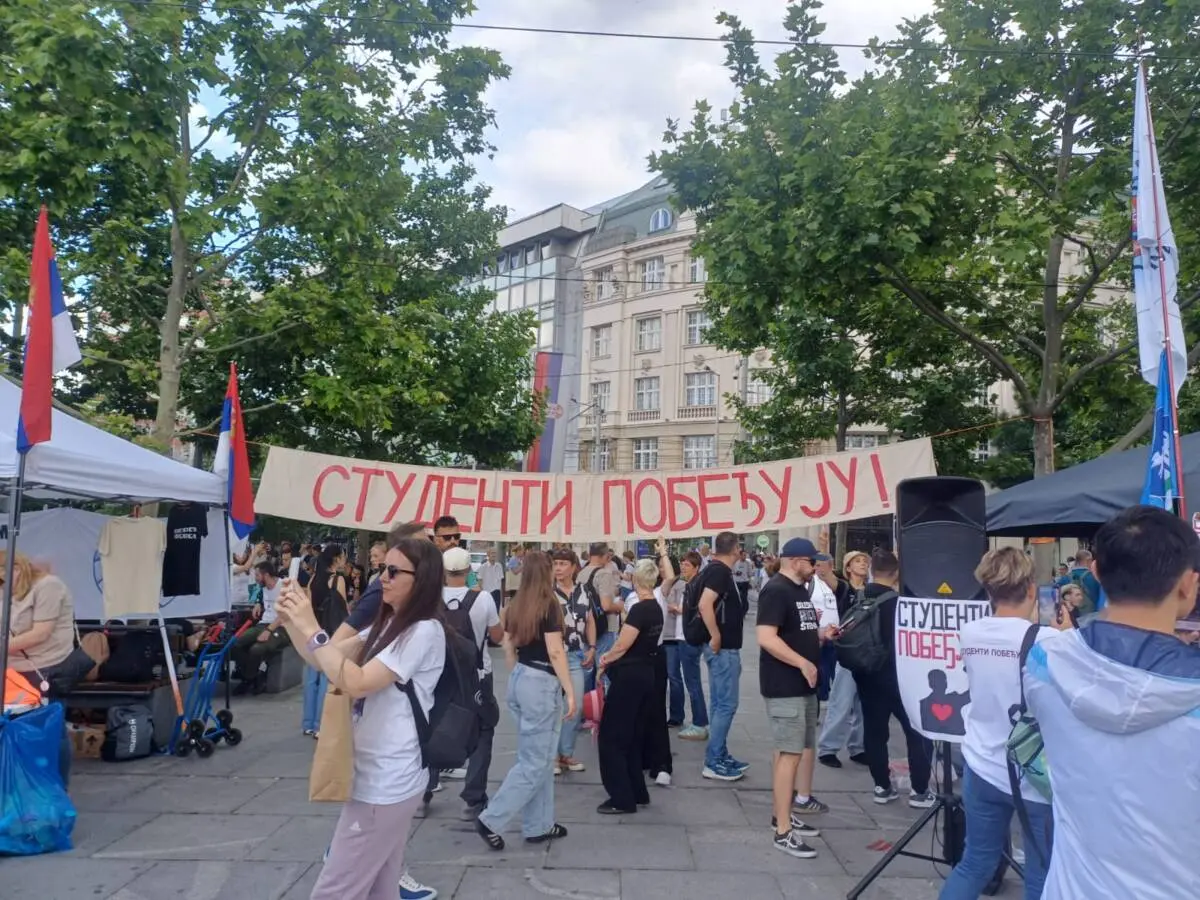 the students' voices
 Investigation
 students' protest