Kosovo: new president, no early elections and a new law on the Specialist Chambers
In a last-minute twist, Kosovo has elected Justina Shiroka-Pula, formerly head of the Kosovo Academy of Sciences, as its new president. Among her first measures, the green light is expected for new legislation limiting the powers of the special chambers that convicted KLA leaders
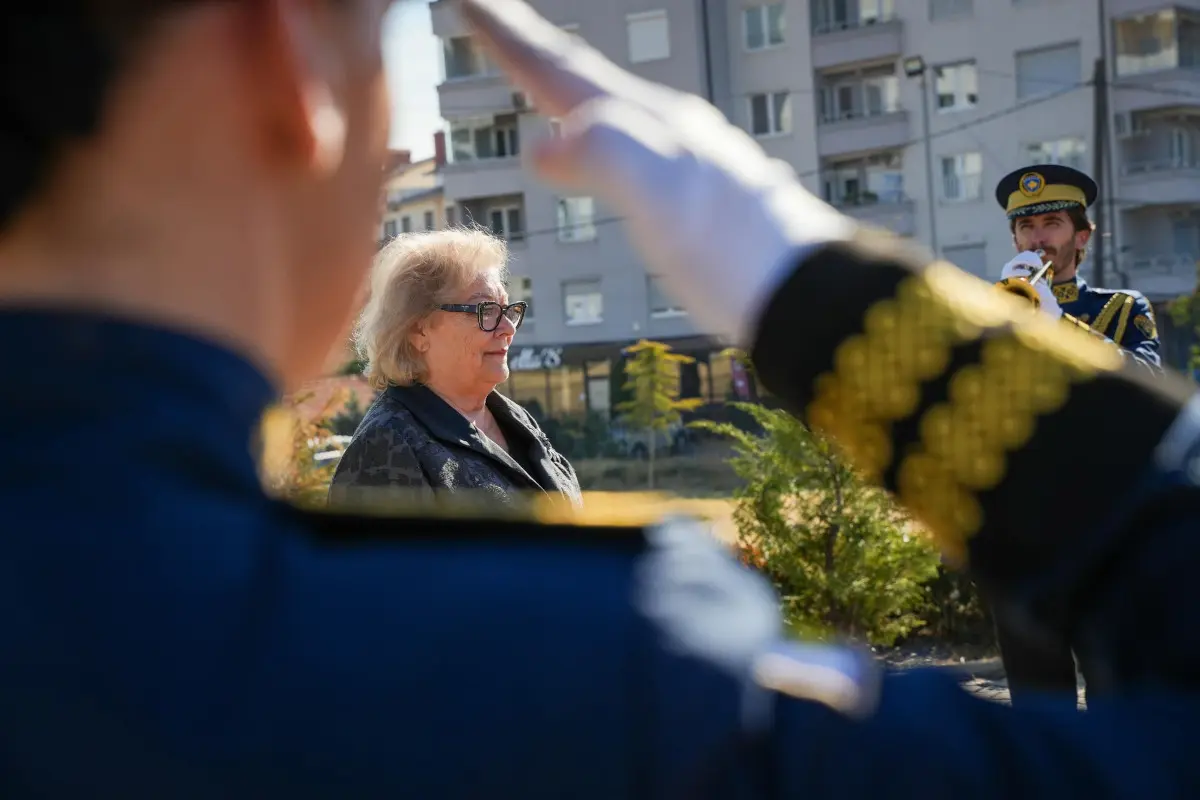
Kosovo’s President Justina Shiroka-Pula ©2025 – Office of the President of Kosovo
Kosovo’s President Justina Shiroka-Pula ©2025 – Office of the President of Kosovo
Amid genuine political drama, Kosovo elected its new President at the very end of the constitutional deadline, late on October 7.
Justina Shiroka-Pula, who until now headed the Kosovo Academy of Sciences and Arts, was elected head of state following a last-minute agreement between the ruling Vetëvendosje Movement (LVV) and the opposition Democratic Party of Kosovo (PDK).
The secret ballot in the Assembly’s extraordinary session began just six minutes before midnight on October 6, when the constitutional deadline for electing the president expired, but the process was completed after the deadline had passed.
Lawmakers rushed to prevent the automatic dissolution of the Assembly and another round of early elections in the event of failure.
The 72-year-old Shiroka-Pula was elected in the first round of voting, receiving 81 votes.
She was sworn in as president and said she accepted the new office with great honour and full responsibility.
“This mandate belongs not only to one person. It belongs to our citizens, our institutions and the state for which many generations sacrificed,” she said in her address to lawmakers. She pledged to be a president for all citizens and to uphold the Constitution and the interests of the Republic.
Her opponent, Eliza Hoxha of the PDK, who was formally in the race, received one vote, while two ballots were invalid.
Doubts over the constitutionality of the process
Shiroka-Pula’s election was formally confirmed by the Assembly 13 minutes after midnight, once the constitutional deadline had expired, meaning that her election could face a legal challenge.
Ehat Miftaraj, director of the Kosovo Law Institute (KLI), told OBCT that the Kosovo Assembly had failed to elect the president within the constitutional deadline and the deadline set by the Constitutional Court in its latest ruling.
“If we read the latest judgment, we see that it explicitly set October 6 as the date by which the President of the Republic should have been elected. We must also understand that this was not a 24-hour, 48-hour or 72-hour deadline, but a period of 60 days, meaning that the political parties in the Kosovo Assembly had 60 days from the day the Assembly was constituted to elect the President,” Miftaraj said.
However, former Deputy President of the Constitutional Court of Kosovo, Kadri Kryeziu, has a different assessment.
He said the voting process began before the deadline expired, while the counting of votes, in his view, does not fall within the constitutional deadline.
“The vote-counting process is not subject to a deadline. The votes could have been counted tomorrow or the day after. What matters is that the procedure began and the vote took place; the procedure began on time. This means that the President was elected on October 6, because before midnight it was announced that there were 81 votes, even before all the votes had been counted,” Kryeziu told OBCT.
Miftaraj, however, argues that the key issue is not when the procedure began, but that it had to be completed within the deadline set by the Constitution.
“Justice, procedure, the law and the Constitution are not elastic and cannot be interpreted or applied according to political whims or because there was a complex political situation in which political parties were unable to reach a political agreement,” Miftaraj said.
According to him, the Constitutional Court could assess the constitutionality of the president’s election only if an authorised party refers the matter to the court.
How did Shiroka-Pula become the candidate?
LVV nominated Shiroka-Pula at a press conference around two hours before the constitutional deadline expired.
An hour later, the PDK accepted Shiroka-Pula’s candidacy. She had previously served as a minister and member of parliament from the party.
The remaining procedures were then expedited in the final minutes before the deadline.
Earlier in the day, LVV had nominated Bekim Sejdiu for president, despite his having withdrawn his candidacy due to a lack of support.
Several hours later, Albin Kurti again proposed his party’s deputy leader, Glauk Konjufca, as well as activist Feride Rushiti.
However, the PDK rejected these candidacies, having also refused to support them in previous months.
The other key development
Before the presidential vote, the Assembly, as the first item on its agenda, approved in the second reading amendments to the Law on the Specialist Chambers of Kosovo in The Hague.
The amendments were initiated by the PDK after the Trial Panel of the Specialist Chambers, on September 16, convicted former Kosovo Liberation Army leaders Hashim Thaçi, Kadri Veseli, Jakup Krasniqi and Rexhep Selimi of war crimes, describing the verdict as an injustice to Kosovo and its struggle for freedom.
The PDK made the final approval of the bill, before the presidential vote, a condition for cooperating with LVV on the election of the head of state. After initially resisting the demand, LVV eventually gave way and accepted the PDK’s request.
As the deadline approached and the country risked going to early elections without the amendments being approved because of the failure to elect a president, thousands of protesters surrounded the Assembly building, demanding that lawmakers complete both processes.
Since the verdict was announced in The Hague, they had organised large protests in Pristina for 21 consecutive days in opposition to the convictions.
Following the approval of the amendments to the law on the Specialist Chambers, however, the protesters suspended their demonstrations and announced that they would oppose the verdict through other forms of action.
What does the new law on the Specialist Chambers contain?
The promulgation of the amendments is expected to be among the first decisions taken by the new president, Justina Shiroka-Pula.
The law does not abolish the Specialist Chambers, but seeks to limit their subject-matter, temporal and territorial jurisdiction, as well as to determine which criminal offenses could be tried before the court.
The aim is for the court to deal only with the criminal offenses mentioned in Dick Marty’s 2011 report, such as the alleged illegal trafficking of human organs, which were the grounds for its establishment, rather than general war crimes or crimes against humanity.
The law provides for a maximum sentence of 15 years in prison, the possibility of appealing Specialist Chambers decisions before the Supreme Court of Kosovo, the serving of sentences in Kosovo, and the possibility for the President of Kosovo to grant amnesty to persons convicted by the Specialist Chambers.
The four former KLA leaders have been sentenced to a combined 81 years in prison for war crimes, while they were acquitted of charges of crimes against humanity.
Their defence will appeal the conviction before the second instance of the court, the Appeals Panel.
Found an error in this article? Please contact our editorial team at redazione@balcanicaucaso.org.
Tag:
Featured articles
 Montenegro Pride 2026
 Political deadlock