From Romania to Italy: governing the algorithm in the classroom
From fear of change to field experiences: the story and challenges of integrating artificial intelligence into Italian and Romanian schools, in search of a model that places the human being at the centre
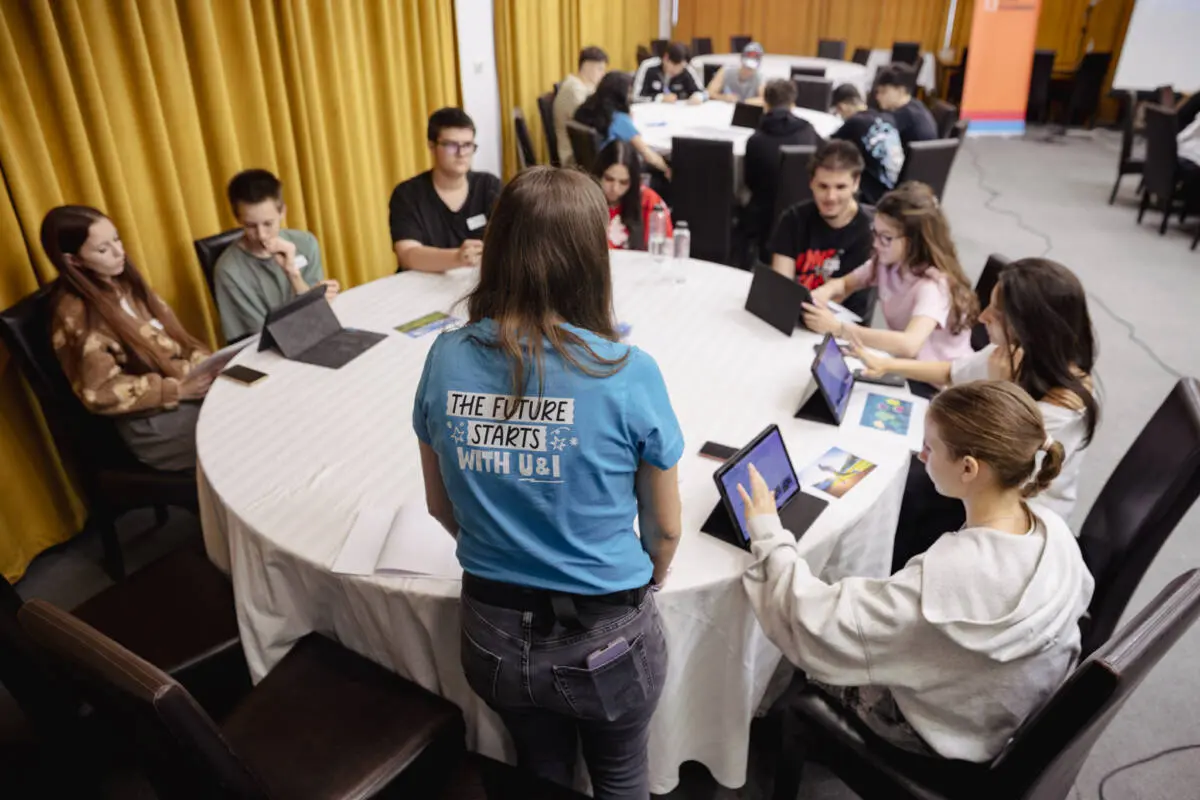
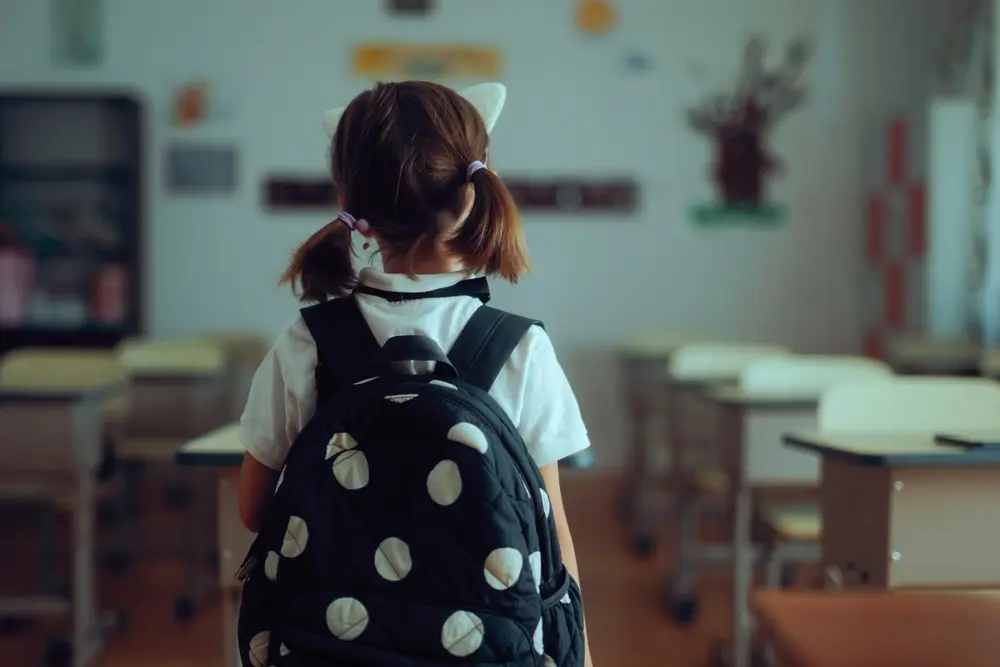
Students at school in Romania – ©UiPath
©UiPath
Artificial intelligence has entered our lives without knocking: in phones, search engines, social media, and, inevitably, in schools. It is used above all by the youngest, often before teachers and institutions have had the time to decide how to regulate its use.
The European Union is trying to build common ground: on the one hand, with practical guides for teachers, updated to March of this year; on the other hand, with the scenario published by OCSE in June to define literacy in artificial intelligence.
From European indications to the reality of schools, however, the path is far from uniform. Some countries have chosen restrictions and bans, others are experimenting with artificial intelligence in a more systematic way; elsewhere, as in Romania and in Italy, national strategies are accompanied above all by isolated projects.

The Romanian model: state strategies, private synergies, and European funds
In Romania, the entry of artificial intelligence into schools occurs through an articulated interplay of public policies, experimentations, and synergies between the private and non-profit sectors.
Alongside the National Strategy for Artificial Intelligence 2024-2027, the education system includes an optional course in machine learning for high schools, the integration of digital skills and artificial intelligence into new school curricula, and even National AI Olympics.
The Romanian Ministry of Education also supports various market and third-sector initiatives. Among these, “Explorers in the World of AI” (with the Vodafone Foundation and CyberKnowledge Club) stands out, which has involved hundreds of institutes.
Targeted technological solutions are also present: SARO, the artificial intelligence tutor developed by Digital Nation with Google; LearnMate by Adservio, with Microsoft; and LIVRESQ, born in the EduLib digital library and enriched with generative artificial intelligence.
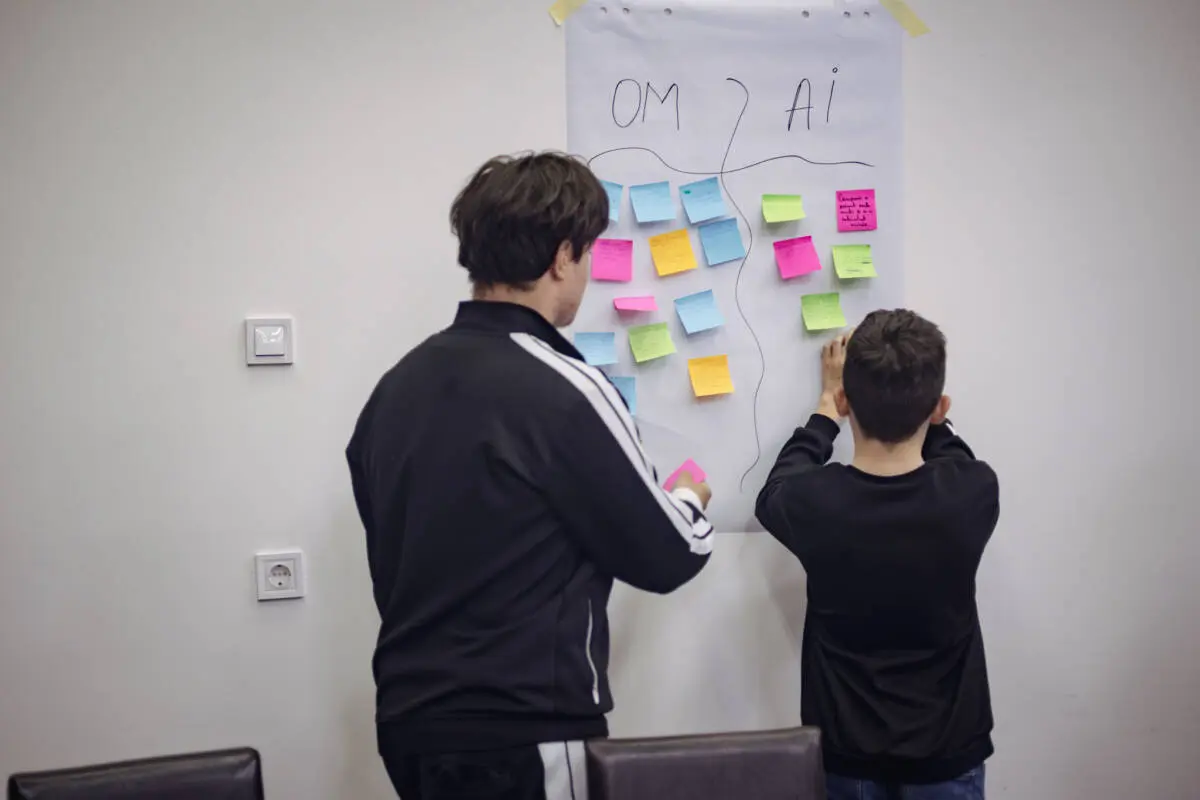
Alongside these public-private interventions, there are initiatives born directly from the non-profit sector such as AI Generation, a free curriculum created by the UiPath Foundation with the App Inventor Foundation.
Based on the UNESCO framework and active in schools since 2024 – anticipating European guidelines, it offers teachers ready-to-use material that can be integrated by high schools as an optional subject, subject to approval by the inspectorates. The material does not require technical skills and can be taught regardless of the study profile of the class.
As Raluca Negulescu Balaci, executive director of the UiPath Foundation, explains, the philosophy of the program is not to teach how to use yet another application, but to develop transversal skills: understanding how systems function, evaluating responses with a critical spirit, verifying sources, and protecting data.
The program manager of the UiPath Foundation, Andreea Pănoiu, observes how students adopt every innovation naturally: since there are no quick and effective solutions to prevent them from doing homework with artificial intelligence, the only path is to help them build a conscious relationship with the tool.
The distinctive element resides in the approach promoted by the United Nations Educational, Scientific and Cultural Organization: “It is not technology that is at the centre, but the human being”, summarizes Pănoiu. A model conceived to fit into the national system and also available in the English language to be translated and replicated abroad according to the local context, with a Creative Commons license.
© UiPath Foundation
In addition to local initiatives, a decisive push comes from European funds of the National Recovery and Resilience Plan for infrastructure, training, and experimentation. In nine pilot schools – from the small rural facility to the high school of prestigious tradition – the project “Learning Management Ecosystems Based on Artificial Intelligence”, supported with one million euros, has traced a gradual path to answer a fundamental question: not whether artificial intelligence should enter schools, but how to do so in the best way.
Professor Anda Laura Silea, leading the project, highlights how the response of students and colleagues exceeded expectations. The path began with the training of teachers and continued in the classroom with approximately nine hundred students, touching four spheres: cognitive, physical, emotional, and social.
The project taught how to structure prompts, verify results, identify hallucinations or manipulations, and use artificial intelligence as a stimulus for creativity. In the final phase, the institutes assimilated the experimentation, transforming it into daily practices, from reading clubs to community projects, gathering materials and prompts in an open-access guide.
The change lies in the transition from the “clandestine” use of artificial intelligence as a shortcut to a conscious use under the direction of the teacher.
Structural fragilities: between functional illiteracy and bureaucracy
Net of the success of individual experiences, the fragmentation of projects leaves the central issue unsolved: transforming isolated good practices into structured and universal literacy.
Gabi Bartic, education expert and Chief Executive Officer of the BRIO evaluation platform, warns against the risk of Romania repeating the errors made with digital skills, only formally assimilating European frameworks and purchasing hardware without a structural impact.
“We adopted the framework of digital skills, but has this really increased the skills of the students? No”, states Bartic candidly. The point is not to declare the importance of a skill, but to define who must teach it, how to integrate it into curricula, and with what criteria to evaluate it.
Literacy in artificial intelligence brings historical fragilities back to the surface, from functional illiteracy to socio-territorial divides. European guidelines focus on the capacity to critically understand content, but, as Bartic observes, “if a young person struggles to understand a written text, they will hardly know how to formulate an effective prompt or judge the reliability of the answer”.
Literacy in artificial intelligence cannot ignore basic skills: without reading comprehension and critical thinking, technology risks amplifying inequalities instead of reducing them, exacerbating the rift with rural areas (“the rural environment is almost another Romania, to which a real possibility continues not to be given”, explains Bartic).
Finally, a bureaucratic issue persists: if training on artificial intelligence is considered the responsibility of everyone without being formally assigned to anyone, its implementation remains entrusted to the goodwill of individuals.
Until artificial intelligence becomes an integral part of study programs, teacher training, and official evaluation systems, Bartic emphasizes, it will remain confined to a pilot project. In Romanian schools, what is not provided for by the curriculum or required in examinations tends to be considered marginal: “If it is not evaluated, for many it simply does not count”.
The Italian strategy: late regulations, Next Generation EU funds, and a race against time
In Italy, too, as in Romania, national strategies are accompanied above all by isolated projects: an archipelago of initiatives that is born and grows faster than any institutional directive.
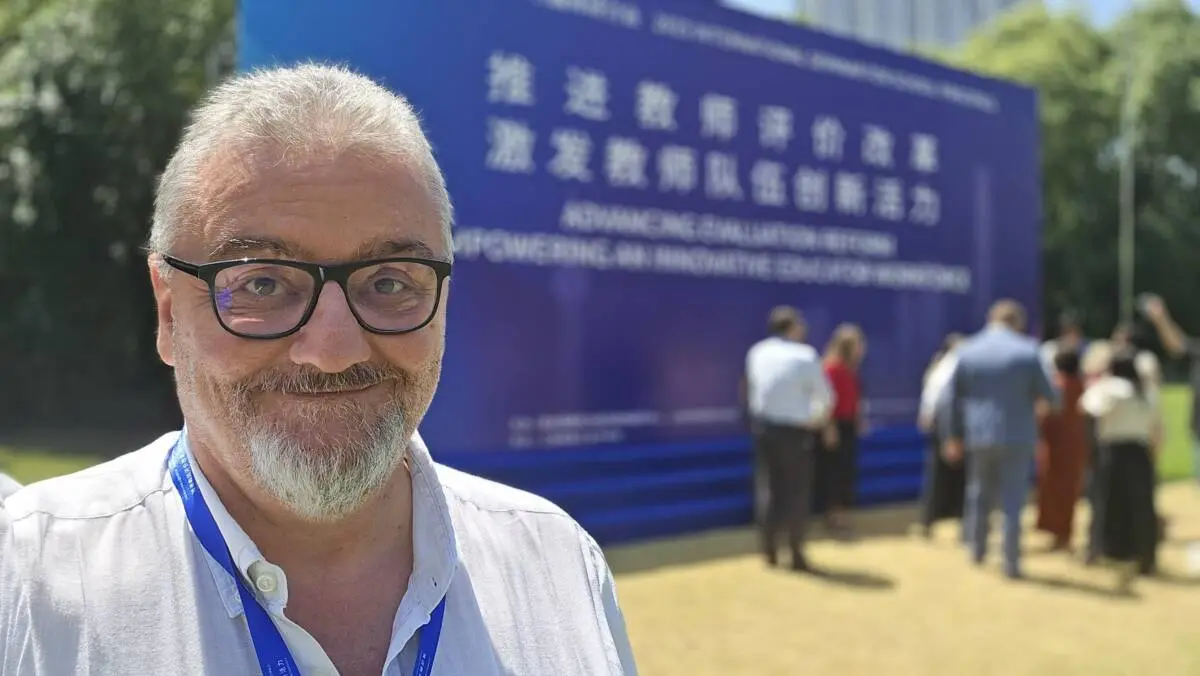
It all started in November 2022, when ChatGPT was released and, as Roberto Castaldo, school principal of ISIS Europa in Pomigliano d’Arco and founder of the MiaSedu network remembers, “students realized that they could do homework without studying”. Since then, for almost three years, artificial intelligence has been in classrooms without anyone having truly invited it.
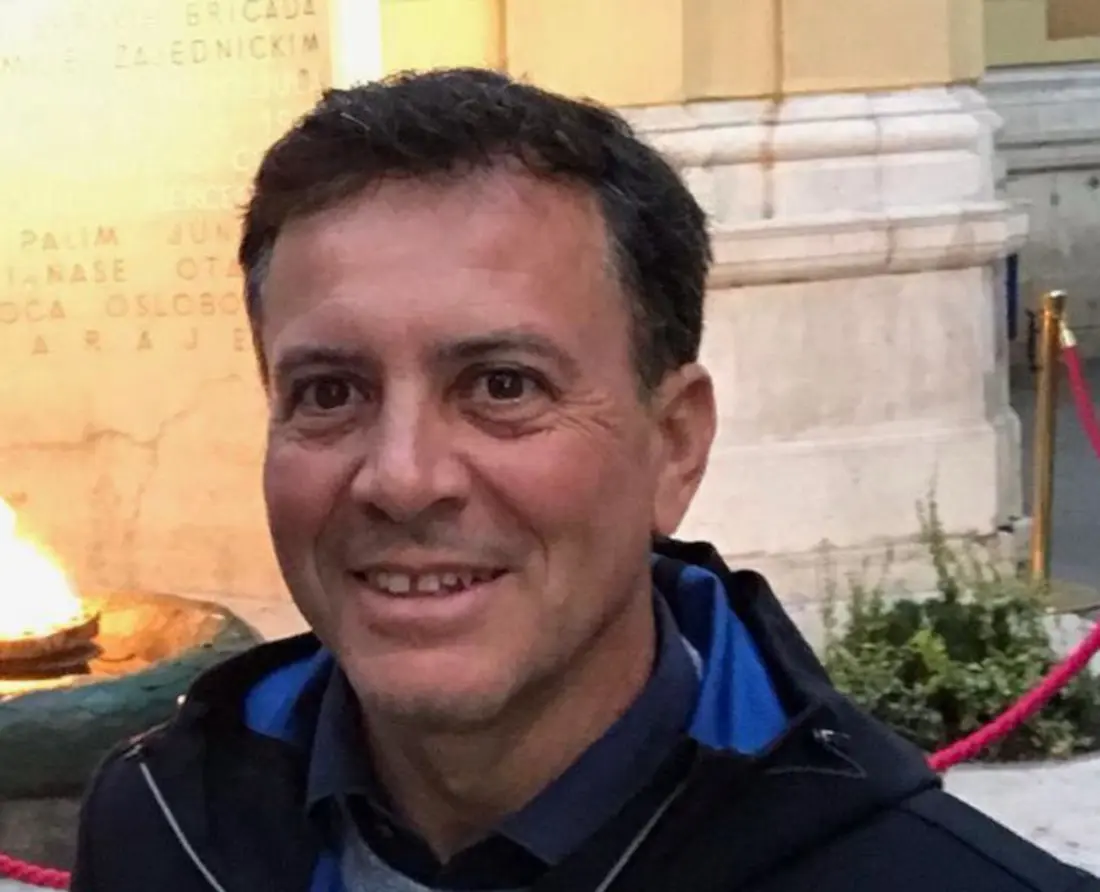
Roberto Castaldo – © Roberto Castaldo
The formal turning point arrived on August 9, 2025, with Ministerial Decree number 166 (Guidelines for the introduction of artificial intelligence in schools), a document that defines the principles: human-centered approach, data protection, contrast to early school leaving, transversal integration in the curriculum.
The actual legal framework arrived a month and a half later with Law 132 of 2025 (in force since October 10, 2025) which incorporates the European Artificial Intelligence Act. Paolo Odasso, trainer for Sloweb, describes the operation as follows: “Italian guidelines moved trying to recover from a delay… Artificial intelligence in schools already exists, the problem was somehow to regulate behaviors”.
Ninety percent of students use it, recalls Odasso, and teachers as well, often unofficially: the risk is the use not guided by educational criteria, which produces cognitive impoverishment instead of growth.
On March 27, 2026, the Ministry of Education and Merit published the notice making available one hundred million euros of Next Generation EU funds – with forty percent reserved for Southern Italy – to establish “territorial training hubs” on the use of artificial intelligence: up to fifty thousand euros per school for the first two thousand admitted applications out of approximately four thousand institutes.
Gianni Garbarini, of Sloweb, describes an administrative machine running faster than schools: “Regional school offices were not minimally involved, it was something done directly in a rush by the Ministry”. Timeframes are extremely tight: call published six days before Easter, closed on April 17, with the first applications arriving in the late afternoon of the same day of publication.
Castaldo is even more direct: “The timing is crazy, because we must conclude everything by December 31. If training must necessarily be completed by this date, it is obvious that quality will suffer”.
The race against time favored the birth of companies and websites designed to intercept schools searching for trainers, giving life to a market created “from one day to the next”. The final reporting, recalls Castaldo, will be “a bureaucratic-administrative aspect, not an educational one”: signatures on a platform, rather than a verification of the actual impact of training in the classroom.
Bottom-up initiatives, teachers’ fears, and future challenges
In this space, realities like Sloweb and MiaSedu have grown. Sloweb, with historical institutes of the Resistance, proposed to the Regional School Office of Piedmont a free course in digital civic education and critical use of artificial intelligence: over two hundred enrolled teachers and now a second year to bring the work into classrooms.
“We cannot pretend nothing is happening”, summarizes Garbarini. MiaSedu was born in February 2024 from the initiative of school colleagues of Castaldo, who wrote a manifesto and an ethical code on the use of artificial intelligence; today the network counts two hundred and twenty institutes throughout Italy, with a principal and a contact teacher.
This bottom-up vitality does not, however, eliminate regulatory confusion. MiaSedu adopts the European Artificial Intelligence Act, Law 132 of 2025, and the Italian Agency for digital guidelines, but not the ministerial guidelines, which – explains Castaldo – “have no regulatory value”, with the risk that principals treat them as mandatory rules: “The fact that the guidelines were released before the law increases all this chaos”.
On the teachers’ front, the key word is fear: “the same as when the Greeks saw lightning and called Zeus”, the fear of those who do not know the tool and perceive it as a threat, explains Castaldo.
The proposal of trainers is to transform artificial intelligence into a “copilot”, to free up time from repetitive work and shift evaluation from the written product to the process that creates it.
A territorial inequality remains, which the notice tries to address by reserving forty percent of funds for Southern Italy, but which a single measure does not bridge. Without lasting direction, literacy in artificial intelligence risks depending once again on the enthusiasm of a few motivated teachers.
Castaldo says this thinking of his own school, hosted in an apartment building without a gymnasium, but included among the ten most innovative schools in the world in 2023 and partner of the Schools+ project of the Organisation for Economic Co-operation and Development: “precisely because our structural situation is so lacking, we are the first who must move with an even higher speed in innovation”.
Time plays against institutional slowness: as much in Romania as in Italy, technology advances much faster than schools. Strategies, reference frameworks, and initiatives multiply, but the challenge remains their translation into concrete changes in daily practice.
A distance between principles and reality that Gabi Bartic summarizes effectively: “The true breakthrough will come only when skills in artificial intelligence stop being a statement of principle and become something that modifies, every day, what happens in the classroom, for students and teachers”.
Found an error in this article? Please contact our editorial team at redazione@balcanicaucaso.org.
This publication has been produced within the Collaborative and Investigative Journalism Initiative (CIJI ), a project co-funded by the European Commission. The contents of this publication are the sole responsibility of Osservatorio Balcani Caucaso Transeuropa and do not reflect the views of the European Union. Go to the project page
Tag: CIJI | Education | technology | Tecnologia