Turkey: Rethinking the opposition with the “New Party”
At the end of July, Özgur Özel, the Turkish opposition leader, left the Republican People’s Party, founded by Atatürk, announcing the formation of a “New party”. How will this split impact the internal dynamics of the opposition and its ability to challenge the Erdoğan regime? An interview
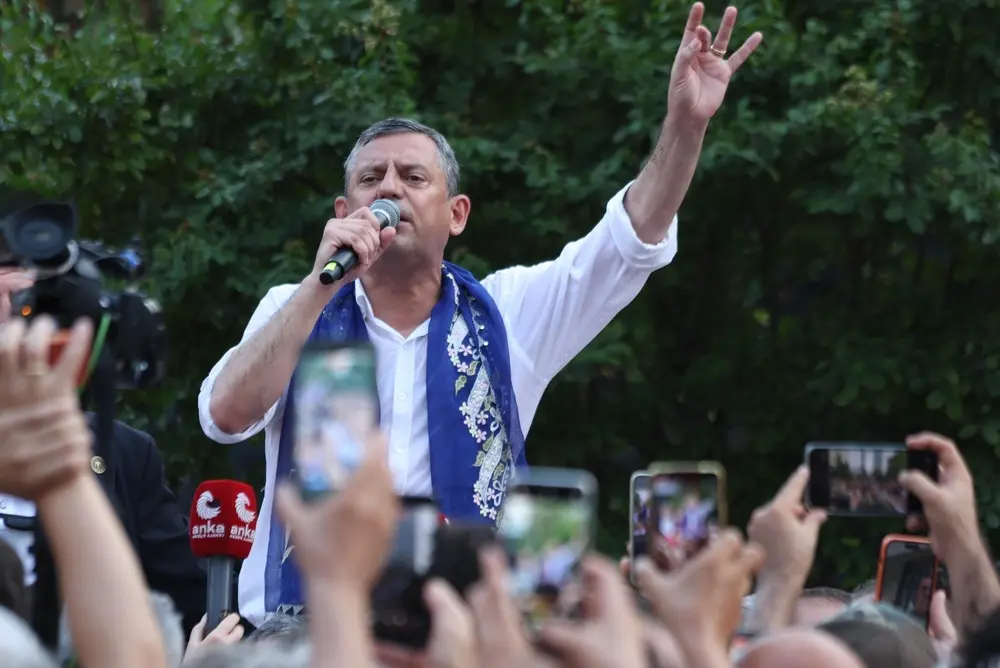
Özgür Özel © Uunal/Shutterstock
Özgür Özel © Uunal/Shutterstock
As the “absolute nullity” (mutlak butlan) case against the main opposition party (Republican People’s Party , CHP) 2023 congress continues to work its way through Turkey’s courts, keeping the party’s leadership in a state of legal uncertainty, a new realignment is taking shape within the opposition.
Against this backdrop, Özgür Özel has launched the New Party (Yeni Party, YP), a formation he describes not as a rupture with the CHP but as a tool to continue the reform process begun within the party in 2023.
What does this move tell us about the broader state of Turkey’s opposition? Can Yeni Parti emerge as a genuine challenge to the government, or does this split risk further fragmenting an already fractured opposition?
We spoke to Murat Somer, professor of Political Science and International Relations at Ozyegin University in Istanbul, and an expert on comparative polarisation, democratisation and depolarisation.
Özgür Özel has framed the New Party as a continuation of the CHP’s political mission rather than a break with it. Beyond the party itself, what does this new formation tell us about the current state of Turkey’s opposition?
As I and others have elaborated in our academic writings, since 2003 the Turkish opposition has tried many different strategies to defeat Erdoğan and reverse autocratisation. But it failed, despite some partial successes mainly in 2015, 2019 and 2024.
The mission that Özel-İmamoğlu’s leadership set for CHP was already defined in 2023 as removing Erdoğan government, coming to power in elections and returning to democracy ‘by doing things differently than before’. They had started a process of internal change, that the voters had rewarded by making the CHP the first party in the 2024 local elections and giving the mandate to run the local governments for roughly two thirds of the country’s population.
The government has been trying to stall this process of change through politicized judicial interventions, arresting and sacking CHP mayors and bringing back the CHP’s old leadership to power.
What Özel means is to continue in the New Party the process of opposition reform he had launched within the CHP, which aimed to make the party a more dynamic and closer to people and more in sync with social opposition.
In a highly competitive electoral environment, do Turkish voters tend to remain loyal to party identities, or to vote strategically for the opposition party that appears most capable of challenging the government?
I think CHP voters would vote strategically if Yeni Parti can ensure them that they will not overly move away from the traditional CHP values, mainly the founding principles of the republic and Atatürk such as unitary state and secularism. But they would be open to more democratic and inclusive interpretations of these principles.
Whether or not other parties’ voters would vote strategically for Yeni Parti depends on whether they can structure themselves as, what I and my coauthor Jennifer McCoy call “trasformative repolarising” party. They need to present a transformative program that a cross-party coalition of voters can support.
In Turkey, the opposition has increasingly relied on broad alliances to challenge the AKP. From the government’s perspective, could this split weaken the opposition’s electoral threat? Could it also create new political costs and risks for the AKP?
The government might have hoped that this split will not only weaken and discredit the CHP but also real opposition as a whole, by making them appear corrupt and unable to work together. If the New Parti can establish itself as a truly new kind of party, it can instead revitalise opposition by leading a cross-ideological spectrum of social opposition.
Turkey’s opposition had increasingly relied on broad alliances to challenge the AKP, but mainly through top-down alliances with institutional parties, which failed to unseat Erdoğan. Under Özel and İmamoğlu, the CHP had succeeded in 2024 based on a different model of more bottom-up alliance of cross-party voters.
The New Party can create a major challenge to the government if it comes to represent public distrust of institutional politics, becomes a party closer to people, and mobilize social opposition against the government.
The CHP has been the institutional anchor of the Turkish opposition for a century. Beyond the fate of this single party, what does such a major split tell us about the opposition’s resilience in a context long dominated by a competitive authoritarian regime?
The CHP was the political opposition party for most of the period since Turkey’s transition to multiparty democracy since 1950, only coming to power several times in coalition governments during this time. Except for the military regime of 1980-83, it did not oppose the regime, on the contrary being a guardian of secular republican democracy, but it operated as political opposition to governments in power.
This continued under AKP rule when the incumbent step by step built up an authoritarian regime with a religious ideology replacing the secular republic and competitive politics. Still, the CHP continued to frame its politics mainly in opposition to the AKP and Erdoğan per se, rather than in opposition to the regime that the AKP has been building. The firnatiin of the New Parti represents the possible rise of an opposition that can operate asanti-regime party.
Are we witnessing a temporary realignment driven by leadership rivalries, or a deeper structural shift in how opposition politics and democratic competition, will evolve in the years ahead?
Social opposition to AKP and Erdoğan has been strong in Turkey. Since the 2010s, a major fault line of Turkish politics has been emerging as a democracy-autocracy cleavage. Top-down opposition alliances have not been able to represent the pro-democracy side of this fault line.
If the New Parti can build itself as a mass party acting anchored in social opposition, it can consolidate the pro-democracy side and reshape the political field for the years ahead. But the incumbent is also strong enjoying state power and is bent on doing everything it can to prevent this from happening.
Found an error in this article? Please contact our editorial team at redazione@balcanicaucaso.org.
Tag:
Featured articles
 History and politics
 Human rights