Erdoğan’s Turkey takes to the streets to mark the 10th anniversary of the 2016 coup attempt
Ten years after the attempted coup of July 15, 2026, President Erdoğan’s Turkey celebrated the victory over the coup plotters linked to preacher Fethullah Gülen with street demonstrations across the country. A report from Istanbul by our correspondents shares the sentiments and reflections of this controversial anniversary
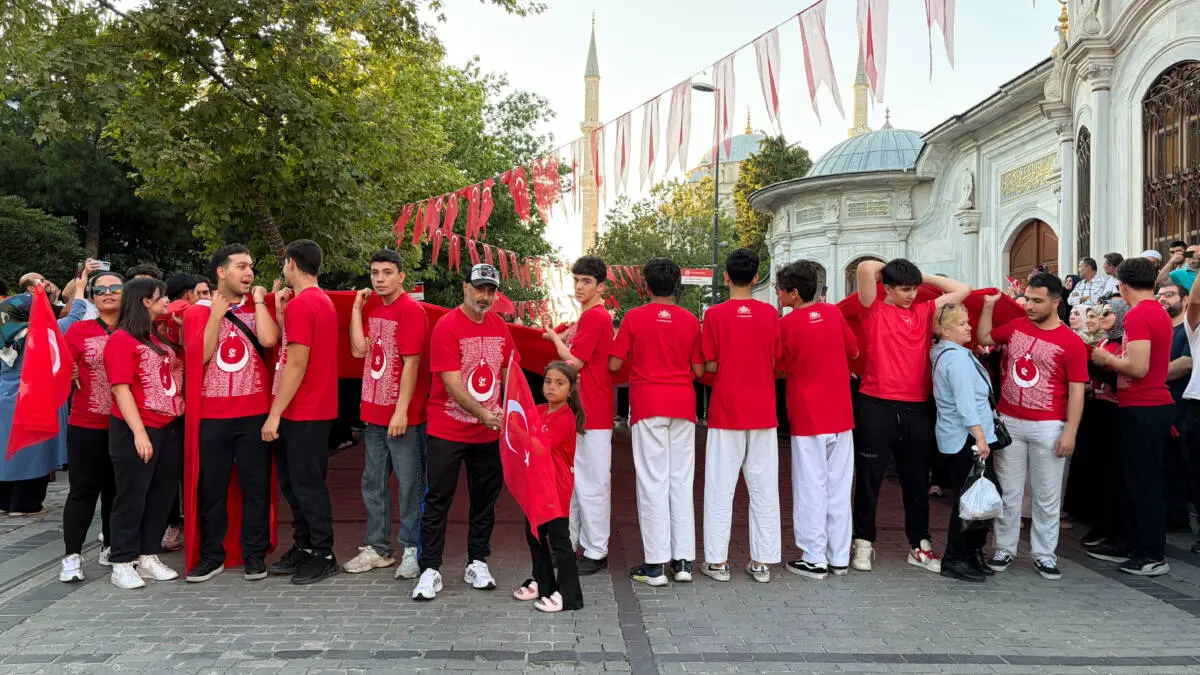
Decennale del tentato golpe a Istanbul – foto A.Lazzaroni
Tenth anniversary of the attempted coup in Istanbul - photo by A. Lazzaroni
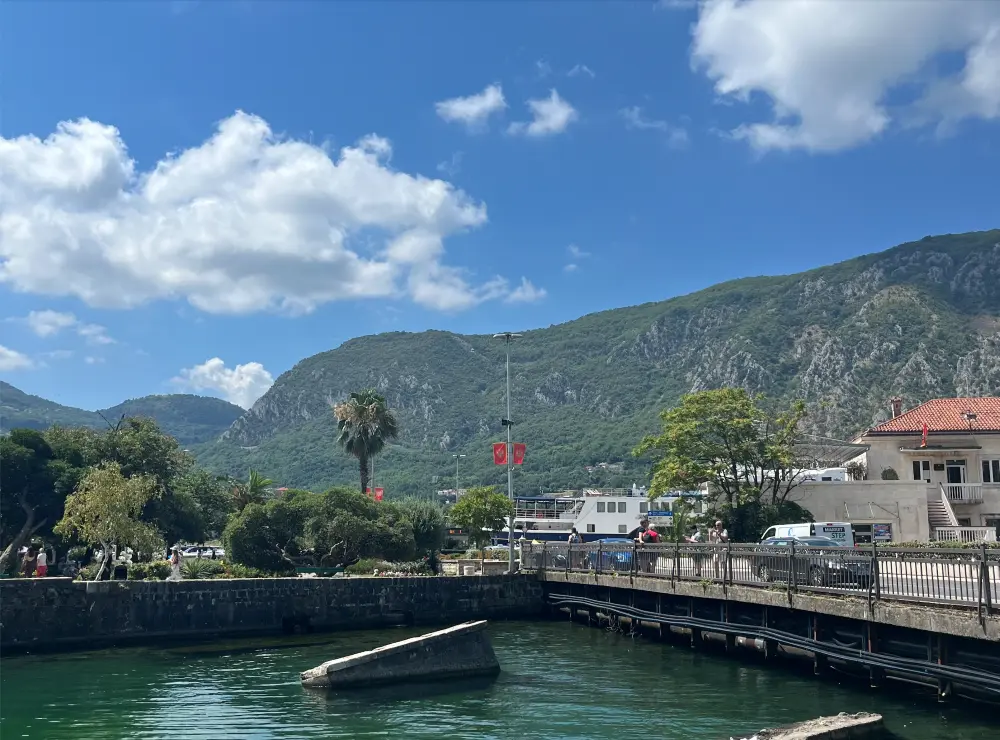
The landscape, seen from the ferry, is reminiscent of certain areas of the Balkans: more or less steep hills sloping down to the sea, houses and minarets poking out here and there among the trees, and deep blue water embellishing the scene. The Beykoz district is located on the Asian side of Istanbul and extends between the Second and Third Bosphorus Bridges.
In past decades, the population consisted primarily of workers from the Black Sea, attracted by the job opportunities offered by factories such as the Kundura shoe factory and the Paşabahçe glassworks, both of which are now decommissioned. Today, Beykoz has taken on a decidedly more residential character, especially in the hilly areas. The abundance of green spaces has attracted the arrival of more affluent residents and the construction of new housing complexes and numerous villas.
Despite the scorching heat, the small square of the Ten Fountains, located in front of the Mustafa Ağa Mosque, is quite lively. The large, centuries-old plane tree offers some shade, but it doesn’t completely block the sun’s rays. Dozens of people are lined up, ready to enjoy a plate of rice accompanied by pieces of slow-cooked meat, known as kavurma.
Celebrations in Beykoz
Today is July 15th, and Turkey celebrates Democracy and National Unity Day. Ten years have passed since the attempted coup of 2016. In memory of that day and its victims, the Beykoz municipality, like other Istanbul municipalities, has organized several commemorative events.
“Beykoz made a significant contribution to the resistance against the coup: three of the 251 martyrs were our residents,” Fatih, the municipality’s communications director, tells us. “This morning, the authorities visited the local cemetery, where a mevlit (a prayer for the souls of the deceased) was recited. We are now serving free food to the citizens. We are trying to keep the memory of that day alive, especially for the new generations.”
The government’s efforts on July 15th were enormous. From the capital to the 81 provinces, from the 922 districts to the thousands of municipalities, every territorial and administrative body has been called upon to mobilize, albeit with varying degrees of success, largely dependent on the political identities at play.
Next to the refreshment stand is a stall run by the Turkish Red Crescent, the Kızılay. “On July 15th, I was on duty as a Kızılay volunteer,” Mithat explains. “Most of the clashes that night occurred on the first bridge, so we headed there with the ambulances. Unfortunately, I saw with my own eyes two of our fellow citizens die in our arms; we couldn’t do anything about it. May Allah never let our people experience something like this again. This evening, we at Kızılay will offer everyone lokma (sweet pancakes soaked in sugar syrup) on the waterfront,” he concludes with a smile.
After Beykoz, we head to Üsküdar, a conservative district and historic stronghold of the AKP (Justice and Development Party). Yet, surprisingly, in the 2024 local elections, the CHP (Republican People’s Party) prevailed here, thanks in no small part to a woman, Sinem Dedetaş.
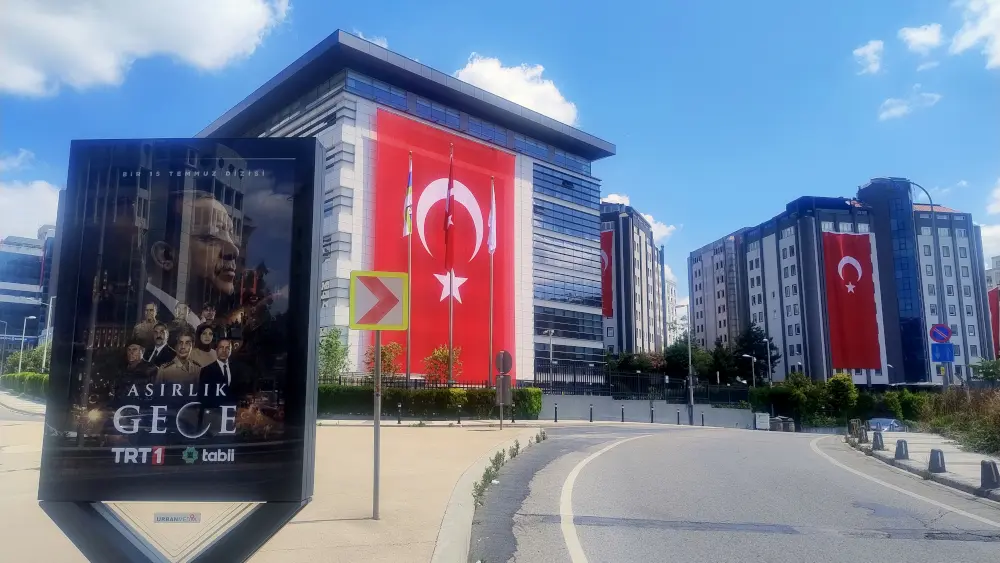
Posters and the Turkish flag – photo by A. Lazzaroni
On the Üsküdar waterfront
Along the waterway, as the view of the Bosphorus shores unfolds, the government’s goal for this tenth anniversary is clear: to institutionalize and entrench in popular sentiment the victory over the coup plotters linked to the preacher Fethullah Gülen. And to achieve this, no expense has been spared.
Schools and public buildings, bridges and financial centers are adorned with enormous Turkish flags and giant posters of President Erdoğan, flanked by an equally sized portrait of Mustafa Kemal. Commemorations are held across the country, including a march on the Martyrs’ Bridge, ship parades on the Bosphorus, drone and hologram displays, fireworks displays, and messages of unity and confidence in the future on public transport.
The aesthetics of July 15th are intended to project an image of strength and stability in which the new Turkey has not prevailed over the old, but is its legitimate and natural heir, having corrected some of its “distortions.” The presence of united political and religious authorities is an effort to further perfect the doctrine known as the “Turkish-Islamic synthesis”: the central state and Islam proceeding in unison, preserving, albeit transformed, Atatürk’s Kemalist legacy, in an attempt not to completely alienate the main segments of the population.
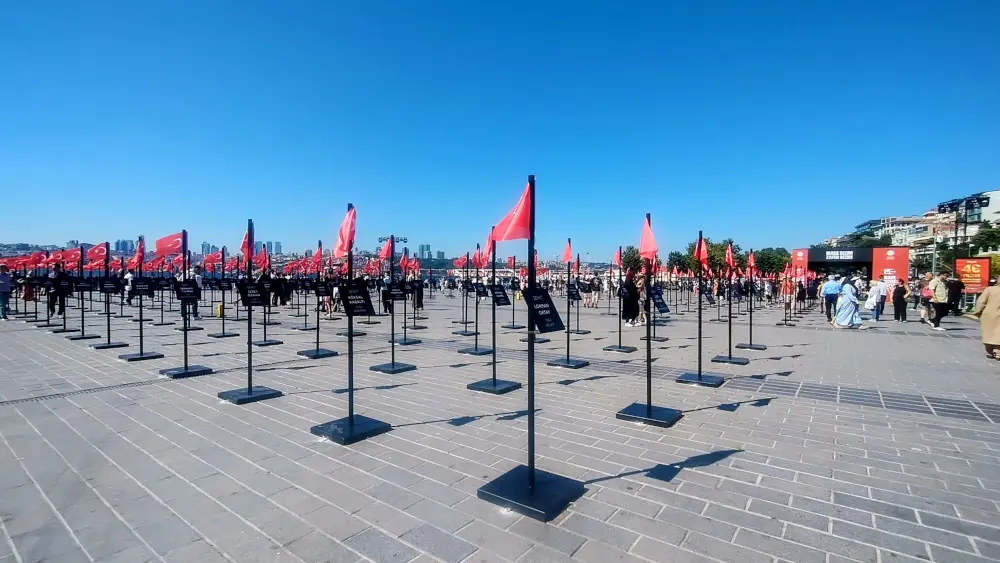
Installation “Sessiz Tanıklık”, “Silent Testimony”, photo by A.Lazzaroni
On the Üsküdar waterfront, there’s an art installation called “Sessiz Tanıklık,” or “Silent Testimony.” It features 251 Turkish flags mounted on poles, each bearing the name, surname, date of birth, and hometown of the July 15 martyrs.
Among those present, we notice a middle-aged woman wearing a bright white headscarf. Her name is Nesibe. She’s accompanied by her husband and young son. “That day, I was in Erzurum, my hometown in the east. If it hadn’t been for television, we wouldn’t have even noticed the coup over there,” she confesses. “I’m Kurdish, as is my husband. I admit I don’t have a strong sense of belonging to the Turkish nation; I’m part of a minority that has often been mistreated. That said, I’m glad the Gülenists failed to seize power; I’m convinced things would have been much worse. Now a new peace process is underway; perhaps it’s all part of a divine plan.”
Like many, Nesibe believes that Fethullah Gülen’s followers would have proved a disaster for Turkey. The more secular segment of the population and the country’s other large minority, the Alevis, share the same view. In hindsight, it’s not surprising that the Gülenists, when it came to taking action, failed to mobilize popular sentiment. Born as an Islamic brotherhood, Hizmet had become a cumbersome, parasitic power structure, whose members were bound as much by faith as by far more worldly interests.
A short distance away is “The Tree of Remembrance” (Hatira Ağacı), a second installation where visitors are invited to leave a thought, a prayer, or a message of gratitude via touch screens. Young volunteers, including Burak, are available to assist visitors. We ask him for his thoughts.
“I was only 13 years old, I couldn’t understand what was happening. I’m glad Gülen was defeated that night and eliminated over the years; they wouldn’t have brought anything good,” he says with conviction. “That said, the political and especially economic situation has steadily worsened, and it’s difficult to have confidence in the future. In many ways, things were better before,” he concludes bitterly.
The TV series “A Night Long a Century”
Before leaving Üsküdar and moving to the European side of the Bosphorus, we come across a billboard advertising the existence of a television series focusing on the events of July 15th: “Asırlık Gecesi,” or “A Night Long a Century.” The 15-episode series is based on the book of the title name by Hüseyin Aydın, published in 2020.
In the work, Aydın collected documents and testimonies about the events of that night. The Turkish government now boasts extensive experience in producing television series for propaganda purposes, a formidable tool for shaping the perception of a historical event and presenting it in the most suitable way for its political narrative.
“Asırlık Gecesi” aims to mythologize the night of July 15th and extol the heroic role of the population. It’s no coincidence that the slogan for the tenth anniversary celebrations is “İrade bizim, zafer bizim,” or “Our will, our victory.” As we board yet another ferry, we plan to watch the premiere, which will air that evening.
Click here to read the other testimonies we have collected on the occasion of the tenth anniversary of the attempted coup in Turkey
The March from Fatih to Saraçhane
The most formal of the celebrations takes place on the historic peninsula, more precisely from the courtyard in front of the Fatih Mosque, the beating heart of Turkish Islam. The march is scheduled to depart at 7:30 PM, but due to the suspension of many public transportation lines — a sign of the desire for a scattered, localized commemoration rather than the massive, centralized one often seen in the past — we arrive slightly late, which, however, doesn’t prevent us from joining the procession.
Our destination is Saraçhane Park, near Istanbul City Hall. It’s impossible not to think of it as a counterpoint to the protests of March 2025, which, in the same location, protested the arrest of then-mayor of Istanbul Ekrem İmamoğlu, a prominent opposition figure and a leading contender to challenge Erdoğan in the upcoming presidential elections.
The crowd is diverse, walking to the sound of a mehterhan, the military band dressed in traditional Ottoman garb. There are children, students, girls with and without headscarves, members of Islamic brotherhoods and foundations, military personnel, and veterans. Turkish flags are omnipresent, and the gesture of the extremist right-wing Grey Wolves is more common than the tekbir (intonations to Allah) or the four-finger Rabia sign, once so dear to Erdoğan, to convey a tangible sign of identity to the religious electorate.
On the stage set up for the occasion, the crowd listens to the President’s words from the big screen, broadcast live from Ankara, lavishing a rhetoric full of national unity and a prosperous future, a long-awaited counterpoint to a current situation that starkly contrasts with the Reis’s wishes. But this is a day of values and ideals, where the burdens of everyday life must be set aside.
Then comes the national anthem, moments of prayer with imams and generals side by side, celebratory music, as a warm night descends and the windows of buildings are thrown open in search of cool breezes. On the way home, precisely thirteen minutes after midnight, a prayer resounds in unison from the minarets of mosques in Istanbul and throughout Turkey.
It is not the ezan, the classic call inviting the faithful to go to the mosque, but rather the sela: a spiritual invocation reserved for funerals and exceptional circumstances. Just as happened on the night between July 15 and 16, 2016, when the then president of the Diyanet (Presidency of Religious Affairs), Mehmet Görmez, instructed all muezzins to recite it to mobilize people and bring them into the streets.
Finally, sitting on the sofa at home, the TV is tuned to TRT1, the country’s main television channel, where, shortly thereafter, the series “Asırlık Gecesi” begins, a natural continuation of the muezzin prayers that, until shortly before, had been entering through the window.
Found an error in this article? Please contact our editorial team at redazione@balcanicaucaso.org.