Kosovo, political stalemate slows country’s EU membership path
Due to its political instability, Kosovo will lose tens of millions of euros from the EU-sponsored Western Balkans Growth Plan for the period 2024-2027. Time is running out to use at least part of the funds earmarked for reforms in the country.
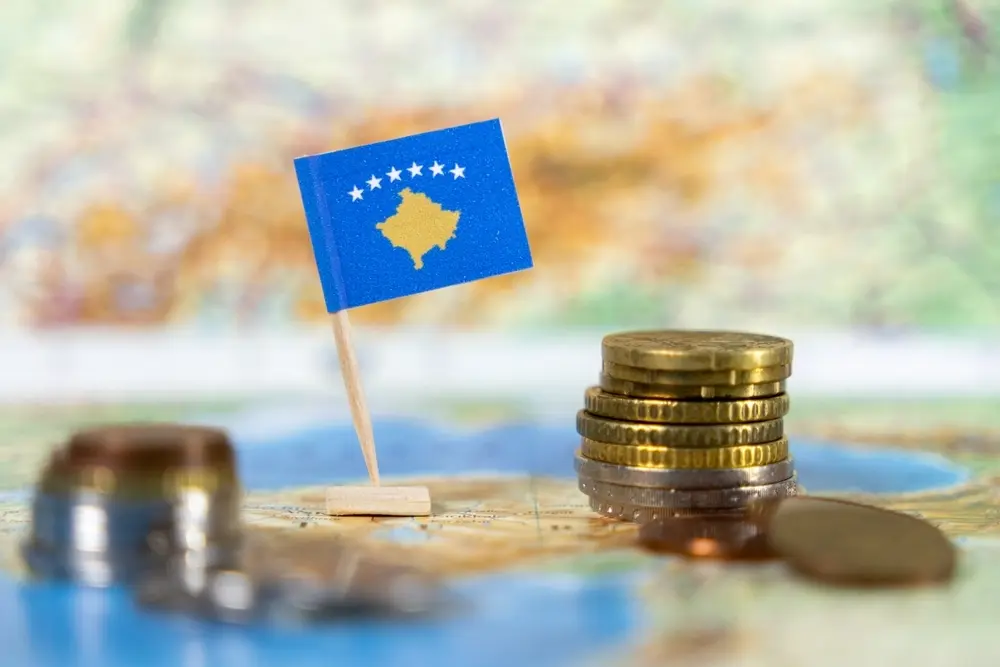
Kosovo’s flag
Kosovo's flag © aileenchik/Shutterstock
Kosovo risks losing millions of euros of funding allocated as part of the framework of the European Union Growth Plan for the Western Balkans introduced by European Commission in October 2023 as a geostrategic investment after Russia’s war against Ukraine. The main aim of the plan is to boost the Balkan countries’ economy; support EU-related reforms and bring the region closer to EU integration.
However, in the case of Kosovo, it seems that the main obstacle appears to be the inability of political parties to create stable and functional central institutions which can deliver on the promises of the Reform Agenda approved by the European Commission in October 2024. Local civil society organizations focused on European integration argue that this process is a matter of direct public interest, meaning that every lost euro means reduced investment in the economy, weaker support for reforms and fewer opportunities for development.
“Kosovo has lost a lot of precious time by not ratifying the Facility and Loan Agreements in a timely manner. Combined with the political instability that the country has been experiencing since the spring of 2025, this situation has created an impotent executive and a non-existent legislative which are the two preconditions for the implementation of the Growth Plan. Therefore, the political crisis has been lethal for the Reform Agenda,” Besar Gërgi, a research fellow from the Group for Legal and Political Studies (GLPS) in Kosovo, told OBCT.
Kosovo was one of the first Balkan countries to close the discussions with the EU about the reforms on the Growth Plan in the summer of 2024, while the reform agenda was approved in October 2024. However, as Kosovo entered an unprecedented cycle of repeated elections, the implementation of these reforms stalled.
The Parliament of Kosovo ratified the Facility and Loan Agreements with the European Union on 13 February 2026, following the second round of elections within a year and just as the country was about to enter a third electoral campaign ahead of the 7 June 2026 elections. Referring to the monitoring mechanism in place by a group of civil society organizations, this legislative action formally opened the path for the implementation of the reform agenda and has provided access to the finance’s incentives designed to accelerate socio economic convergence with the European Union.
But this alone did not prevent the country from risking the loss of approximately 90 million euros which belong to the second semester of the Growth Plan, as the one-year grace period expired on 30 June 2026.
According to the GLPS, 30 June 2026 is specifically an important date because it marks the end of the fourth semester of the EU Growth Plan. But at the same time, Kosovo risks losing approximately 90.6 million euros because it did not fulfill its obligations towards the European Commission. The GLPS cites about 13 reform steps that Kosovo’s institutions, government and parliament had additional time to work on, however with the end of the grace period the financial losses are irreversible.
Referring to the Kosovo’s Reform Agenda, the second semester covering the period from January to June 2025, with a one year grace period extending until 30 June 2026, focused on reforms in the area of digital transition. These included expanding online public services through the e-Kosova platform, improving interoperability between public institutions, implementing digital identity legislation in line with EU standards, strengthening cybersecurity, and advancing 5G infrastructure and digital connectivity.
While Kosovo does not currently have a functional parliament to approve the laws required under the Growth Plan Reform Agenda, it does have a caretaker government which is also not capable of delivering many of the reforms, such as for example the National strategy against organized crime. However, according to Jeton Zulfaj, Kosovo’s Chief Negotiator, the government has implemented several reform steps and will submit its first payment request to the European Commission on 15 July to seek funding for the reforms completed so far. Jeton Zulfaj, appointed by the Government of Kosovo as the National Coordinator for the instrument of the Growth Plan just this year, blamed the non-existent parliament for the rest of the failure in the reform delivery.
“In other words, almost all of the reform steps that were not completed within the extended deadline are a consequence of the Assembly’s failure to function and the parliamentary deadlock. The estimated cost of failing to complete these six reform steps on time amounts to more than 40 million euros,” Zulfaj said.
Some of the reform steps that have not been realized, according to Kosovo’s chief EU negotiator, are laws on energy and electricity together with secondary legislation, state aid control system and law on state aid, the package of justice reform laws comprising six laws, the strategy against organized crime together with the subsets forming part of its implementation, the law on innovation and entrepreneurship, the framework legislation and secondary legislation on bankruptcy and insolvency.
According to Kosovo’s Reform Agenda, the Growth Plan is structured around five main policy areas, each divided into specific reforms and measures. In essence, the disbursement of European Union funds is conditional upon the fulfilment of agreed reform steps. However, now that the Kosovo Central Election Commission has not certified the electoral results yet and the political parties have not yet met to resolve key political issues, including the election of Kosovo’s President, some reform steps are more urgent than others.
“Since the certification of the results alone is going to take place in July, we can confidently say that Kosovo is set to lose tens of millions of euros in funding because of the elections. After this, there are 165 million euros allocated for the reform steps whose grace period ends in December 2026. So these reforms are the most urgent out of all”, Besar Gërgi told OBCT.
Found an error in this article? Please contact our editorial team at redazione@balcanicaucaso.org.
This article is written as part of the project “InteGraLe – Western Balkans vi-à-vis the Trio: single market, cohesion and regional policy for gradual integration into the EU.” The project is supported by the Analysis, Programming, Statistics, and Historical Documentation Unit – Directorate General for Political Affairs and International Security of the Ministry of Foreign Affairs and International Cooperation, pursuant to Article 23-bis of Presidential Decree 18/1967. The opinions expressed in this publication are those of the authors and do not necessarily represent the views of the Ministry of Foreign Affairs and International Cooperation.