For an Anti-Imperialist Leftist movement. An interview with Andriy Movchan
In April 2026, the Ukrainian left-wing activist Andriy Movchan joined the Global Sumud Flotilla alongside his compatriot and fellow activist Nina Potarska. In this interview, Movchan shares his experience and discusses the parallels between supporting the Palestinian and Ukrainian peoples, both of whom are oppressed by occupation
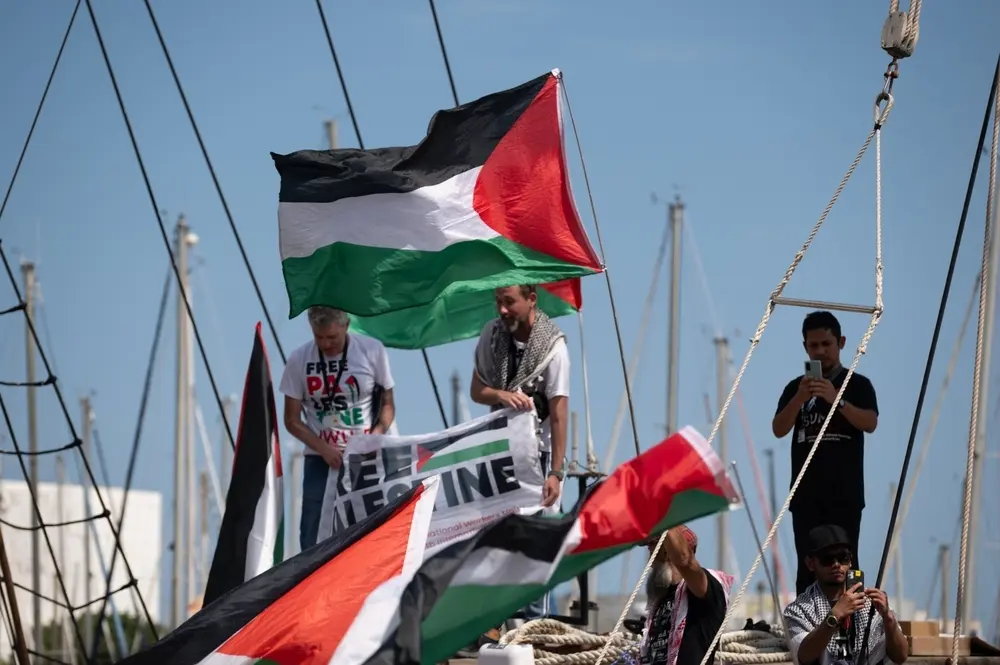
Global Sumud Flotilla © NICORIVERAPH/Shutterstock
Global Sumud Flotilla © NICORIVERAPH/Shutterstock
(This interview has originally been published on Meridiano 13)
Andriy, at the end of April you and your fellow activist Nina Potarska embarked on the Global Sumud Flotilla as the first Ukrainian participants on board. Why did you take part in this mission as representatives of an invaded country, and how is it possible to combine the struggle for Palestinian solidarity with the conflict ravaging your country?
When I was in the prison-ship kidnapped by Israeli forces, in the middle of the Mediterranean Sea, surrounded by armed guards with Israeli patches, I was looking at them and thinking: “How did I end up here? What am I doing here? How did the trajectory of my life bring me to this point?”. Because it’s unexpected that a Ukrainian guy finds himself in the Mediterranean Sea, among a group of seized fellow activists, guarded by Israeli soldiers. But on the other hand it is very logical that I was there, because at some point I felt that it is my duty to join the Flotilla. When I saw the first Flotilla in September 2025, I decided that I had to be there no matter what, and that Ukraine had to be represented in this mission.
Who is Andriy Movchan?
Andriy Movchan is a Ukrainian left-wing activist currently living in political exile in Barcelona following repeated physical attacks from the far right back in Kyiv.
He is currently active in the European Network for Solidarity with Ukraine (ENSU), which brings together trade unions and left-wing organisations across Europe in support of Ukrainian resistance against Russian imperialism. His political position, which he describes as anti-campism, holds that invaded and occupied nations have the right to self-determination regardless of geopolitical alignments, a position that has led him to join the international support towards the oppressed Palestinian people against Israel’s occupation.
In April 2026, Movchan sailed on the Global Sumud Flotilla alongside his fellow Ukrainian activist Nina Potarska, making them the first Ukrainian participants in the mission to break Israel’s naval blockade of Gaza.
I belong to the European network for solidarity with Ukraine, which unites trade unions and organisations in Europe who support Ukrainian resistance against Russian imperialism. Our stand is anticampism: we believe that oppressed and invaded nations, occupied nations have the right to self-determination and a free life, no matter which geopolitical camp the government belongs to and which geopolitical camp the oppressor belongs to.
From the very beginning of Russia’s invasion of Ukraine we were in constant debate with the campist sector of the left that rejected solidarity with Ukraine because its oppressor – Russia – declares its anti-Americanism. We were saying that all imperialisms, all aggressors should be condemned. When it came to Palestine, when the genocide in Gaza started to unfold it was very obvious for us to support the Palestinian people, to be against occupation and Israel’s aggressive policies.
Unfortunately a significant sector of the left, especially the radical left, oversimplifies the reality, reducing it to opposing just hegemonic imperialism. For many people it is easier to cut off nuances. Because nuances don’t allow you to radicalise your stance to the extreme – simplification does. This is why nuanced and more elaborate positions are not comfortable.
This was one of the goals of our participation in the Flotilla: to show that standing against both imperialisms at once is not only possible but also obvious.
I think the fact that Ukrainians have joined the Flotilla is a very important stage in the development of the anti-imperialist movement. For the vast majority of the left in the West, Latin America, the Middle East, rejection of the campist logic is a new concept. So I feel like one of the pioneers of this tendency. Ukrainian presence in the Global Sumud Flotilla is a significant contribution to the global agenda on the left.
Shortly after sailing, Israeli naval forces intercepted several Flotilla boats off the coast of Crete, including the one carrying you and Nina. Testimonies speak of widespread abuses and violations of human rights against activists carried out by Israeli forces. Can you tell us what happened?
Indeed we were expecting to be intercepted in the so-called “orange zone” between Cyprus and Palestine, as had happened to the previous Flotilla. Nobody expected that part of the Flotilla would be intercepted just four days after departing from Sicily, when we were just approaching Crete. It was so unexpected that, when we spotted the drones above our boat and we saw some vessels, we all assumed that it was the Greek Coast Guard. But when they came on board and started pointing at us with guns and green laser pointers (I cannot forget how the pointer was often appearing on my chest) I noticed the Hebrew accent in their English and realised that they were not Greeks. This was the only moment when I got somewhat scared. I was expecting more anxiety and more fear from myself, but what I felt was that courage infects people. The confidence of the people around me and the dedication to the cause were really contagious and boosted my morale.
When we were intercepted, they transferred us to a small Zodiac boat – the whole scene felt like something out of a videogame, like Cyberpunk. It was 2 am, a dark night, the sky and the sea totally black. We could only see stars and drones, and we were on a high-speed, high-tech boat surrounded by soldiers, taken to nobody knew where. There was no land on the horizon and no other vessel in sight, it was like we were going into the dark. When we were taken to the prison ship in the open sea, the level of violence grew. We were put on our knees with heads down. Some people were beaten, fortunately not me. A man was shot in his leg with a rubber bullet and lost a lot of blood. We were interrogated with our hands on the metal walls, with heads down. I was put in front of an Israeli flag on that wall. Then I was told that some people were forced to kiss the flag.
Israeli soldiers were initially reluctant to use excessive violence against activists, but there were some forms of humiliation that did not imply physical harm. One of the most disgusting moments that I was told about happened during the second night on the vessel: some people were sleeping in the containers, which were full and there was no space for everyone, so some were sleeping outside on the deck. Those on the deck were deliberately flooded with water.
Interrogation was about our personal data and I was surprised that they asked about serious medical conditions. At first it seemed strange, but later it made sense: they were afraid of killing someone. Humiliating, causing harm, torturing are one thing, but kidnapping European citizens and returning a dead body to their government is something else.
We spent 40 hours on the prison ship. Due to international pressure they were forced to release us in Crete.
I was lucky but this doesn’t mean that what happened was acceptable. Kidnapping people who didn’t commit any crime is even against Israeli law – we were entirely innocent. This is not normal.
What was the reaction of the Ukrainian government and civil society to you, and do you think your participation brought greater attention to the Palestinian issue in your country?
Unexpectedly, the Ukrainian Ministry of Foreign Affairs proved very responsive. After being released, my comrade Nina was contacted by the Ukrainian consulate and provided with emergency funds, practical assistance, and useful contacts. She was pleasantly surprised by that.
After the reported abuses in Ashdod, the Ukrainian MFA issued an official statement condemning how the Flotilla participants had been treated. We didn’t expect this. I am more than sure that our participation at least had some effect on the public stance of the Ukrainian state. It’s a small achievement, it’s not enough but it’s better than nothing.
In Ukraine we have a very paradoxical situation that is the inverse of the European one. Our government takes a more reasonable and balanced stance on Palestine than the active part of civil society. Civil society in Ukraine is liberal and nationalist: there is a significant sector that directly supports Israel, especially in the media, which is deeply influenced by Israeli propaganda and by Zionist lobbying groups that are active on social media. In fact, we felt active and aggressive pressure from them. The rest of the society is quite indifferent to the Palestinian cause, which is understandable since we have our own war and this is the top priority for everyone. But we were genuinely surprised by how many people who support Palestine we managed to find and bring together: Ukrainian Muslims who serve in the armed forces of Ukraine, but also Ukrainian refugees living abroad who are more familiar with the Palestinian cause after all the protests in Europe. Also people of Ukrainian descent who live in Arab and Muslim countries. These people had been feeling very isolated, in need of a voice – and we became that voice. There are a few hundreds Ukrainians living in Gaza, mostly women who married Palestinian students in Ukraine, most of whom were evacuated by the Ukrainian government with their families two years ago.
What was the atmosphere like on board the Flotilla, among activists from over 70 different countries? Was there awareness or curiosity that you were also from Ukraine?
In general I was afraid that we would not be welcome and would be met with suspicion, but my concern proved unfounded – we were welcomed and that was a very good surprise. Participants of the Flotilla were far more welcoming towards Ukrainians than the average leftists in Europe. I also met many people who had supported Ukraine at different points – journalists, medics, volunteers – who came with the same sense of duty to support Palestine.
Since October 2023, the world’s eyes have been focused on the ongoing genocide in Gaza, while global attention has declined on the West Bank, where continuous and unpunished attacks by Israeli settlers against the Palestinian population have never stopped. How do you think Ukraine’s experience under Russian aggression allows you to understand or interpret the situation of the population in Gaza? In your opinion, what are the colonial parallels between the occupation of the West Bank and the occupied Ukrainian territories, and why is it important to highlight them now?
After participating in the Flotilla I started to feel these connections even more closely because of my personal connection to the Palestinian cause. But I see objective and direct links. For example during Flotilla’s training sessions we discussed different aspects of occupation. One of them was economic occupation – the expropriation and seizure of Palestinian property. Our family has an apartment in the Russia-occupied territories in my mother’s hometown. Now the occupiers have passed a law stipulating that if you want legal access to your property, you must obtain a Russian passport, or the property will be expropriated and most likely handed to a settler from Russia. This aspect of property expropriation, settlers and deliberate alteration of ethnic composition of the occupied territories – all of this sounds very familiar to me, just the practice is different.
The ethnic distance between Palestinians and Israelis is large and deliberately emphasised by the Israeli state; the occupiers cannot incorporate Palestinians into their society. They cannot re-educate them and assimilate them as Jews. The goal of Israeli occupation is to get as much land as possible with as few Palestinians as possible. The practice of Russian occupation, due to cultural and ethnic similarities, is to get as much territory as possible with as much population as possible, in order to seize not only territory but also “human material” to turn Ukrainians into Russians. This is why they re-educate Ukrainians in occupied territories, they kidnap children, they erase their identity and militarise them for war against Ukraine. These mechanisms of occupation are different. But both are occupations. And I say this with apologies to my Ukrainian compatriots: in some respects, the Palestinian situation is harder. In our case, one can choose to become a collaborator, a traitor, in order to save one’s life or property. Palestinians are not even given that choice.
Is there a space in Ukraine, perhaps within left-wing, social, or trade union movements, for discussion of international solidarity that isn’t dictated solely by the government’s strategic alliances? What narratives dominate in Ukraine and post-Soviet media about Palestine?
First I should a very important aspect about post-Soviet societies, including Ukrainian society. People in Western Europe have some expectations about our society and have a vision of how they want our society to behave, and when we fall short of those expectations, they condemn us. But our society is the way it is for objective historical reasons – the point is to understand them, not to condemn. The pro-Palestinian movement in Europe has a decades-long history. For all sectors of the left it is a strong part of their identity, it’s something obvious. When people come to the movement, they start supporting Palestine.
However, our Ukrainian society is different because in our past we had no established opinion on this issue. The Soviet state had a pro-Palestinian stance, which was reflected in its propaganda. But starting from the Seventies, society grew deeply sceptical of anything the state said. Also, many Jews and Ukrainians emigrated to Israel, and these dissident voices also shaped public opinion in all post-Soviet states. After the collapse of the USSR the Palestinian agenda disappeared from our public space and no other group stepped in to carry it forward. Our societies, as a result, have no organic familiarity with the Palestinian cause.
Moreover, Poland, Lithuania, Belarus, Ukraine and western Russia were the historic heartland of Ashkenazi settlement – and of the Holocaust. These countries consequently became the largest sources of what is known as Aliyah [immigration of Jews from the diaspora to the land of Israel and Palestine]. This is why – at least in big cities – virtually every Belarusian, Ukrainian, or Russian has friends or former classmates who have migrated to Israel. 20% of Israel’s population is Russian speaking. People tend to trust those they know. They have contacts in Israel and they receive news from there. So our social networks and even personal spaces are full of narratives from the Zionist perspective. Having such a large percentage of Russian-speaking Israelis – many of whom are even well educated – makes it very easy to flood our media space with Zionist propaganda, with no language barrier. This is a very serious problem and it shapes public opinion.
Hasbara [the public diplomacy of Israel which is carried out through social media] in Ukraine constantly refers to campist arguments, to these simplified and manipulative arguments that claim that Palestinians are not independent actors, that they are proxies of Iran, and Iran is an ally of Russia. You can see where the chain leads. According to their twisted logic, in order to weaken Russia’s invasion we – Ukrainians – have to support the occupation of Palestine. This mirrors the campist left’s own reasoning: the Ukrainian government is an ally of the USA, the USA is a direct ally of Israel, therefore, in order to liberate Palestine, we must encourage the occupation of Ukraine. This very sick logic mirrors itself in both camps.
For a traumatised society like Ukraine, such manipulations work really well. This is why it is so difficult to convince our society to support Palestine. It is possible, but it is more difficult than in other countries.
I have seen this same kind of reasoning applied by some Palestinians, who recognise that Ukraine is somehow a victim, but since it’s allied with the USA then it doesn’t deserve support against Russian invasion.
These logics also conveniently ignore some contradictions. For instance, Russia and Israel have close ties. In the Knesset, Netanyahu declared that Putin is his close contact and that they often have direct calls. While there were no direct calls between Netanyahu and Zelensky – who some call a “Zionist”. Also, just before the attack on Gaza in 2023 Russian secret political influencers were deliberately supporting Netanyahu.
As for the responsibility of the Western left in addressing these issues, the international left needs to be understood and supported by Ukrainians who suffer from non-Western imperialisms. We must learn how to talk to these societies – not from a position of superiority, not with the dismissal that “Ukrainians are anti-communist and Zionist”. No. This is our common problem. The left has the responsibility of addressing these societies too and building bridges.
The main challenge of the 21st century for the left is to come out of this box of black and white thinking of this campist mentality. We are not in the 20th century: we live in the century of rivalry between different imperialist powers. This contradiction will be getting sharper and sharper. Ukraine is only the beginning. The main task is to stop simplifying reality and start seeing nuances. This is why these obvious parallels are so important to show and highlight.
Found an error in this article? Please contact our editorial team at redazione@balcanicaucaso.org.
Tag: In evidenza | Palestina | Palestina
Featured articles
 the students' voices
 Investigation
 students' protest