Bosnia’s EU Growth Plan, another chance, another failure?
Bosnia and Herzegovina has not completed any of the 113 reform steps it committed to implementing in exchange for Growth Plan funds. With almost a billion earmarks and deadlines approaching, the gap between what was promised and what has been delivered is stark – and growing.
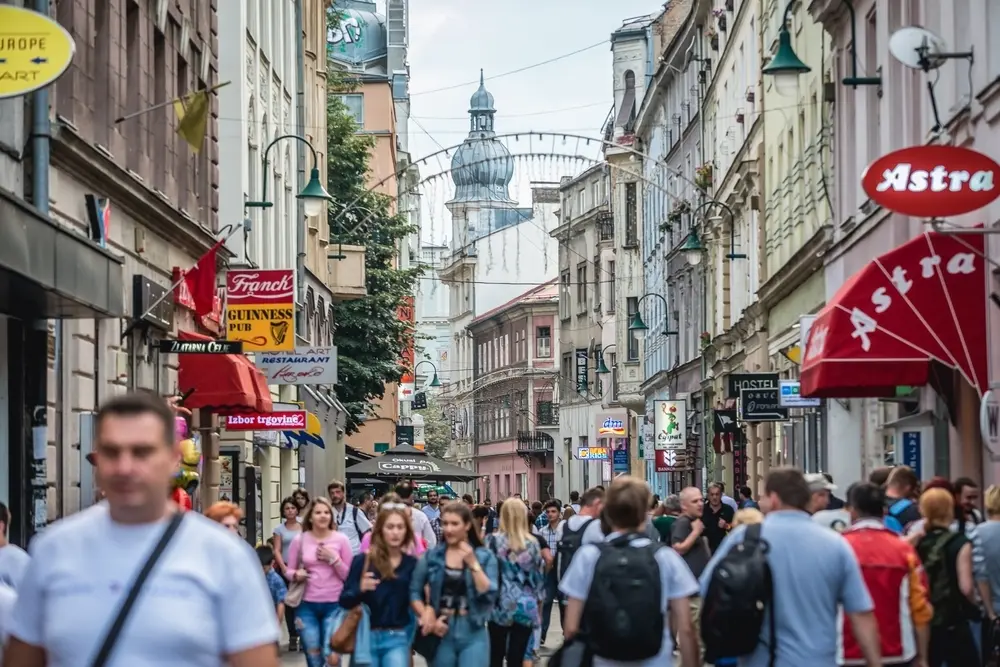
Sarajevo © Fotokon/Shutterstock
Sarajevo © Fotokon/Shutterstock
A candidate by circumstance
The gradual integration concept gained traction in Brussels as a way to reinvigorate the enlargement process, and after Russia’s full-scale invasion of Ukraine in 2022, integrating the Western Balkans (WB) have become geopolitically significant.
When Bosnia and Herzegovina (BiH) received EU candidate status in 2022 – having held potential candidate status since 2003 and formally applied for membership in 2016 – it was not because the country had made meaningful progress on reforms. It was because the war in Ukraine had reshuffled Europe’s geopolitical priorities.
The EU Growth Plan for the Western Balkans was the concrete expression of this idea: a framework for progressively integrating the region’s countries into EU policies and the single market, offering some of the benefits of full membership as an incentive to push through reforms. Countries propose their own reforms and commit to delivering them through a reform agenda.
For Bosnia and Herzegovina, the Growth Plan earmarks 976.6 million euros (in grants and favourable loans) for the 2024–2027 period. After a two-year delay that cost the country a 108 million euros loss, in December 2025, the European Commission approved the Bosnian reform agenda.
The reform agenda is organised around 26 reforms, 113 reform steps, and 372 activities, grouped under four areas: Green and Digital Transition, Private Sector Development, Human Capital, and Fundamentals. The last category is the most critical for accession credibility – covering judicial independence, rule of law, and anti-corruption, areas where the Commission reports have for years documented limited progress.
Millions at stake
The Commission recently released the third payment of 49 million euros to Albania, 44.2 million euros to Montenegro, and 65.7 million euros to North Macedonia as part of the Growth Plan. BiH found itself in the spotlight because, once again, it did not receive any money – the only country in the region that did not benefit a single euro from the Growth Plan.
Instead of bringing an improvement in the quality of life for Bosnia and its citizens, the Growth Plan has become a subject of disputes between the entities – the Federation of Bosnia and Herzegovina, which is governed by European-oriented Bosnian and Croat politicians, and the Republika Srpska (RS), which is led by Eurosceptic members of the Serb people.
The main obstacle to adopting the reform agenda came from the Republic Srpska. Ministers Srđan Amidžić and Staša Košarac – from governing party in RS, Alliance of Independent Socialist (SNSD) – repeatedly blocked the document, objecting specifically to measures requiring compliance with Constitutional Court decisions, filling judicial vacancies, and abolishing the entity veto in the State Aid Council – provisions they deemed unacceptable for the RS. Košarac made the political logic explicit: “Without the Consent of Republika Srpska, there is no European Path for BiH.”
The financial cost of the obstruction is already tangible. Bosnia permanently lost 108 million euro after missing the first deadline for submitting the reform agenda. Even though the Commission approved it later, it made it clear that no funds – including 70 million euros in pre-financing – could be released until BiH signed and ratified both the Facility Agreement and the Loan Agreement. Those agreements are standard administrative documents, nearly identical across all Western Balkans countries. However, they remain unsigned.
Marta Kos, European Commissioner for Enlargement, sent a letter of warning to Bosnia’s authorities that if promised reforms are not delivered by December this year – Bosnia can lose permanently 373 million euros.
New status, old problems
Moving forward requires Bosnia to appoint a Chief Negotiator with the EU – a position that has been deadlocked for over a year. Under existing political agreements, the Chief Negotiator is expected to be a Bosnian Serb. SNSD – with the support of the Croatian Democratic Union of BiH (HDZ BiH) – is pushing for its own candidate. The Trojka parties – a coalition of three Bosniak parties – have refused to support any SNSD nominee.
Central to the reform agenda are two laws reforming Bosnia’s judiciary – one governing the Court of BiH, the other restructuring the High Judicial and Prosecutorial Council (HJPC), which oversees all judges and prosecutors in the country. Both aim to strengthen judicial independence, introduce financial disclosure requirements, and reduce political influence over judicial appointments – precisely the reason they remain so contested among Bosnia’s political class.
“The establishment of stronger accountability mechanisms and judicial independence is being constantly obstructed, because the parties in power have an interest in maintaining control over the judiciary and preserving the ethnic distribution of positions,” said Ivana Korajlić, Executive Director of Transparency International in Bosnia and Herzegovina for Radio Free Europe.
Part of the problem lies in the fundamentally different attitudes the two entities hold toward European integration. While the Federation BiH actively supports European integration, Republika Srpska continues to obstruct it. The political logic behind this obstruction has been stated openly.
Milorad Dodik, former President of Republika Srpska – stripped of his mandate last year by the Central Election Commission for defying decisions of the High Representative – was characteristically blunt: “We are not ready to sell the character of this country and its people for their miserable 300 million euros, because we can solve that (money) today in any other place in the world.” Finance Minister Amidžić echoed this dismissiveness, attempting to reframe the narrative entirely: the country was not at risk of losing a billion euros in grants, he argued, but merely a billion in loans.
In a column, EU Ambassador in BiH, Luigi Soreca called the argument highly misleading. Of the 976.6 million euros earmarked for Bosnia, 280.3 millions are non-repayable grants – equivalent to more than one-third of the country’s entire annual state budget. The remaining funds are loans offered on exceptionally favourable terms: repayment periods of up to 40 years and grace periods delaying principal payments until 2034.
The price of irresponsibility
For years, the citizens of Bosnia have been paying the price for not holding politicians in power accountable. The loss of money from the Growth Plan will directly affect the living standards of citizens of both entities.
The money Bosnia has already lost was earmarked for sectors that matter to ordinary people. Green and digital transformation alone accounted for around 262 millions as this sector needs urgent transformation. Bosnia has not aligned with EU energy market rules, has not established an electricity exchange, and has not introduced emissions trading – meaning EU penalties are now expected, which will drive up energy prices for consumers.
Other undelivered reforms would have brought tangible improvements: modernised employment services, social welfare cards, digital identity, and 5G connectivity. Alongside Ukraine, Bosnia remains the last country in Europe yet to offer its citizens 5G internet access.
The slowdown in reforms has been further intensified by the fact that this year is an election year in Bosnia and Herzegovina, which makes a political agreement even more difficult. The reasons for Bosnia’s paralysis are many, but the root cause is structural. The Dayton Agreement, which ended the war in 1995, created a political system built on ethnic division and entity-level vetoes – a system that brought stability but made reforms almost impossible. Calls for its revision have existed for years. None have succeeded.
The Growth Plan was perhaps the strongest external incentive yet offered to break that pattern. With 373 million euros at risk and a December 2026 deadline that the EU says will not be extended, Bosnia is running out of time and excuses.
Found an error in this article? Please contact our editorial team at redazione@balcanicaucaso.org.
This article was written as part of the project "InteGraLe - Western Balkans vi-à-vis the Trio: single market, cohesion and regional policy for gradual integration into the EU." The project is supported by the Analysis, Programming, Statistics, and Historical Documentation Unit – Directorate General for Political Affairs and International Security of the Ministry of Foreign Affairs and International Cooperation, pursuant to Article 23-bis of Presidential Decree 18/1967. The opinions expressed in this publication are those of the authors and do not necessarily represent the views of the Ministry of Foreign Affairs and International Cooperation.