Parting with Gazprom in Serbia: A difficult divorce
As Gazprom’s imminent withdrawal approaches, the future of the Serbian oil industry remains uncertain. In addition to the economic repercussions, the geopolitical balance will also be shaken, and Russian influence in Serbia appears destined to decline
Gazprom
© Baloncici/Shutterstock
At NIS gas stations across Serbia, Visa, Mastercard and other international cards are no longer accepted. You can only pay with cash or DinaCard, the local Serbian alternative. “Sanctions”, the cashier says curtly.
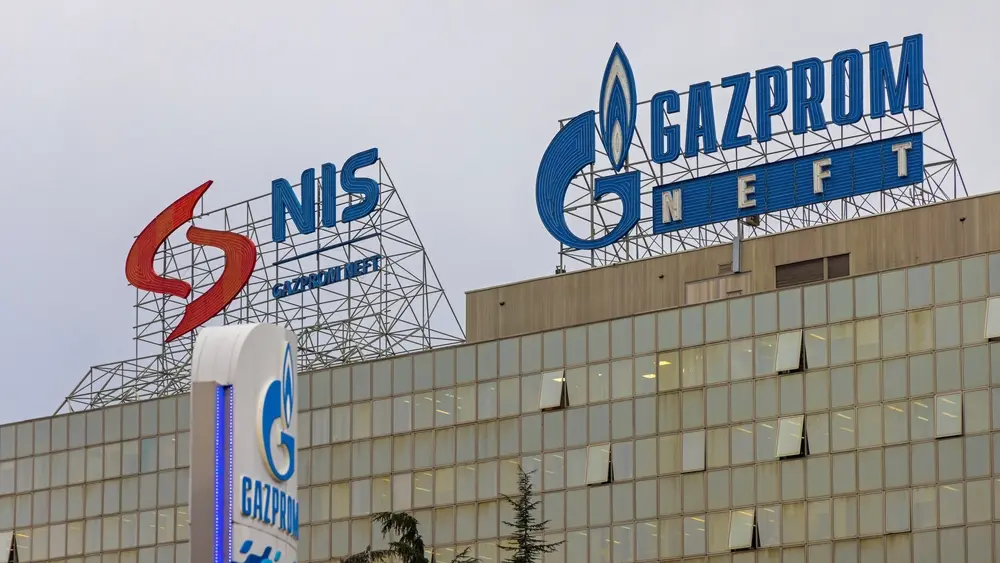
Naftna Industrija Srbije (NIS), Serbia’s national oil company, has been under U.S. sanctions since January 2025. The company was sanctioned alongside its majority owner, the Russian oil producer Gazprom Neft (a subsidiary of the energy giant Gazprom). The U.S. demands that the Russian stake in NIS be reduced to zero.
The full implementation of the sanctions has been repeatedly postponed to allow the company to continue operating while preparing to sell the Russian stake. However, it is clear that the shares will eventually be sold, and Russia will lose significant influence over Serbian affairs.
This situation highlights a paradox that has been clear since February 2022. For Russia, territorial aggrandizement in Ukraine has come at the cost of sharply reduced influence in other countries, whether economic, diplomatic or “soft power” (reputational).
Indeed, despite its imperialist ambitions, Russia is weaker as a global power than it was before 2022. Its corporate capital is in continuous retreat, only partly compensated by reorienting to the non-Western world.
For Serbia, the situation with NIS is just one factor in the complex game of balancing EU, US, Chinese and Russian influences. Serbia’s multi-vector foreign policy is quite unique among smaller states. This gives it flexibility and room for maneuver but also creates multiple dependencies and complicates domestic politics.
Foreign influence creates local stakeholders with sometimes conflicting agendas, such as corporate officials who depend on income from foreign-owned assets. Russia’s potential loss of control over NIS is a new development, but the game essentially remains the same.
Energy and Kosovo
Gazprom Neft acquired NIS in 2008 under specific political circumstances. Since the mid-2000s, there has been increasing pressure on Serbia to resolve the Kosovo situation. The Serbian government needed Russia’s help to block Kosovo’s bid for international recognition. According to some analysts, Russia’s acquisition of Serbian energy assets was essentially a quid pro quo for diplomatic support regarding Kosovo.
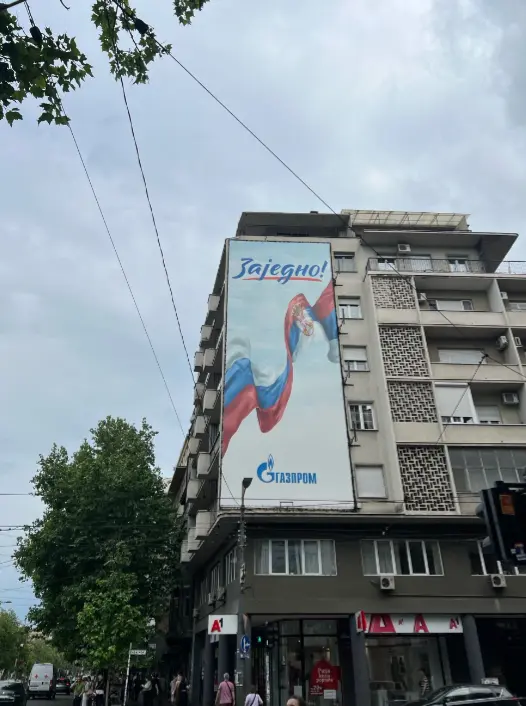
Gazprom and Serbia – not so “together” anymore. Photo: Ilya Matveev (Belgrade, June 2026)
However, this view should be qualified. First, Russia would have likely helped Serbia even without the energy deal. Opposing Western plans to separate Kosovo from Serbia has been a long-term Russian foreign policy stance. On the other hand, Russian energy companies have been acquiring assets all over Europe since the late 1990s, mostly without political favors involved. For instance, Lukoil purchased Neftochim Burgas, Bulgaria’s only major oil refinery and one of the largest in the Balkans, in 1999. Russian energy capital had money and competence, not just the power of the Russian state.
Nevertheless, the Serbian deal was unusual in its comprehensiveness. NIS is a vertically integrated oil company and monopolist in the Serbian market. In addition to acquiring NIS, Russia agreed to finish building an underground gas storage facility, Banatski Dvor, and to route part of the South Stream gas pipeline through Serbia, thus providing the Serbian government with lucrative transit fees.
Some allege that the 400 million euros paid for NIS was well below market value. The Serbian branch of the consulting firm Deloitte valued the company at 2.2 billion euros. Mlađan Dinkić, the minister of economy at the time, protested the deal’s conditions and was eventually dismissed from the Serbian negotiating team. This reveals the political importance of the sale to the Serbian leadership.
Ultimately, Russia’s control of major energy assets turned out not to be such a bad deal for Serbia. On the one hand, the South Stream project never materialised due to EU pressure. Furthermore, some of NIS’s activities were environmentally unsustainable. On the other hand, NIS has received over 4 billion euros in investments since 2009. Since Gazprom Neft’s acquisition, the company’s profits have increased (see Fig. 1)
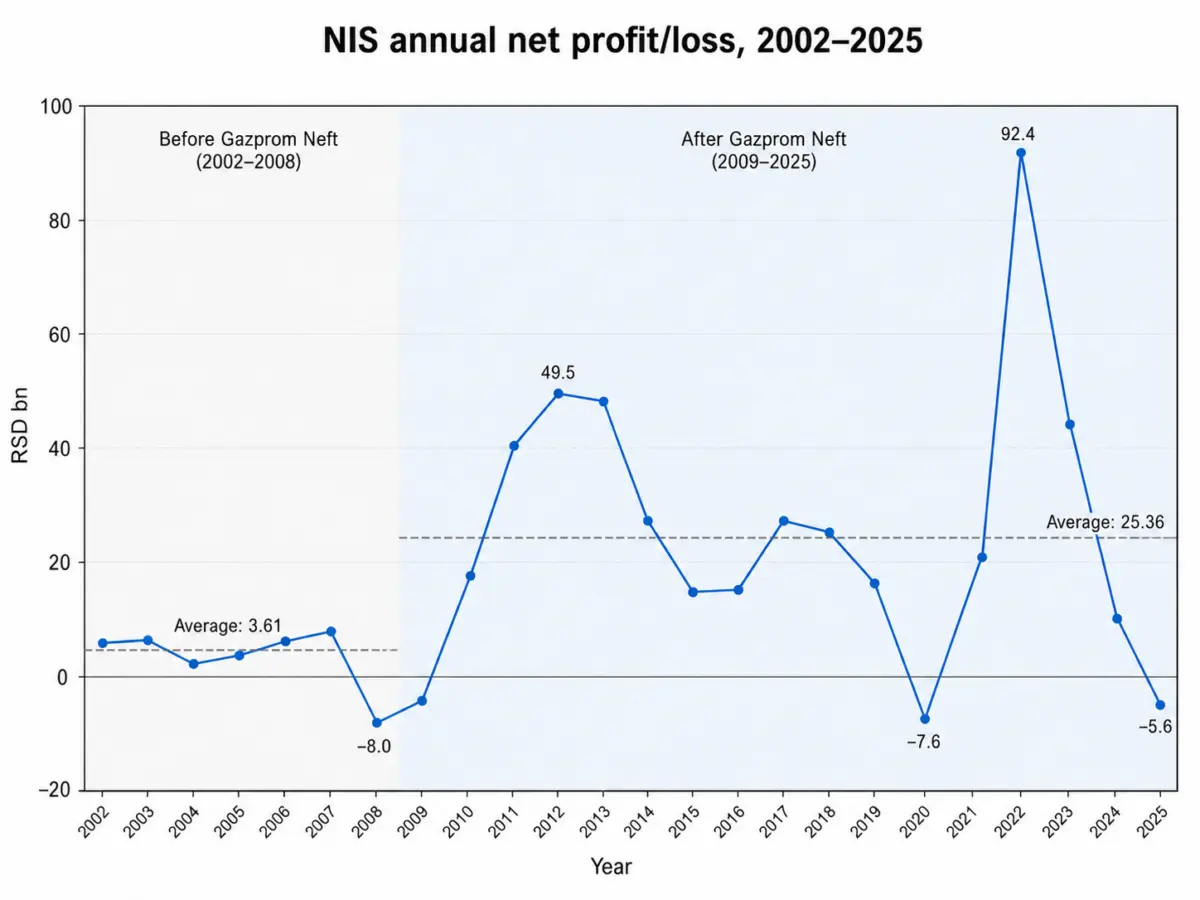
Figure 1. NIS annual net profit/loss before and after Gazprom Neft’s entry into the ownership structure, 2002–2025. Sources: NIS Investor Relations financial figures and company releases, SeeNews archive, RTV, B92/Ekonomist and Poslovni dnevnik
Since Russia’s invasion of Ukraine in February 2022, NIS has had to replace its supply of Russian crude oil with other sources. The biggest challenge, however, came with the introduction of US sanctions in 2025.
The way forward
In late 2025, the Hungarian oil company MOL emerged as the likely buyer of Gazprom Neft’s shares in NIS. However, negotiations between the Russian, Serbian and Hungarian sides have been difficult and have yet to result in a deal. There are multiple complications.
The Serbian authorities want to maintain the domestic supply of gasoline through the Pančevo refinery. In Hungary, the ouster of long-term prime minister Viktor Orbán has led to a change in priorities. His successor, Péter Magyar, is not so keen on following through on Orbán’s commitments, which may include the NIS deal. Another possibility is the nationalisation of NIS by the Serbian government. However, Gazprom Neft believes that the price the Serbian government is willing to pay is insufficient.
While negotiations have stalled, one thing is clear: the eventual sale of Gazprom Neft’s shares in NIS will not end Russian influence in Serbia. Much of the population still has a positive view of Russia, and the authorities still need Russia’s support on the Kosovo issue. Overall, though, Russian influence is waning. Serbia increasingly views Russia as a legacy partner.
*Ilya Matveev is a political scientist, researcher at the University of Bremen and the University of Helsinki, and member of the Public Sociology Laboratory.
Found an error in this article? Please contact our editorial team at redazione@balcanicaucaso.org.
This article was written in the context of a Marie Curie Staff Exchange within the Horizon Europe Programme (grant acronym: ORCA, no: 101182752).
Tag: Economy