
The EU enlargement process has entered a new re-energizing phase, after years of stalled political momentum. The shift of the Union’s geopolitical priorities, in the aftermath of Russia’s war of aggression against Ukraine, has reshaped EU accession, turning it into a strategic instrument.
In 2022, the European Council endorsed the gradual integration approach towards the Western Balkans, later on extended also to the Eastern Trio countries, making it a central pillar of the current enlargement strategy. On the one hand, gradual integration injects dynamism into the process and allows the candidate countries to reap the benefits of the EU Single Market prior to full membership. On the other, its operationalisation relies on disparate legal frameworks – such as the Stabilisation and Association Agreements for the Western Balkan countries or the Association Agreements, including Deep and Comprehensive Free Trade Areas for Ukraine and Moldova – that have been negotiated at different moments in time and with different purposes.
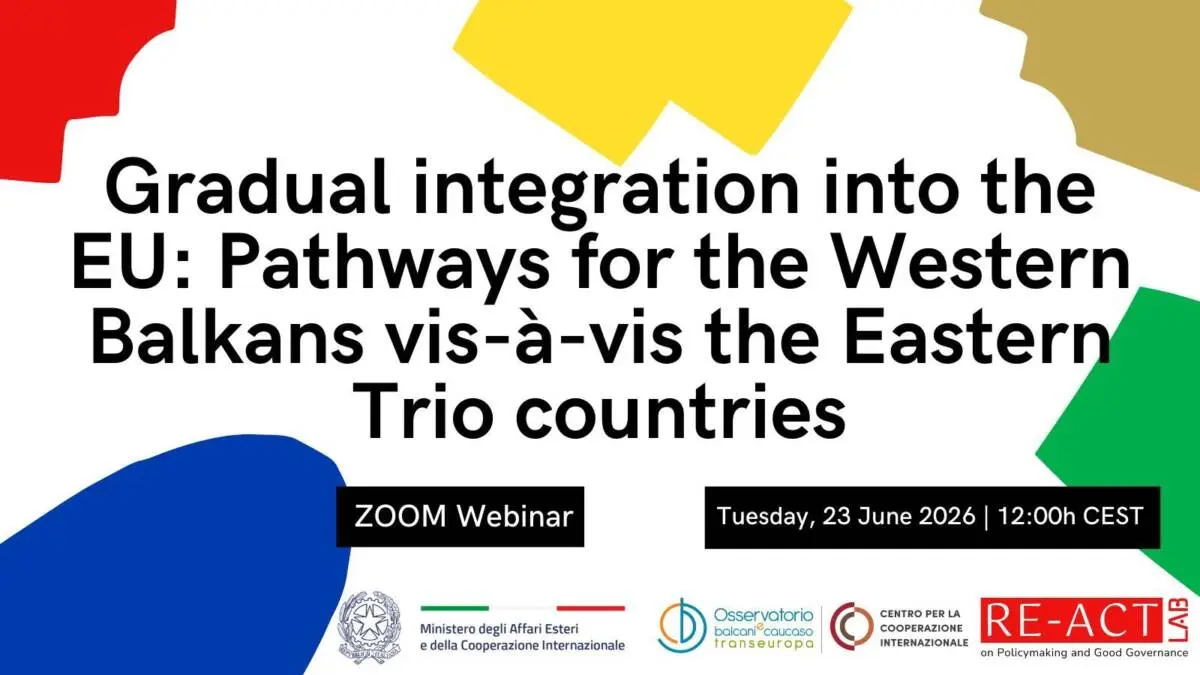
In this context of uncharted waters, the webinar aims to compare and contrast similarities and differences between the existing legal frameworks in place for candidate countries and analyse their legal pathways to facilitate gradual integration. Moreover, it seeks to contextualize enlargement in the wider future financial perspective of the EU, with a particular focus on the next MFF and cohesion policy.
Panelists:
Federico Paolini, Desk officer, Office II at Italian Ministry of Foreign Affairs and International Cooperation
Sokol Zeneli, Director of research and programmes at Re-ACT Lab
Raffaella Coletti, Senior researcher at CNR Issirfa
Zoe Gaspar, Legal and policy officer in DG ENEST B1 at European Commission
Moderator: Gentiola Madhi, Researcher at OBCT
The event will be held in English
Here’s the video recording
This event is organized as part of the project “InteGraLe – Western Balkans vi-à-vis the Trio: single market, cohesion and regional policy for gradual integration into the EU.” The project is supported by the Analysis, Programming, Statistics, and Historical Documentation Unit – Directorate General for Political Affairs and International Security of the Ministry of Foreign Affairs and International Cooperation, pursuant to Article 23-bis of Presidential Decree 18/1967. The opinions expressed in this publication are those of the authors and do not necessarily represent the views of the Ministry of Foreign Affairs and International Cooperation.